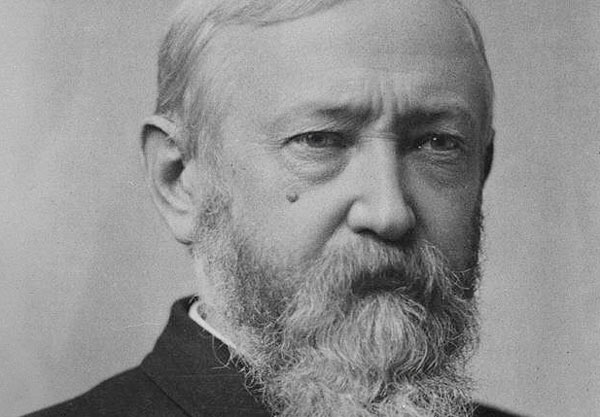
Benjamin Harrison |
|
|
|
Benjamin Harrison was born August 20, 1833, in North Bend, Ohio. He was one of eight children. His grandfather was ninth president and war hero William Henry Harrison and his great grandfather was Benjamin Harrison V, a Virginia governor and signer of the Declaration of Independence. Despite his prestigious family lineage, Benjamin's family was not wealthy and he attended school in a single-room schoolhouse. Civil War ExperienceIn 1852, Harrison graduated from Miami University (Ohio) and studied law afterwards. In 1853, Harrison married Caroline Lavinia Scott. The couple would have two children, Russell and Mamie, both of which would live to adulthood. The following year, the couple moved to Indianapolis, Indiana, where Benjamin practiced law and became interested in politics. As Harrison's law practice became more successful, his political prospects improved among the Republican Party. During the Civil War, despite no military experience, Harrison commanded Union brigades in several battles in Georgia toward the end of the war. In 1865, President Lincoln nominated Harrison to the grade of brevet brigadier general. Disputed ElectionAfter the war, Harrison had become a wealthy and respected lawyer. After an unsuccessful bid to become governor of Indiana, he was elected as the state's Senator in 1880, a position which he held until 1887, before being defeated in a bid for re-election. Harrison, however, was nominated by the Republican Party as President in the election of 1888 against Grover Cleveland. In a tightly contested battle, Harrison lost the popular vote, but won the presidency in the electoral college. Political opponents would assert that Republicans bought the votes of electors to get Harrison elected. PresidencyDuring Harrison's presidency, Congress passed the Sherman Antitrust Act, which prohibited companies from engaging in monopolistic (anti-competitive) behaviors. In this way, customers could have choices between service providers, giving companies incentives to improve services and price competitively. Congress also passed the McKinley Tariff, which was designed to protect domestic industries from foreign companies by raising duties (taxes) on imports. During his presidency, Harrison repeatedly championed for civil rights for African Americans and introduced legislation that would have provided federal funding to school regardless of the races such schools served. None of his measures however, made it through Congress successfully. Despite the positive steps forward made during his term, the nation's overall economic conditions worsened and support for Harrison dwindled in the Republican Party. Harrison would be defeated in his quest for re-election by Grover Cleveland. Grover Cleveland would become the first and only president to serve two non-consecutive terms as president. Following his presidency, Harrison continued his legal work and served on the board of trustees at Purdue University in Indiana. He died on March 13, 1901, of complications from influenza. Discussion Questions
Glossary
Early LifeBenjamin Harrison was born on August 20, 1833, in North Bend, Ohio. He was part of a well-known family. His grandfather, William Henry Harrison, was the 9th president of the United States, and his great-grandfather signed the Declaration of Independence. Even though his family was famous, they were not wealthy. Benjamin grew up in a modest home and went to a small, one-room school.Education and FamilyHarrison went to Miami University in Ohio and graduated in 1852. After that, he studied law. In 1853, he married Caroline Lavinia Scott. They had two children, Russell and Mamie. The family moved to Indianapolis, Indiana, where Benjamin became a lawyer and started getting involved in politics.Civil War and Military ServiceWhen the Civil War started, Harrison joined the Union Army, even though he had no military experience. He worked hard and became a leader in several battles. In 1865, President Abraham Lincoln gave him the rank of brevet brigadier general, which was an honorary title for his service.Political CareerAfter the war, Harrison became a well-known lawyer and politician. He tried to become governor of Indiana but lost. In 1880, he was elected to the U.S. Senate. After losing his Senate seat in 1887, the Republican Party chose him to run for president in 1888. He ran against Grover Cleveland. Harrison lost the popular vote but won the presidency through the electoral college.PresidencyAs president, Harrison helped pass important laws. One of them was the Sherman Antitrust Act, which made it illegal for companies to form monopolies. Another was the McKinley Tariff, which raised taxes on goods coming from other countries to help American businesses. Harrison also believed in civil rights and wanted to give schools money no matter what race the students were, but Congress did not pass his ideas.Later Life and DeathBecause the economy was not doing well, many people stopped supporting Harrison. In 1892, he lost the presidency to Grover Cleveland, who became the only president to serve two non-consecutive terms. After leaving office, Harrison worked as a lawyer and helped Purdue University. He died on March 13, 1901, from complications caused by influenza. |