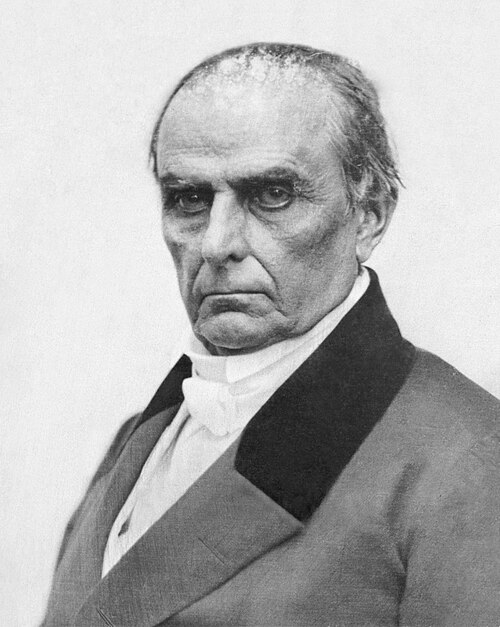
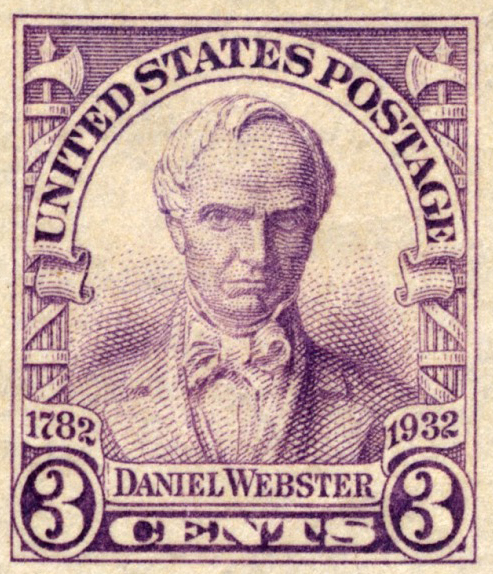
Daniel Webster |
|
Early Life and EducationDaniel Webster was born on January 18, 1782, in Salisbury (now Franklin), New Hampshire. He grew up on a small farm, where hard work was part of daily life. His parents valued learning, and Daniel proved to be a gifted reader and speaker. He attended Phillips Exeter Academy briefly and graduated from Dartmouth College in 1801. After teaching school to earn money, Webster studied law, passed the bar in 1805, and began practicing first in New Hampshire and later in Boston, Massachusetts. Rising Lawyer and OratorWebster quickly became one of the nation’s most respected courtroom lawyers. He argued major cases before the U.S. Supreme Court, including Dartmouth College v. Woodward (1819), which protected private contracts, and Gibbons v. Ogden (1824), which strengthened the federal government’s power over interstate commerce. His clear logic and booming voice made him famous as an orator—someone who gives powerful speeches. Congress and the UnionWebster served in the U.S. House of Representatives and the Senate for many years. In 1830 he delivered his most famous speech, the “Second Reply to Hayne,” defending the Constitution and the idea that the United States was one nation, not just a group of states. He warned against “nullification,” the idea that a state could cancel a federal law, and argued that secession would destroy the Union. Diplomacy and the 1850 CrisisAs Secretary of State, Webster helped negotiate the Webster–Ashburton Treaty (1842), which settled a border dispute between the United States and British Canada. In 1850, when the nation was splitting over slavery, he supported the Compromise of 1850 to keep the Union together. His stance—especially support for the Fugitive Slave Act—angered many Northerners, but Webster believed compromise was necessary to avoid war. LegacyWebster died on October 24, 1852, at his home in Marshfield, Massachusetts. He is remembered as one of America’s greatest speakers, a leading constitutional lawyer, and a powerful defender of the Union. His words—“Liberty and Union, now and forever, one and inseparable!”—still capture his lifelong goal: a strong, united United States.
Discussion Questions
Glossary
Five Interesting Facts
Timeline
Early Years and LawDaniel Webster was born in 1782 in New Hampshire. He worked hard on his family’s farm but loved reading and learning. After graduating from Dartmouth College, he studied law and opened a practice. Moving to Boston gave him more chances to take important cases. Simplified Version: Famous Cases and SpeechesWebster became a leading lawyer and speaker. In the Supreme Court, he argued cases that protected contracts and strengthened federal power over trade between states. In 1830 he gave the “Second Reply to Hayne,” saying the United States was one nation and warning against states trying to cancel federal laws or leave the Union. Simplified Version: Leader and LegacyAs Secretary of State, Webster helped settle the U.S.–Canada border with the Webster–Ashburton Treaty. In 1850 he supported a compromise to calm the conflict over slavery, even though the Fugitive Slave Act upset many Northerners. He died in 1852 and is remembered as a great orator, a top constitutional lawyer, and a strong defender of the Union. |