Harriet Tubman and the Underground Railroad |
||||||
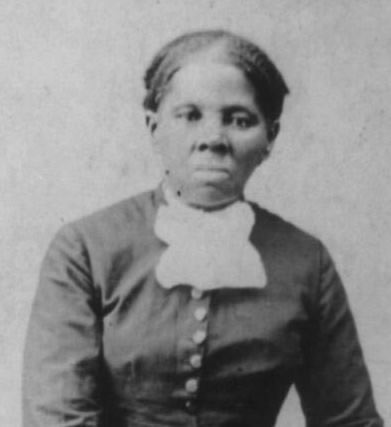
"Minty" is InjuredHarriet Tubman was one of the most famous women in American history. She was born on March 10, 1821, in Dorchester County, Maryland, the daughter of slaves on a Maryland plantation. Her original name was Araminta Ross and she was nicknamed "Minty." From an early age she worked as a servant at the plantation house. As a teenager, she suffered a vicious head wound as she tried to protect a fellow slave from a beating. According to legend, the woman who was beating the other slave hurled a two- pound weight, hitting Harriet in the head. Her injury would haunt her for the reminder of her life, resulting in periodic fainting spells. A Path to FreedomTubman spent her early life as a slave. In 1844, she married a free Black man named John Tubman, who would prove disloyal. Life as a slave was extremely difficult. They were forced to work in the merciless heat without rest. They were often beaten and forced to live in poor conditions. In the early and mid 1800's, slaves were often sold to southern plantations where they would never have contact with their families again. Harriet was a particularly strong and powerful woman who could be sold for a hefty sum. Fearing that she was about to be sold, Harriet resolved to run away. Despite the brutal punishment that would be inflicted upon her if she was caught, Harriet took off in the middle of the night sometime in 1849 and headed north to freedom. She gained assistance along the way by abolitionist Quaker families who hung specially designed carpets or lights on the outside of their houses as a sign that runaway slaves were welcome and would receive help. She traveled by night through the dense woodlands of Maryland, guided north by the North Star and the moss that grew on the north side of the trees. She eventually made it to Philadelphia, Pennsylvania, a free city where she landed a job and saved money. After living in Philadelphia for two years, Harriet decided to return to Maryland, in the hopes of freeing her family members. She succeeded in guiding her sister and mother to freedom along the same path that she had taken. This path became known as the Underground Railroad. The Underground Railroad was a network of woodland paths scattered throughout parts of the south that led to freedom in the north. Harriet returned again and guided her father and brother to freedom.
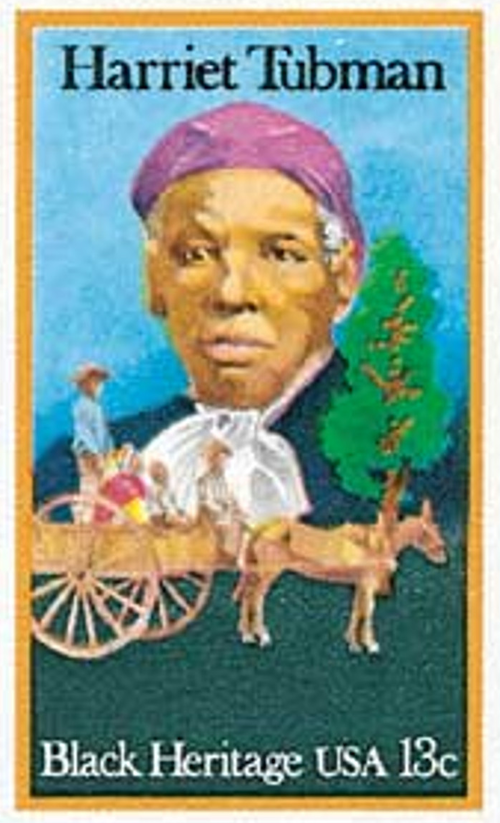
Harriet Tubman Postage Stamp "Wanted Dead or Alive"Soon, Harriet became known as the "conductor" on the Underground Railroad and made more daring trips to the south to guide more slaves to their freedom. Harriet devised strategies to trick various parties that tried to capture her. If she was traveling with a baby, she would use herbal drugs to ensure it didn't cry. She made sure that she traveled on Saturdays as "runaway notices" in southern newspapers could not be printed until Monday. Harriet's daring "forays" continued to elude slave hunters who were offered huge bounties for returning slaves to their owners. By 1856, a $40,000 bounty was placed on her capture - dead or alive. She became a serious threat to southern plantation owners who made large investments in their slaves. In one famous story, Harriet was close to being captured at a bus station. To avoid capture, she pulled out a book and pretended to read. Since nearly all slaves were illiterate, the hunters simply ignored her and continued their search. LegacyBy 1860, Tubman was said to have completed 19 successful journeys on the Underground Railroad, freeing as many as 300 slaves. She was never captured, nor were any of her "passengers." During the Civil War, she served as a cook, nurse, and spy for the Union army. After the war, she settled in Troy, New York, where she would die in 1913. Discussion Topics
"Minty" is InjuredHarriet Tubman, one of America's most famous women, was born on March 10, 1821, in Dorchester County, Maryland. Her birth name was Araminta Ross, and she was called "Minty." As a young girl, she worked in the plantation house. When she was a teenager, she was hit in the head while trying to protect another slave. The injury caused her to have fainting spells for the rest of her life. A Path to FreedomHarriet spent her early life as a slave. In 1844, she married a free Black man named John Tubman. Life was hard for slaves, who worked in the heat, were often beaten, and lived in poor conditions. Many were sold and separated from their families. Harriet feared she would be sold, so in 1849, she escaped at night and headed north. Along the way, she was helped by kind families who supported runaway slaves. She used the stars and tree moss to guide her to Philadelphia, where she found work. After two years, she returned to help free her family. This journey became known as the Underground Railroad—a secret route that helped slaves escape to the North. "Wanted Dead or Alive"Harriet became known as a "conductor" on the Underground Railroad and made many trips to free other slaves. She used clever tricks to avoid capture, like drugging babies to keep them quiet and traveling on Saturdays to delay newspaper notices. Slave hunters were offered big rewards to catch her—by 1856, a $40,000 bounty was placed on her head. In one clever moment, she pretended to read a book, tricking hunters who believed all slaves were illiterate. LegacyBy 1860, Harriet had made 19 trips and helped around 300 slaves escape, without being caught. During the Civil War, she served as a cook, nurse, and spy for the Union army. After the war, she moved to Troy, New York, where she died in 1913. |
||||||
| Harriet Tubman and the Underground Railroad Activities FEATURED | ||||||
|
||||||
| Harriet Tubman and the Underground Railroad Activities | ||||||
|
||||||