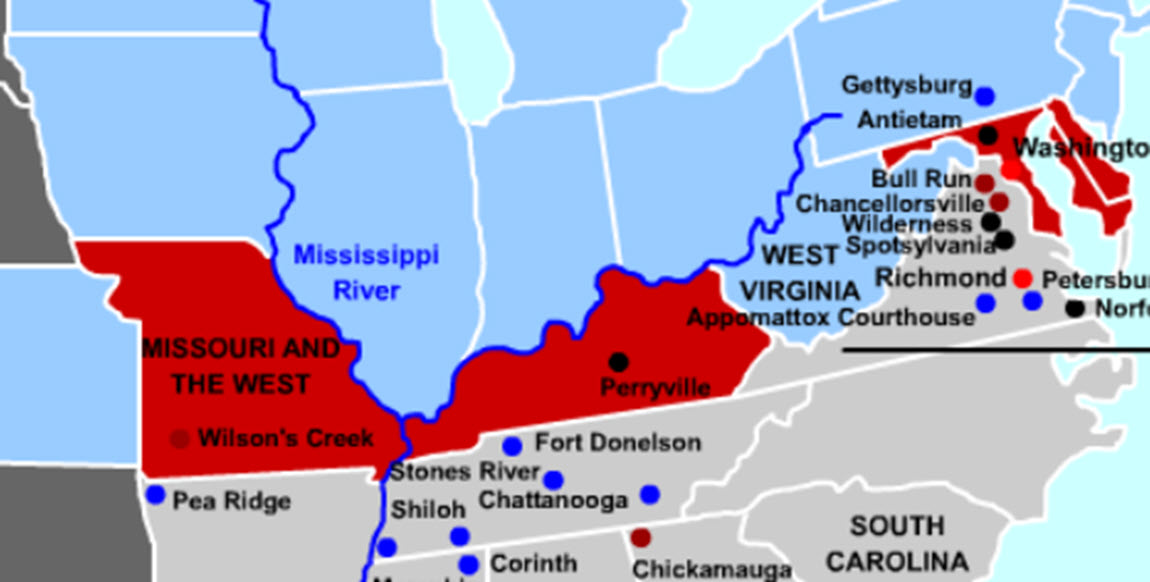
Amidst the tumultuous backdrop of the American Civil War, the Border States emerged as a pivotal battleground where loyalty was tested, alliances were strained, and the fate of the nation hung in the balance. Situated on the border between the Union and the Confederacy, these states—Delaware, Maryland, Kentucky, and Missouri—found themselves torn between conflicting loyalties.
Origins and Significance
The Border States occupied a unique position within the geography and politics of the Civil War. Situated on the border between the North and the South, these states were characterized by their mixed demographics, divided loyalties, and strategic importance. While officially part of the Union, the Border States contained significant pockets of pro-Confederate sentiment, as well as large populations of enslaved people whose status remained uncertain. In the case of Maryland and Kentucky, in general, populations in their eastern parts favored secession, and populations in their Appalachian regions favored the Union.
The Border States played a crucial role in determining the outcome of the Civil War, as control of their territory and resources could tip the balance of power in favor of one side or the other. Moreover, the Border States served as a buffer zone between the Union and the Confederacy, providing a strategic corridor for military operations and a critical lifeline for communication and transportation. If Maryland had seceded, for example, the Union capital would be completely surrounded by Confederate territory. In the case of Kentucky, President Lincoln thought its control the key to the entire war:
"I think to lose Kentucky is nearly the same as to lose the whole game. Kentucky gone, we cannot hold Missouri, nor Maryland. These all against us, and the job on our hands is too large for us. We would as well consent to separation at once, including the surrender of this capitol."
Abraham Lincoln
Internal Struggles and Divisions
Throughout the Civil War, the Border States grappled with internal divisions and conflicts as competing factions vied for control of their allegiance. In states like Maryland and Missouri, where secessionist sentiment ran high, Unionist governments struggled to maintain control against pro-Confederate insurgents and sympathizers. In Kentucky, the state legislature declared neutrality in the conflict, seeking to avoid choosing sides and preserve its precarious balance of power.
The presence of enslaved people further complicated the situation in the Border States, as Union authorities wrestled with the question of emancipation and the status of slavery within their borders. When President Lincoln issued the Emancipation Proclamation, he strategically freed the enslaved in "enemy territory," which did not include those in the border states. Lincoln was afraid that liberating the enslaved in the border states might push those states to secede.
Military Significance and Strategic Importance
The Border States played a crucial role in shaping the course of the Civil War, serving as strategic prizes coveted by both the Union and the Confederacy. Control of the Border States would provide access to vital resources, manpower, and transportation routes, while denying them to the enemy. As a result, the Border States became the focus of intense military campaigns, political maneuvering, and diplomatic overtures throughout the war.
Some of the most significant battles of the Civil War were fought in the Border States, as Union and Confederate forces clashed for control of key cities, riverways, and railroads. Battles such as the Battle of Antietam in Maryland, the Battle of Wilson's Creek in Missouri, and the Battle of Perryville in Kentucky had far-reaching consequences for the outcome of the war and the fate of the nation. |