Battles in and Around Chattanooga |
||
|
||
|
The Battle of Chattanooga was a major engagement in the Western Theater of the Civil War in the fall of 1863. The Western Theater of the Civil War was the group of battles that occurred in Alabama, Georgia, Florida, Mississippi, North Carolina, Kentucky, South Carolina and Tennessee, as well as Louisiana east of the Mississippi River. Confederate SiegeFollowing the bloody Confederate victory at Chickamauga in northern Georgia, Union forces withdrew to Chattanooga, Tennessee, where they were besieged by the Confederate Army of the Tennessee under Braxton Bragg, which occupied two heights around the city called Lookout Mountain and Missionary Ridge. A siege is defined as a military operation in which one force surrounds a town or other military force with the intention of starving it into submission by cutting off its supplies. Sieges are often accompanied by intense bombardment. Soon after the siege began, General Ulysses S. Grant was assigned command of Union forces in the Western Theater. Grant promptly sent reinforcements from Mississippi and Virginia to help liberate the trapped army. Battle of WauhatcheeOn October 28, Union forces under Ulysses S. Grant seized Brown's Ferry on the Tennessee River for the purposes of opening a supply line (called the Cracker Line) for soldiers besieged in Chattanooga. On the night of October 28, Confederate forces were defeated in an attempt to take back Brown's Ferry in what came to be known as the Battle of Wauhatchee. Next, Union forces would aim to dispatch Confederate forces from heights at Lookout Mountain and Missionary Ridge to proceed with offensives in the Deep South. Battle of Lookout MountainWith Union forces in possession of Orchard Knob, a rocky hill east of Chattanooga, Confederate General Braxton Bragg strengthened the center of his defensive line along Missionary Ridge, which left Confederate General Carter Stevenson's men vulnerable near the summit of Lookout Mountain. Early on the morning of November 24th, Union General Joseph Hooker formed a battle line up the slope of the mountain, aided by a dense fog that hid their movements. In what came to be known as "the Battle among the Clouds," Union forces soundly defeated the Confederates and Braxton Bragg made the decision to withdraw from the mountain completely for the purposes of reinforcing defenses on Missionary Ridge. Battle of Missionary Ridge
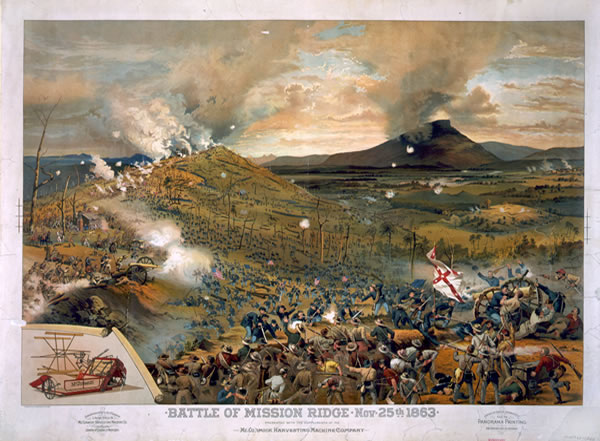
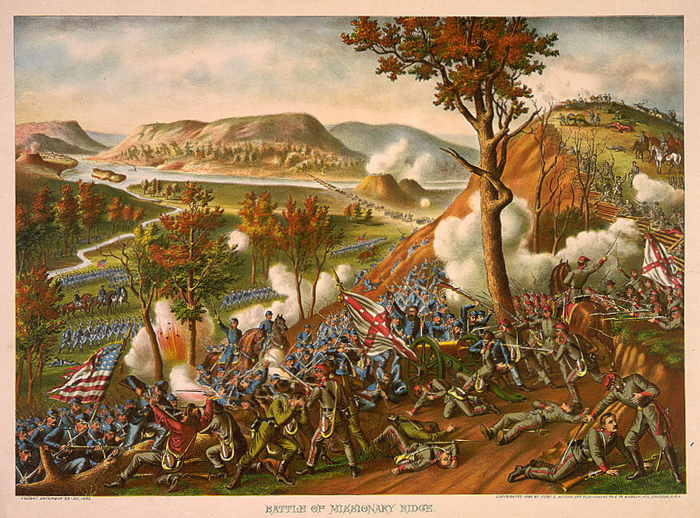
General Grant knew that Bragg had reinforced the center of his lines on Missionary Ridge and decided to assault both flanks of the line simultaneously. Grant believed this would cause Bragg to draw soldiers from the center of his lines to reinforce the flanks, thereby enabling the Union Army to strike the weakened center. On November 25th, Union General William Tecumseh Sherman launched his attack on the right flank of Bragg's army under the command of Patrick Cleburne. Despite the intense fighting, Sherman's army failed to make progress and the army of Joseph Hooker, that was supposed to attack the Confederate left, had not yet arrived on the battlefield. Grant changed his plans and ordered the army of George Thomas to attack a group of soldiers in rifle pits at the base of Missionary Ridge. Thomas' soldiers swept the Confederates from the base of the hill, sending them up the hill. Meanwhile, Union soldiers continued their assault (at this point without orders) up the hill under intense fire. After an hour or so of intense fighting, Union forces reached the top of the ridge and captured the Confederate cannons. Confederate soldiers panicked and fled. General Bragg ordered their retreat in two columns toward Dalton, Georgia. General Grant ordered a Union pursuit, which was repulsed by the Confederates in what came to be known as the Battle of Ringgold Gap.
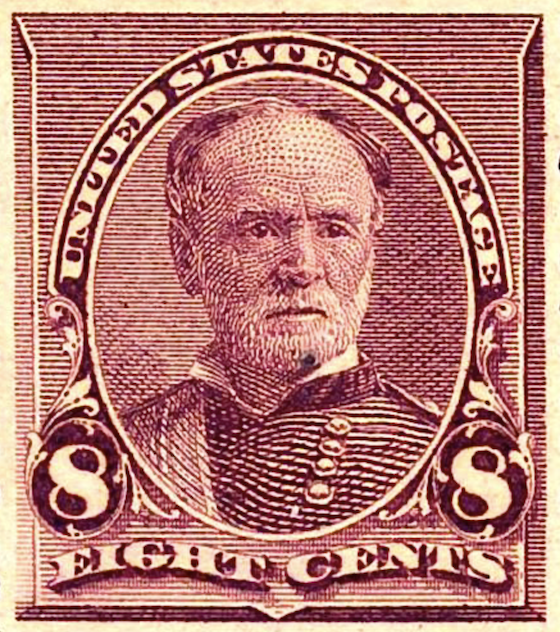
William Tecumseh Sherman Combined, the Battles for Chattanooga resulted in over 12,000 total casualties. The city of Chattanooga, which was now firmly in Union hands, became a base of operations for William Tecumseh Sherman during his "March to the Sea" through Georgia the following year. Discussion Questions
The Battle of ChattanoogaThe Battle of Chattanooga was a major battle in the Western Theater of the Civil War in fall 1863. The Western Theater included battles in states like Tennessee, Georgia, Mississippi, and others east of the Mississippi River. Confederate SiegeAfter the Confederate win at Chickamauga, Union forces retreated to Chattanooga. Confederate General Braxton Bragg’s army surrounded the city and held the high ground at Lookout Mountain and Missionary Ridge. This was called a siege, which means cutting off supplies to force surrender. Union General Ulysses S. Grant took command and sent reinforcements to break the siege. Battle of WauhatchieOn October 28, Union troops captured Brown’s Ferry to reopen a supply line known as the “Cracker Line.” That night, Confederate troops tried to take it back but were defeated at the Battle of Wauhatchie. Union forces then planned to remove Confederate troops from the mountain positions. Battle of Lookout MountainOn November 24, Union General Joseph Hooker led an attack up Lookout Mountain. Fog helped hide the Union soldiers as they climbed and attacked. This became known as “The Battle Among the Clouds.” The Union won, and Bragg pulled back from the mountain to focus on defending Missionary Ridge. Battle of Missionary RidgeGeneral Grant hoped to attack both sides of Bragg’s army and then strike the center. But Union attacks on the flanks failed. Grant then ordered an attack on the Confederate center at the bottom of the ridge. Union soldiers charged up the hill without orders and captured the top after heavy fighting. Confederate troops panicked and fled. Bragg’s army retreated toward Georgia, and a Union pursuit was stopped at the Battle of Ringgold Gap. AftermathThe battles around Chattanooga caused over 12,000 casualties. With Chattanooga under Union control, it became a major base for General Sherman’s future campaigns, including his famous “March to the Sea.” |