Battle of Chickamauga |
|
|
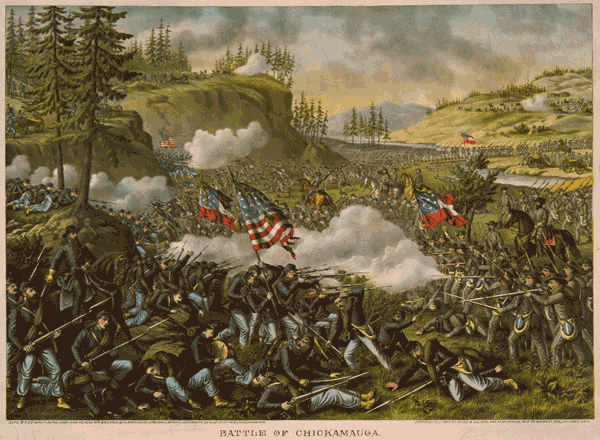
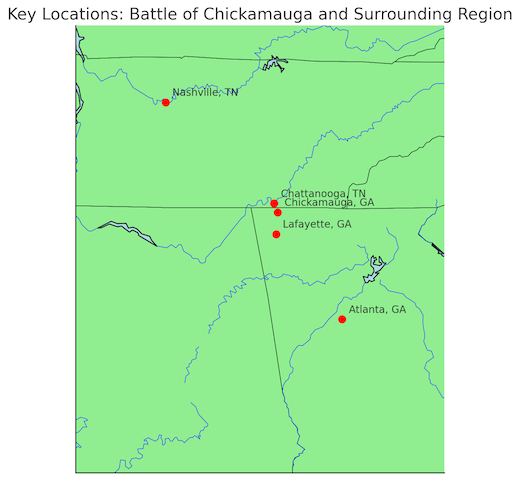
The Battle of Chickamauga was the second deadliest battle in the entire Civil War, and the most significant defeat for Union forces in the Western Theater. The Western Theater of the Civil War was the group of battles that occurred in Alabama, Georgia, Florida, Mississippi, North Carolina, Kentucky, South Carolina and Tennessee, as well as Louisiana east of the Mississippi River. Driving Toward GeorgiaAfter his victories over the Confederates in middle Tennessee, Union General William Rosecrans continued through Tennessee in an attempt to drive the Confederate Army from Chattanooga in the southeastern part of the state. Controlling Chattanooga would open up much of Georgia, including Atlanta, to Union assaults and would result in the capture of essential Southern railroad lines. In converging on Chattanooga, Rosecrans divided his army into three divisions, each of which would approach Chattanooga from different directions. As Rosecrans' army threatened his rear, Confederate General Braxton Bragg temporarily withdrew from Chattanooga with his Army of the Tennessee to Lafayette, Georgia. Bragg planned to attack the Union divisions in isolation, before they could consolidate, but such plans never made it to fruition. By the 17th of September, two of Rosecrans' division had united and moved north toward Chickamauga Creek to unite with the third. Bragg planned to attack the Union force as they crossed the creek to drive them back to the mountains, away from Chattanooga. The EngagementFighting began in earnest on the morning of September 19. Union forces under George Thomas engaged Confederate cavalry in what turned out to be a massive back and forth battle through a setting of thick forests that spanned the duration of the afternoon. By the end of the night, neither side had gained the advantage and Union forces built defensive works along Lafayette Road.
Stuck in ChattanoogaOn September 20th, Confederate General Braxton Bragg divided his force into a right wing under the command of Leonidas Polk and into a left wing commanded by James Longstreet, who had brought reinforcements from Virginia. Bragg's attack strategy however was foiled by Polk, who began his assault two hours after schedule. In the meantime, Union lines were reinforced, and Confederate assaults were turned back. At around 11:00, Union General Rosecrans began shifting his troops to fill a perceived gap in the defensive line. In doing so, he created a real gap that was exploited by Longstreet and his men. Longstreet's division crushed the center and right wings of the Union army causing uthinkable casualties as well as a disorganized Union retreat toward Chattanooga. Despite Longstreet's success, and the subsequent retreat of the Union Army, Confederate forces were unable to follow-up or pursue the enemy. While Rosecrans was unable to proceed into Georgia, Union forces maintained Chattanooga, despite a Confederate siege and the ensuing Battle of Chattanooga. In all, nearly 34,000 casualties were recorded at Chickamauga, making in the second bloodiest battle in the Civil War. Discussion Questions
The Battle of ChickamaugaThe Battle of Chickamauga was the second deadliest battle of the Civil War. It was also the worst Union defeat in the Western Theater, which included battles in states like Tennessee, Georgia, Alabama, and others east of the Mississippi River. Moving Toward GeorgiaAfter winning battles in Tennessee, Union General William Rosecrans tried to push Confederate forces out of Chattanooga. Taking Chattanooga would allow Union troops to move into Georgia and take over important railroad lines. Rosecrans split his army into three groups to surround Chattanooga. Confederate General Braxton Bragg left the city and went to Lafayette, Georgia, planning to attack the Union groups before they joined together. But two Union divisions united near Chickamauga Creek before Bragg could attack. Bragg still hoped to strike as the Union troops crossed the creek. The Battle BeginsOn the morning of September 19, Union troops led by George Thomas fought Confederate cavalry in a battle through thick forest. The fighting lasted all afternoon. By nightfall, no side had won, and Union soldiers built defenses along Lafayette Road. The BreakthroughOn September 20, Bragg split his army between two commanders: Polk on the right and Longstreet on the left. But Polk attacked late, which gave the Union time to bring in more troops. Later that morning, General Rosecrans made a mistake—he moved soldiers to fix a gap that didn’t exist, creating a real one instead. Longstreet’s troops saw the gap and charged, smashing through the Union center and right. The Union army suffered heavy losses and had to retreat toward Chattanooga. After the BattleAlthough the Union army retreated, the Confederates were too disorganized to chase them. Rosecrans didn’t get into Georgia, but the Union still held on to Chattanooga. Even after a siege, they were able to win there later. The Battle of Chickamauga ended with nearly 34,000 total casualties, making it the second bloodiest battle of the war. |