The Battle of Fredericksburg |
||
|
||
A New CommanderThe Battle of Fredericksburg is remembered as one of the most decisive Confederate victories of the Civil War. It occurred between December 11 and December 15, of 1862, in and around the city of Fredericksburg, Virginia. Union forces had hoped to assault Richmond after crossing the Rappahannock River, but Confederate forces blocked their path in Fredericksburg. President Abraham Lincoln, dissatisfied with the tentative performances of General George B. McClellan, had touted Ambrose Burnside to take over command of the Army of the Potomac. Although Burnside tried to decline the promotion, he eventually accepted when it became clear the alternative choice would be Joseph Hooker, whom he despised. The Confederates Take the High GroundGeneral Burnside had planned a quick assault on Richmond but pontoon bridges he had requested for the crossing of the Rappahannock River arrived much later than anticipated. Confederate Commander Robert E. Lee, aware of the slow movement of the Union Army, ordered his forces to take up defensive positions in Fredericksburg. Lee ordered General James Longstreet's corps to occupy a series of heights west of the city known as Marye's Heights. Lee also had time to position corps in various defensive positions outside of Fredericksburg. By the time Burnside's armies had begun crossing the river; Lee's armies were fully entrenched and would provide resistance to the crossing. On December 11, the first of the Union forces successfully crossed the Rappahannock, directly into Fredericksburg, precipitating fierce fighting in the streets and neighborhoods of the city. Union soldiers proceeded to loot the city, angering Robert E. Lee.
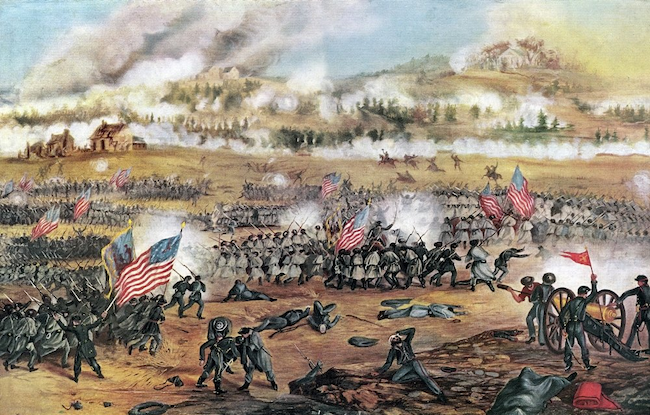
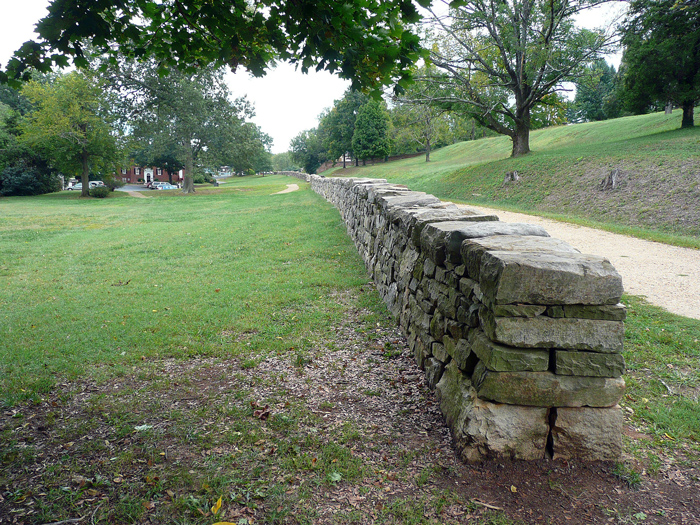
The 14 Failed Assaults on Marye's HeightsOn December 13th, combat intensified as Union forces under Major General William Franklin attacked a hole in the defensive line of Confederate soldiers under Stonewall Jackson. After initial success, the Confederates were able to repulse this assault. More troublesome to Union forces was General Longstreet's corps of 9,000 soldiers occupying Marye's Heights. To reach the heights, Union forces would have to proceed through an open field and cross one of three bridges over a small canal. At 10:00 A.M. on the 13th, Union forces attempted the first assault on the heights and were promptly routed by Confederate gunners behind a stone wall in front of the heights. Ensuing attempts to dislodge Confederate positions on Marye's Heights were also repulsed. In all, 14 assaults on Marye's Heights were repulsed and Union forces suffered as many as 8,000 casualties compared to 1,200 for the Confederates. Despite the carnage, Ambrose repeatedly decided against changing strategies. Only nightfall on the 13th prevented even more destruction of the Union ranks. Furious Confederate gunfire prevented Union soldiers on the field below the heights from advancing. Fredericksburg had quickly become an utter disaster for the Union Army. A Truce Following a Decisive Confederate VictoryOn December 14th, Confederate Brigadier General Joseph Kershaw gave permission for 19 year-old Richard Rowland Kirkland, a Confederate soldier, to personally deliver canteens and supplies to wounded Union and Confederate soldiers who could be heard screaming in pain below Marye's Heights. Union soldiers, aware of Kershaw's intentions, held their fire as Rowland attended to both the Union and Confederate wounded for over an hour and a half. Kershaw would forever be known as the Angel of Marye's Heights for his courage and humanity. On December 15th, Burnside made the decision to withdraw across the Rappahannock River, ending the fighting in Fredericksburg.
Discussion Questions
A New CommanderThe Battle of Fredericksburg was one of the most decisive Confederate victories of the Civil War. It took place between December 11 and 15, 1862, in and around Fredericksburg, Virginia. Union forces hoped to move toward Richmond, but Confederate troops blocked their path. President Abraham Lincoln replaced General George McClellan with General Ambrose Burnside. Although Burnside didn’t want the promotion, he accepted it to prevent General Joseph Hooker from taking command. The Confederates Take the High GroundBurnside planned a fast attack on Richmond, but the pontoon bridges he needed to cross the Rappahannock River arrived late. Meanwhile, Confederate General Robert E. Lee took the high ground around Fredericksburg, including Marye’s Heights. When Union troops finally crossed the river on December 11, they fought fierce battles in the city streets and looted Fredericksburg, angering Lee. Marye’s Heights: The 14 Failed AssaultsOn December 13, Union forces attacked a weak point in the Confederate line under Stonewall Jackson but were pushed back. The main challenge came at Marye’s Heights, where General Longstreet’s corps was well-defended behind a stone wall. Union troops had to cross an open field and three bridges under heavy fire. Starting at 10:00 A.M., Union forces launched 14 separate attacks but were stopped each time. Around 8,000 Union soldiers were killed or wounded, while the Confederates lost only about 1,200. Burnside refused to change tactics, and only nightfall stopped more casualties. Union troops were trapped on the field, unable to retreat due to Confederate gunfire. A Truce After a Bloody BattleOn December 14, a 19-year-old Confederate soldier named Richard Rowland Kirkland was allowed by his general to bring water and aid to the wounded on both sides. Union soldiers, aware of his actions, did not fire on him. Kirkland’s bravery earned him the name “The Angel of Marye’s Heights.” On December 15, Burnside ordered the Union army to retreat, ending the Battle of Fredericksburg. |