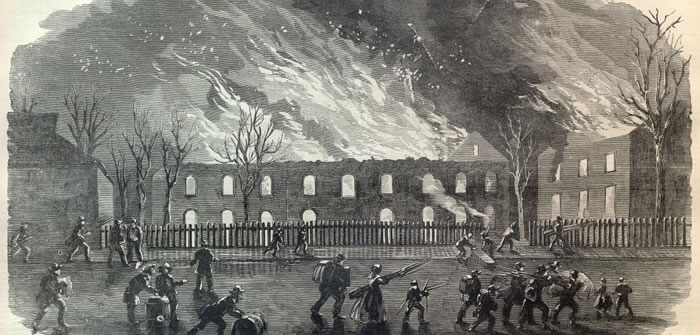
Battle of Harper's Ferry (VA) |
|
Maryland-boundIn 1862, after Robert E. Lee had taken over command of Confederate forces, he decided to invade the North, particularly the states of Maryland of Pennsylvania. Lee believed an invasion of Maryland would incite the people of that state, still in Union control, to rebel against the United States. He also believed an invasion of the North would damage the Union morale, and he believed he could garner critical food and supplies from the unspoiled farms that had not been torched by battles as those in Virginia had. He also sought to destroy the Baltimore & Ohio Railroad which supplied Washington D.C. An Easy Confederate Victory, 12,000 Union Soldiers Taken PrisonerAs Lee’s Army marched through the Shenandoah Valley and into Maryland, he split his main forces, sending Stonewall Jackson’s brigade to Harper’s Ferry for the purposes of commandeering the city’s federal arsenal full of ammunition and weapons, but also to open a supply line to Virginia. Union Colonel Dixon Miles was in charge of Harper’s Ferry and concentrated his force in the city, rather than spreading them among the high hills surrounding it. On September 13, 1862, Confederate forces arrived and scattered the scant Union defenses in the hills, leaving them open to Confederate occupation. Meanwhile, Confederate General Stonewall Jackson made preparations for an attack on Harper’s Ferry and positioned his artillery around the city. Jackson was able to place fifty pieces of artillery on a high hill overlooking Harper’s Ferry known as Maryland Heights and at the base of a hill known as Loudoun Heights. Jackson commanded General A.P. Hill to move along the west bank of the Shenandoah River for an assault on the Union left flank. On the morning of September 15, Jackson ordered his artillery to fire and viciously bombarded Harper’s Ferry while simultaneously ordering an infantry charge. Colonel Miles quickly realized he had no chance and began surrender negotiations. Before he could officially surrender, however, he was killed by an artillery shell. Confederate forces would take nearly 12,000 Union prisoners making it the largest surrender for the Union in the entire Civil War. Because of the poor tactics and preparation under the leadership of Colonel Miles, the outcome of the battle came quickly, resulting in less than 500 total casualties. From Harper’s Ferry, Jackson would rush to join General Robert E. Lee at Sharpsburg, Maryland for what would become the infamous Battle of Antietam. Discussion Questions
Lee Heads into MarylandIn 1862, Confederate General Robert E. Lee decided to invade the North, especially Maryland and Pennsylvania. He hoped the people of Maryland would rise up against the Union, and he wanted to lower Union morale, gather supplies from untouched farmland, and damage the Baltimore & Ohio Railroad, which was important for supplying Washington, D.C.Jackson Captures Harper’s FerryAs Lee’s army moved through the Shenandoah Valley into Maryland, he split his forces. He sent General Stonewall Jackson to take Harper’s Ferry and its federal weapons stockpile. Union Colonel Dixon Miles kept his men inside the town instead of guarding the surrounding hills. On September 13, 1862, Confederate troops took control of the high ground. Jackson placed 50 cannons on Maryland Heights and Loudoun Heights, aiming down at the town.The Surrender of Harper’s FerryOn September 15, Jackson ordered a heavy artillery bombardment and a ground attack. Union Colonel Miles realized defeat was certain and began to surrender, but he was killed by an artillery shell. The Confederates captured nearly 12,000 Union soldiers—the largest Union surrender in the Civil War. Poor planning and leadership by Miles led to a quick Confederate victory, with fewer than 500 total casualties.On to AntietamAfter the victory, Jackson quickly moved his troops to join Lee at Sharpsburg, Maryland, for the next major battle—Antietam. |