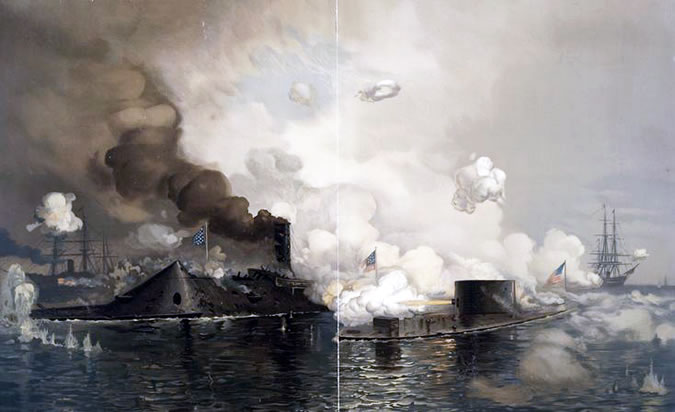
The Battle of the Ironclads (Hampton Roads) |
|
|
The Battle of the Ironclads, also known as the Battle of Hampton Roads, was likely the most important naval battle of the American Civil War. On March 8-9, 1862, Confederate forces attempted to break a powerful Union naval blockade that had isolated Norfolk and Richmond from international trade by deploying their ironclad warship, the CSS Virginia, which was originally the USS Merrimac. Building a MonsterAfter the secession of the southern states, the Confederacy had gained control of the Gosport Navy Yard and all of its ships formerly under Union control. Nevertheless, Union naval forces remained in control of several forts in the region and staged a powerful blockade that the Confederacy was initially powerless to break. Because of the Union’s naval and industrial superiority, Confederate engineers were forced to think of new ways to combat the Union advantage. The world’s first ironclad ship had set sail in France in 1860 and Southern engineers believed they could duplicate the idea. Work began in 1861 on the Merrimac, which had been partially destroyed, and which was recently raised from the bed of the Elizabeth River. The plan was to build an iron shell around the ship and to outfit it with an iron ram. It took seven months to complete. When it was done, the armor encasing the Virginia was two inches thick backed by two feet of iron and pine. It was equipped with ten guns and fourteen gun ports and was ready for action by February of 1862. The Union Countermeasure - the MonitorWhen Union intelligence learned of the construction of the Virginia, they scrambled to make their own ironclad war ship. Union naval officials commissioned Swedish architect John Ericsson to design what would be called the Monitor, an Ironclad warship to equal the Virginia. Even though Ericsson actually completed the Monitor before the Virginia was finalized, the Virginia would be activated first and would wreak havoc in Hampton Roads before the Monitor could arrive. On the morning of March 8, 1862, the CSS Virginia stormed into the waters of Hampton Roads where it immediately engaged the Union fleet, utterly destroying the USS Cumberland with the ram, sinking the ship, and killing 120 sailors. The Virginia next destroyed the USS Congress, resulting in its surrender. Union attempts to shoot at the Virginia proved completely useless. Only darkness saved the remainder of the Union fleet. Naval officers aboard the Virginia and its support fleet planned to finish the job on the morning of March 9. Much Ado About NothingThe next morning, much to the surprise of the Confederates, the Union ironclad Monitor met the Virginia on her way to dispatching the remainder of the Union fleet. The two ironclads fired at each other at close range for hours; neither side able to sink the other. Eventually, each ship withdrew prompting both sides to proclaim victory. Surprisingly, neither ship would ever fight again. The Virginia was set afire by the Confederacy after she became stuck in the shallow water of the James River. The Monitor would sink en route to North Carolina on December 31, 1862. The Ironclads Changed Naval Warfare ForeverToday, most historians believe the Battle of the Ironclads was a draw; although the Confederates failed to break the Union blockade. One thing is for sure – The ironclad warships used in this battle influenced navies around the world to abandon the construction of wooden war ships in favor of iron ones. Discussion Questions
The Battle of the IroncladsThe Battle of the Ironclads, also known as the Battle of Hampton Roads, was the most important naval battle of the Civil War. It happened on March 8–9, 1862, when the Confederacy tried to break the Union blockade that was cutting off Norfolk and Richmond. They used their new ironclad warship, the CSS Virginia, which was rebuilt from a Union ship called the USS Merrimac. Building a MonsterAfter the South seceded, the Confederacy took over the Gosport Navy Yard and some Union ships. But the Union still controlled nearby forts and had a strong blockade. To fight back, Southern engineers built a new kind of warship using the remains of the Merrimac. They covered it with two inches of iron backed by thick wood, added a ram, and ten guns. The new ironclad, renamed the CSS Virginia, was ready by February 1862. The Union Countermeasure – the MonitorWhen the Union learned about the Virginia, they rushed to build their own ironclad. A Swedish designer named John Ericsson created the USS Monitor. Although it was finished first, the Virginia struck first on March 8, destroying the USS Cumberland and the USS Congress. Union cannons couldn’t harm the ironclad. Only nightfall saved the rest of the Union fleet. Much Ado About NothingThe next morning, the Union Monitor showed up and surprised the Virginia. The two ironclads battled for hours at close range but neither could sink the other. Eventually, both ships left the fight, and both sides claimed victory. Neither ship fought again. The Virginia was destroyed by the Confederates after getting stuck, and the Monitor sank later in a storm. The Ironclads Changed Naval Warfare ForeverHistorians now call the battle a draw, but the Union blockade remained. What really mattered was that ironclad warships showed the world that wooden ships were outdated. Navies around the world began switching to iron ships after this battle. |
| Ironclads Activities |
|