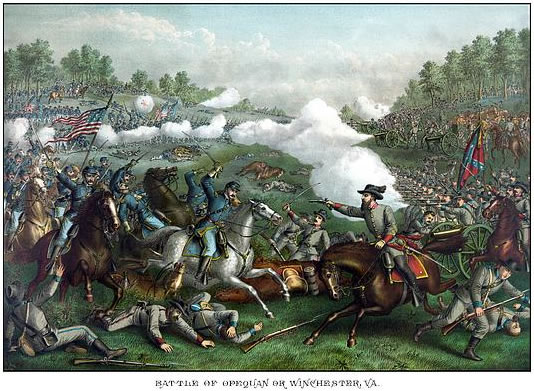
Battle of Winchester (VA) |
|
Taking a Stand at WinchesterAs part of a larger plan by Union forces to position armies for an eventual assault on Richmond, Union Major General Nathaniel Banks had ordered his army to retreat from their positions at Strasburg, Virginia, in response to the capture of his garrisons by Confederate forces at Front Royal. During their retreat, Confederate forces attacked the retreating forces, capturing hundreds of soldiers and numerous supplies. In order to slow the ferocious Confederate pursuit, Banks decided to take a stand at Winchester. Stonewall Jackson Commands a Decisive VictoryOn the night of May 24, 1862, four additional Confederate brigades under the command of Richard Ewell became available to Confederate General Stonewall Jackson, who was in overall command, giving the Confederates an advantage in manpower of more than two to one. Jackson would command his brigades to assault the Union left flank on the morning of the 25th and were initially repulsed by Union gunners entrenched behind stone walls. Confederate forces regrouped and moved toward two roads (pikes) in the early morning fog. Jackson would order the placement of artillery on a hill to counter Union artillery about a half mile away atop Bower’s Hill. Jackson’s ordered the concentration of his brigades to assault the Union position on Bower’s Hill which proved successful. Overwhelmed by the number of Confederate troops assaulting Bower’s Hill, Union soldiers atop the hill broke ranks and fled into downtown Winchester before turning north to the Martinsburg Pike for a full retreat. Although many Union troops were captured, the exhausted Confederates attempted a half-hearted pursuit, allowing the majority of Union forces to escape. Get Back to Washington!The Battle of Winchester was a decisive Confederate victory; the first of what became known as Jackson’s Valley campaign. Union reinforcements, too late to make a difference at Winchester, were forced to march to Washington for the defense of the Union capital. Casualties were light in comparison to other battles with the Union losing approximately 2,000 soldiers and the Confederates losing about 400. Discussion Questions
Retreat and Stand at WinchesterUnion General Nathaniel Banks was ordered to pull back his troops from Strasburg, Virginia, after Confederate forces captured Union soldiers at Front Royal. As the Union army retreated, Confederate troops attacked and captured many soldiers and supplies. To slow down the Confederate chase, Banks decided to stop and fight at Winchester.Stonewall Jackson's VictoryOn the night of May 24, 1862, Confederate General Stonewall Jackson received four more brigades under Richard Ewell, giving him a strong manpower advantage. The next morning, Jackson sent his troops to attack the Union’s left side, but they were pushed back at first by Union soldiers behind stone walls. In the early morning fog, the Confederates moved toward two roads and placed artillery on a hill to fight back against Union cannons on Bower’s Hill. Jackson then focused his troops on taking Bower’s Hill. The Union soldiers, overwhelmed by the large Confederate force, retreated into Winchester and then headed north along the Martinsburg Pike. Many were captured, but most escaped because the tired Confederate army didn’t chase aggressively.Aftermath of the BattleThe Battle of Winchester was a clear Confederate win and the first big success in Jackson’s Valley Campaign. Union backup forces arrived too late and had to go back to Washington to help defend the capital. Compared to other battles, the casualties were low: the Union lost about 2,000 men, and the Confederates lost around 400. |