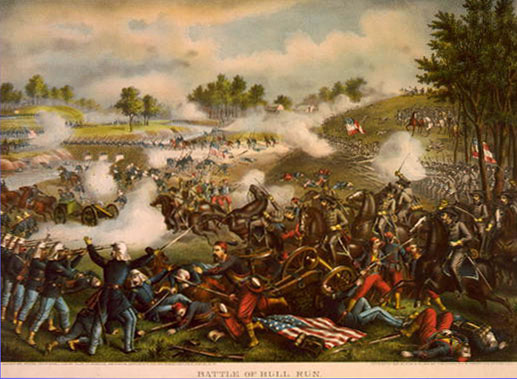
The First Battle of Bull Run (Manassas)

First Battle of Manassas
 

A Nice Day at the Battlefield!

The first major battle of the American Civil War occurred on July 21, 1861, in Manassas, Virginia. The Battle is known both as the First Battle of Bull Run, after the creek that ran through the battlefield, or, the First Battle of Manassas. Union forces under General Irvin McDowell, hoping for a decisive blow against the newly formed Confederacy, planned a surprise attack against the left flank of Confederate General P.G.T. Beauregard's forces at the railroad junction of Manassas. Both sides were unseasoned and unprepared for the carnage that would ensue. Hundreds of spectators from Washington lined the hills of the battlefield to cheer on the Union. McDowell, who was skeptical of the Union plan, amassed 35,000 soldiers - the largest land army ever assembled in America at the time, to attack the Confederate positions.

"Stonewall" Saves the Day

At 2:30 in the morning on July 21, McDowell sent two detachments from nearby Centreville toward Confederate positions. By 5:15, the first shots had been fired. Through the morning, Union forces had slowly pushed Confederate forces back until they broke through the Confederate right flank at about 11:30, sending them into a disorganized retreat. Gen McDowell elected not to pursue the retreating Confederates, who were able to regroup at the Henry Hill House. At 12:00, Confederate reinforcements under General Thomas J. Jackson arrived on the battlefield. It was at this moment, when Confederate General Bernard Bee is said to have uttered the timeless words "There is Jackson standing like a stone wall." From that point on Thomas J. Jackson would be known as Stonewall Jackson. Some historians believe Bee was actually angry at Jackson for not sending his troops directly into battle. The tide of the battle soon changed when Confederate forces under Jackson and Calvary Commander J.E.B. Stuart captured Union artillery around 3:00. Jackson commanded his soldiers to press on and for the first time in the war, Union forces would be horrified by the "rebel yells" screamed by Confederate soldiers on the attack. At 4:00, more Confederate reinforcements led by Kirby Smith and Jubal Early crushed a Union brigade and caused the collapse of McDowell's Union Army. Union forces began a disorderly and poorly managed retreat, accompanied by screaming spectators who clogged the retreat path. Confederate forces, also in a state of disarray, captured several hundred Union soldiers but failed to pursue the remaining forces back to Washington.

A Grim Reality

The First Battle of Bull Run proved to be the deadliest battle in American history to that point. Nearly 5,000 total casualties were recorded, with Union forces suffering roughly 1,000 more than the Confederates. The North was shocked and dismayed at the Union defeat and many feared the Confederacy would move immediately on Washington. At the very least, the First Battle of Bull Run proved the war would be long and violent. President Lincoln was forced to sign a bill that allowed for the enlistment of up to 500,000 additional soldiers.

Discussion Questions

  1. Why did both the Union and Confederate armies struggle with the First Battle of Bull Run?
  2. What role did "Stonewall" Jackson play in turning the tide of the battle?
  3. How did the public and political leaders react to the Union defeat?
  4. What does the outcome of the First Battle of Bull Run suggest about early expectations for the Civil War?

A Nice Day at the Battlefield

The first big battle of the Civil War happened on July 21, 1861, in Manassas, Virginia. It’s called the First Battle of Bull Run or the First Battle of Manassas. Union General Irvin McDowell tried to surprise Confederate General P.G.T. Beauregard at a key railroad spot. Both armies were inexperienced. People from Washington came to watch, thinking it would be an easy Union win. McDowell gathered 35,000 soldiers, the largest army in the U.S. at that time.

"Stonewall" Saves the Day

At 2:30 AM, McDowell sent troops from Centreville to attack. By 5:15 AM, fighting had started. The Union pushed the Confederates back and broke their lines by 11:30 AM. But McDowell didn’t chase the retreating Confederates, who regrouped at Henry Hill House. At noon, Confederate General Thomas J. Jackson arrived with help. General Bernard Bee reportedly shouted, “There is Jackson standing like a stone wall,” which gave Jackson the nickname "Stonewall" Jackson.

Later, Confederate troops led by Jackson and J.E.B. Stuart captured Union cannons at 3:00 PM. Confederate soldiers gave loud “rebel yells” as they attacked. More Confederate reinforcements came at 4:00 PM, led by Kirby Smith and Jubal Early, breaking the Union army. Union soldiers and panicked spectators ran away in confusion. Confederates captured some soldiers but didn’t chase the rest.

A Grim Reality

The First Battle of Bull Run became the deadliest U.S. battle at the time, with about 5,000 total casualties. The Union lost around 1,000 more than the Confederates. People in the North were shocked and feared an attack on Washington. The battle showed the Civil War would be long and bloody. President Abraham Lincoln had to approve a law to recruit 500,000 more soldiers.

Bull Run Activities