The Confederate Withdrawal to Richmond
The Peninsula Campaign was a Union military operation in southeastern Virginia designed to strike at the Confederate capital of Richmond between March and July of 1862. It was led by General George B. McClellan and his Army of the Potomac, which numbered over 120,000 soldiers. McClellan's massive army moved via water on March 17, 1862, from Alexandria, Virginia to the Virginia peninsula, where McClellan besieged Yorktown in early May of 1862. McClellan vastly overestimated the size of Confederate forces defending Yorktown under Joseph Johnston and lost valuable time moving heavy artillery into place. Meanwhile, Confederate forces, realizing they could not hold Yorktown, escaped. Union forces would next engage the retreating Confederates on May 5, 1862, at Williamsburg, resulting in over 4,000 casualties and the continued Confederate withdrawal in the direction of Richmond. Union General McClellan continued the pursuit and ordered Brigadier General William Franklin and his army to board transport ships on the York River to cut off Johnston's escape.
Just Seven Miles from Victory!
On May 7th, 1862, Franklin's army was attacked by Confederates upon landing at Eltham's Landing, which prevented him from cutting off Johnston. Union forces nevertheless, continued to press on toward Richmond. On May 15, 1862, in what was likely the closest Union approach to the Confederate capital, Union naval vessels, including the ironclad USS Monitor, sailed up the James River toward Richmond and took massive fire from Confederate forces at Fort Darling, just seven miles from Richmond. In what came to be known as the Battle of Drewry's Bluff, the Union naval vessels were forced to withdraw. Confederate General Joseph Johnston withdrew his 60,000 man army in preparation to defend Richmond from an imminent attack.
McClellan Proves Gullible
Following Drewry's Bluff, Union forces under McClellan set up a several supply bases on the Pamunkey River and planned to use the region's railroad lines to bring his heavy artillery within range of Richmond. By May 18, McClellan had positioned 105,000 men northeast of Richmond, outnumbering Johnston's army of 60,000. Despite the huge advantage in manpower, McClellan was fooled into believing HE was outnumbered two to one by faulty intelligence. On May 27, in response to information that indicated a small Confederate force had moved into position at Hanover Courthouse, near the Union lines, McClellan dispatched Corps Commander Fitz John Porter to engage the enemy, where Union forces scored an insignificant victory.
Massive Casualties and the Union Withdrawal
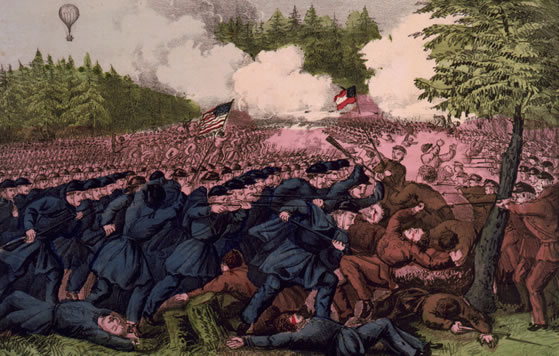
Meanwhile, Confederate General Joseph Johnston, desperate to prevent a siege of the Confederate capital, preemptively attacked McClellan's army on May 31, 1862. In what came to be known as The Battle of Seven Pines (also called the Battle of Fair Oaks), Union and Confederate forces fought to a draw, although the Union advance on Richmond came to a screeching halt, as Confederate forces collapsed back to Richmond. Combined, the two sides suffered over 11,000 total casualties. Following the draw at Seven Pines, Confederate President Jefferson Davis replaced Johnston as Commander with Robert E. Lee. Lee immediately made plans to strengthen the defenses surrounding Richmond and to extend the defensive lines south of Richmond to Petersburg. On June 25, 1862, Lee launched a series of counterattacks on McClellan's Army that would cause McClellan to withdraw his army under withering fire south of the James River. These battles would collectively become known as the Battles of Seven Days and would result in 36,000 total casualties. Despite the heavy toll incurred by Confederate forces under Lee (20,000 casualties), he succeeded in driving McClellan's army away from Richmond. The Army of the Potomac would soon be recalled to Washington to support Union offensives in Northern Virginia. For now, the Confederate capital was safe.
|
|
Discussion Questions
- What mistakes did General McClellan make during the Peninsula Campaign?
- Why was the Union’s advance on Richmond stopped, even though they had more troops?
- How did the leadership change from Johnston to Lee affect the Confederate defense?
- Why was the Battle of Drewry’s Bluff important, even though it was a naval battle?
The Confederate Withdrawal to Richmond
The Peninsula Campaign was a Union plan to capture the Confederate capital, Richmond, between March and July of 1862. General George B. McClellan led over 120,000 Union soldiers, moving them by water to the Virginia Peninsula. In early May, he besieged Yorktown, believing the Confederate force under Joseph Johnston was larger than it really was. While McClellan prepared, the Confederates escaped. The Union army caught up with them on May 5 at Williamsburg, where a battle caused 4,000 casualties. The Confederates kept retreating toward Richmond, and McClellan ordered General William Franklin to try to block their path.
Just Seven Miles from Victory!
On May 7, 1862, Franklin’s forces landed at Eltham’s Landing but were attacked before they could stop the Confederate retreat. Meanwhile, Union ships, including the ironclad USS Monitor, sailed up the James River on May 15. They reached Fort Darling, just seven miles from Richmond, but were turned back by heavy fire in the Battle of Drewry’s Bluff. Johnston’s army of 60,000 men pulled back to prepare for defending Richmond.
McClellan Proves Gullible
McClellan set up supply bases and got 105,000 troops in position northeast of Richmond. Even though he had more troops, he believed—incorrectly—that the Confederates outnumbered him two to one. On May 27, he sent troops to fight what turned out to be a small enemy force at Hanover Courthouse. The Union won, but it was not an important victory.
Massive Casualties and the Union Withdrawal
On May 31, 1862, Johnston attacked McClellan’s army in the Battle of Seven Pines (or Fair Oaks). Both sides suffered heavy losses—over 11,000 total—but neither won clearly. After this battle, Confederate President Jefferson Davis replaced Johnston with General Robert E. Lee. Lee strengthened Richmond’s defenses and launched a series of attacks starting on June 25, known as the Seven Days Battles. These battles caused 36,000 total casualties, including 20,000 on the Confederate side. Despite this, Lee forced McClellan to retreat, and the Union army pulled back to Washington. Richmond remained under Confederate control.
|