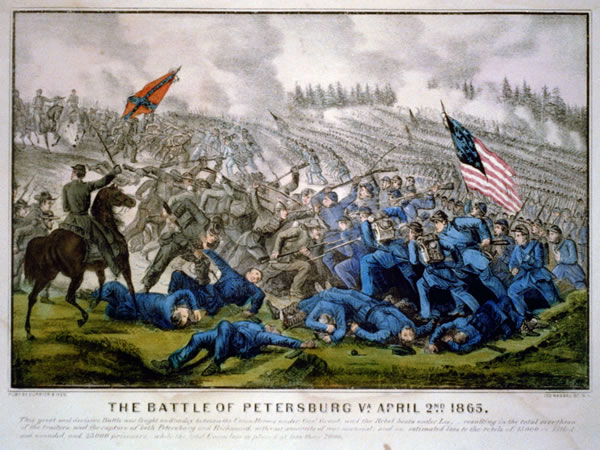
The Siege at Petersburg was actually a series of battles in south central Virginia in and around both Petersburg and Richmond that involved trench warfare for the eventual purposes of destroying the Confederate supply line and railroad system to Richmond. After nine and a half months, the "siege" finally succeeded and Petersburg fell to Union forces.
The Start of the Longest Siege in American History
The Union assault on Petersburg began on June 15th, in what came to be known as the Second Battle of Petersburg (The First Battle of Petersburg was little more than a skirmish). In the battle, Union forces were soundly defeated and totaled more than 11,000 casualties while the Confederates totaled 4,000. On June 18th, Confederate forces received reinforcements which prevented any additional Union attacks directly on Petersburg. Instead, Grant endeavored to besiege Petersburg by cutting the three major railroad lines that supplied it. In the first attempt to destroy one of those lines, known as the Weldon Railroad, Union forces were driven off by Confederates in what came to be known as the Battle of Jerusalem Plank Road. In the battle, Union forces suffered nearly 3,000 casualties compared to only 572 on the Confederate side. Nevertheless, the Union was able to shift the siege lines further west. Later that month, Union forces were able to disrupt transports from Lynchburg to Petersburg by destroying tracks southwest of the city, at the heavy cost of 12 cannons and 1,500 casualties (mostly captured Union troops).
Preparing for the Crater
On July 27, 1864, Grant sent Union General Phillip Sheridan and Winfield Hancock on a mission to threaten Richmond. The "mission" was really a diversion. The goal was simply to draw Confederate defenses away from Petersburg to make sure the coming (see below) Battle of the Crater would be as effective as possible. While Union forces could not break the Confederate defenses, they did manage to draw some forces away from Petersburg.
The Battle of the Crater
For weeks before the Battle of the Crater, Union forces had built a mine shaft under the Confederate defenses at Elliott's Salient (a fort). Upon its completion, it was over 500 feet long and 50 feet below the surface. It was built with an innovative air-exchange system to allow soldiers deep within the mine to breathe fresh air. The plan was hatched to fill the mine with 8,000 pounds of explosives and to detonate it from beneath the ground. In theory, the explosion should have killed all of the soldiers in the fort as well as scatter Confederate defenses so that Union forces could rush in and assault the Confederates. At 4:44 A.M. on the morning of July 30th, the mine was detonated, immediately killing 278 Confederate soldiers and blasting a crater in the Earth that still exists today 170 feet wide and 30 feet deep. Despite the crater, Union forces leaving the mine shaft and entering the crater were easy targets for Confederate gunners. Over 500 Union soldiers would be killed in the ensuing battle and thousands more injured or captured. The plan was a complete failure.
Staging the Siege
Slowly but surely, however, Union forces became successful in destroying parts of the railroad lines serving Petersburg despite heavy casualties in numerous battles. With parts of the Weldon Railroad out of service, Confederate supplies had to be transported by wagon trains or by hand into Petersburg. As the summer transitioned to fall, Union forces gradually wore down Lee’s army and extended their lines east and southwest of Petersburg. Both armies would suspend operations for the winter. During the winter, Confederate forces within Petersburg were plagued by desertions, a lack of supplies, and disease.
Five Forks
By March 25th, 1865, Lee’s Army was outnumbered 125,000 to 50,000 and was suffering greatly as a result of the siege. In what came to be known as the Battle of Stedman’s Farm, the Confederates tried one last time to break the Union siege, but were ultimately unsuccessful in doing so. Confederate casualties were four times those of the Union. On April 1st, 1865, Union forces under Phillip Sheridan defeated the Confederates at Five Forks. The Union victory resulted in control over the Southside Railroad, the last supply line to Petersburg and its retreat line.
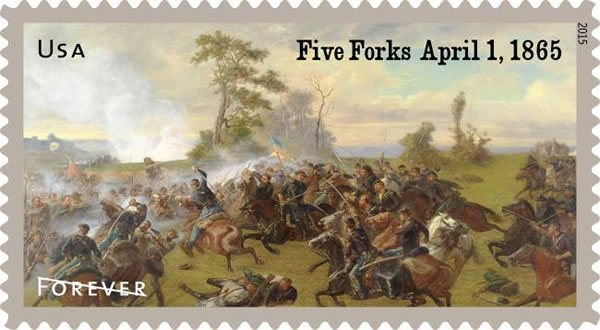 |
| Sheridan's Victory at Five Forks |
The Final Attack; Petersburg Falls and Richmond is Doomed
The next day, on April 2nd, Union Commander Ulysses S. Grant launched a final attack on the Confederates at Petersburg. While the Confederate defenders were able to hold off the Union assault long enough for most of the military to flee from Petersburg and for the government to vacate Richmond (which would fall the next day), Union forces had scored a major victory