Siege at Vicksburg |
||
Siege at Vicksburg |
||
The Gibraltar of the ConfederacyBy 1863, Union forces had gained control over much of the Mississippi River. President Abraham Lincoln considered control of the nation's largest waterway crucial, but the fortified city of Vicksburg, Mississippi, located above a horseshoe-shaped bend in the river, stood in the way of Union success. As long as Vicksburg was controlled by the Confederacy, the Union could not navigate the river and the Confederacy could ship supplies and send communications between its parts east and west of the river. Located high on the bluffs overlooking the river, Vicksburg was referred to as "the Gibraltar of the Confederacy." Attacking Vicksburg was difficult. It was surrounded by swamps and poor country roads. Furthermore, there was a giant fortress atop the bluffs making a naval assault virtually impossible.
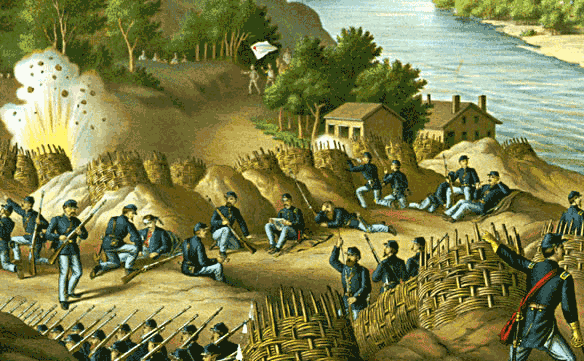
Key Points ofr Union Control of the Southern Mississippi River Direct Assault, Impossible. Preparing for a SiegePrior to the Siege of Vicksburg, Union General Ulysses S. Grant had won control of Mississippi River ports in Louisiana, as well as Mississippi's capital, Jackson. Confederate forces, facing an overwhelming Union assault, were forced to withdraw to the fortifications of Vicksburg. Grant, fully cognizant of the difficulties of taking Vicksburg, ordered an immediate assault on the city before the Confederates could get fully organized and entrenched. Union forces would come under withering fire as they attempted to negotiate steep ravines, deep ditches, and the 17 foot-high walls of what was called the Stockade Redan. Their first assault, on May 19th, under the command of Major Generals William T. Sherman and Francis Blair, were summarily repulsed resulting in crushing casualties as Confederate forces fired on them from above. In a second series of assaults ordered by General Grant on May 22nd, Union forces suffered even greater casualties and made virtually no progress in advancing on the fortifications. Union losses totaled over 3,000 soldiers on May 22, compared to less than 500 in the Confederate ranks. It soon became apparent that Union success would rely on a prolonged siege, something that Grant hoped to avoid. Misery on the Bluffs
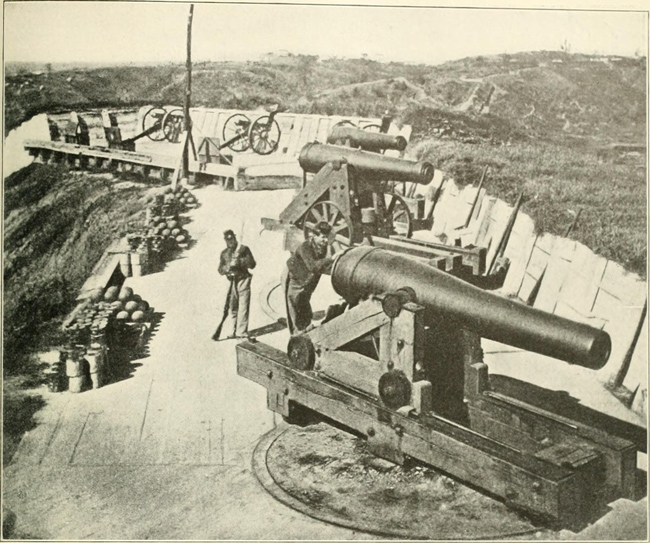
Union forces began to build entrenchments in the hopes of gradually moving closer and closer to the Fortifications and trapping Confederate forces and the population of Vicksburg. Over time, Grant moved 77,000 Union soldiers into positions completely encircling Vicksburg and eventually cutting off their supply line. Any chance of a Confederate escape was gone. By the end of June, many Confederate soldiers began suffering from malnutrition and scurvy, a condition which frequently afflicted sailors in the Age of Exploration, caused by an acute lack of Vitamin-C. Others suffered from unsanitary conditions and came down with diarrhea, dehydration, malaria, and dysentery. Confederate forces were forced to eat their horses, dogs, and to steal vegetables from the gardens of Vicksburg residents. Amidst the misery, Union gunboats and cannons continuously bombarded the city and fortifications, destroying suitable shelters. Residents and soldiers would dig over 500 caves into the hillside to escape the bombardment. SurrenderBy July, the situation had grown hopeless for the Confederates. Surrender negotiations began and Grant agreed to parole the remaining Confederate soldiers, rather than having to ship 30,000 to prison camps. On July 4, 1863, a day after Lee’s defeat at Gettysburg, surrender terms were finalized and the Union gained total control of the Mississippi River (five days later Fort Hudson, Louisiana fell into Union hands as well). Confederate forces were forced to relinquish 172 cannons and over 50,000 rifles. The 82 year-long GrudgeFor the Confederacy, the Vicksburg defeat, combined with the Gettysburg defeat, is often considered the turning point in the Civil War. July 4th, America's birthday, would not be celebrated in Vicksburg again until World War II. Discussion Questions
The Gibraltar of the ConfederacyBy 1863, the Union had taken control of most of the Mississippi River, but the city of Vicksburg, Mississippi, still blocked complete control. Located on high bluffs above a bend in the river, Vicksburg was called “the Gibraltar of the Confederacy.” Its strong defenses and location made it hard to attack, especially by water. As long as the Confederacy held it, they could send supplies and messages across the river. Assault Fails – Siege BeginsUnion General Ulysses S. Grant had already captured nearby ports and Mississippi’s capital, Jackson. He tried to attack Vicksburg quickly before Confederate forces were ready, but his first assault on May 19 failed. A second attack on May 22 also failed and caused over 3,000 Union casualties. Grant realized a direct attack wouldn't work, so he began a long siege instead. Suffering During the SiegeGrant’s army surrounded Vicksburg with 77,000 soldiers, cutting off supplies and escape routes. Over time, Confederate soldiers ran out of food and medicine. Many suffered from disease, hunger, and malnutrition. People ate horses, dogs, and stolen vegetables. To survive the constant bombing, residents dug caves into the hills for shelter. Surrender on the Fourth of JulyBy July, the Confederates had no hope. They began surrender talks, and Grant agreed to let the 30,000 Confederate soldiers go home instead of sending them to prison camps. On July 4, 1863—just one day after the Union victory at Gettysburg—Vicksburg surrendered. The Union now fully controlled the Mississippi River. The Confederacy also lost 172 cannons and over 50,000 rifles. A Long-Lasting GrudgeThe defeat at Vicksburg, combined with the loss at Gettysburg, is seen as a major turning point in the Civil War. Because the city surrendered on the Fourth of July, Vicksburg did not celebrate Independence Day again until World War II—82 years later. |
||
| Vicksburg Activities | ||
|