The Fall of Atlanta |
|
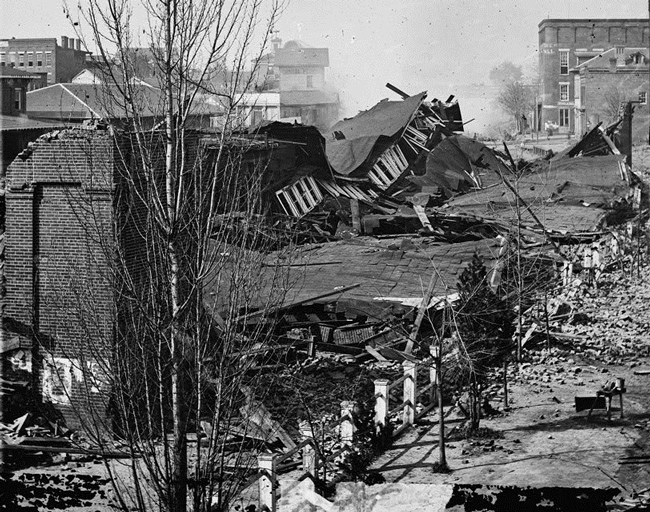
Fighting for Bald HillIn 1864, Union Major General William Tecumseh Sherman led a major campaign to seize supply lines that powered the Rebel cause in the state of Georgia. The capture of the capital city of Atlanta was one of the main missions of Sherman. For several months, the Union Army of the Tennessee had chased Confederate forces under Joseph Johnston in Georgia and Tennessee. Johnston's lack of success frustrated Confederate President Jefferson Davis, who replaced him with John Bell Hood. Hood believed he had a better chance of defending the crucial city of Atlanta by withdrawing from it, and enticing Union forces moving toward Atlanta to pursue his smaller army. Instead, on July 21, Union forces under James McPherson descended upon Decatur, just to the east of Atlanta. It was in Decatur where most of the fighting for control of Atlanta would occur. That day, violent fighting erupted for control of the high ground called Bald Hill that resulted in 5,500 casualties for the beleaguered Confederates, compared to around 3,400 for the Union Army. The fighting on July 21st lasted until dusk and sometimes involved hand-to-hand combat. Decatur was lost, but the Confederates maintained control of Atlanta. Hood Abandons Atlanta; Sets it AflameUnable to pierce Confederate defenses and take Atlanta, Sherman decided to lay siege to the city. A siege is when a military unit such as an army surrounds an enemy position for the purposes of cutting off supplies. The Confederates inside the city held strong for a while, but on August 31, 1864, Union forces finally severed the supply line from Macon to Atlanta. Confederate General Hood, who realized the situation in Atlanta was now hopeless, abandoned it on the next day, burning military supplies, ammunition, and gunpowder. The fire spread and before long most of Atlanta was totally in flames. Effect of the Siege of AtlantaFrom a political perspective, the Siege of Atlanta positioned Abraham Lincoln to be re-elected to the presidency in 1864. Prior to the victory, Democrats, who favored immediate peace with the South, had gained significant ground and may have secured the presidency with their candidate George B. McClellan, whom Lincoln had replaced as Commander of the Army of the Potomac in 1863. With the victory at Atlanta, the public's confidence in Lincoln's prosecution of the war was restored and the Democratic overtures to submit to the South quickly lost favor. Additionally, the fall of Atlanta set the stage for Sherman's March to the Sea. The "march," which was designed to break the will of the Southern people, resulted in widespread destruction throughout much of Georgia. Discussion Questions
Fighting for Bald HillIn 1864, Union General William Tecumseh Sherman led a campaign to capture key supply lines in Georgia. His main goal was to take the city of Atlanta. Confederate General Joseph Johnston was replaced by John Bell Hood, who tried to trick Union forces by pulling his army away from Atlanta. On July 21, Union forces reached Decatur, near Atlanta, and heavy fighting took place over a hill called Bald Hill. The battle caused about 5,500 Confederate and 3,400 Union casualties. Fighting lasted until dark and sometimes involved hand-to-hand combat. The Confederates lost Decatur, but still held Atlanta. Hood Abandons Atlanta and Sets It on FireSherman could not break through Confederate defenses in Atlanta, so he surrounded the city to cut off supplies. This is called a siege. On August 31, Union troops cut the last railroad line into the city. The next day, General Hood decided to leave Atlanta and burned supplies as he left. The fire spread and destroyed much of the city. The Effect of the Siege of AtlantaWinning the battle for Atlanta helped Abraham Lincoln get re-elected as president in 1864. Before the victory, many people wanted peace with the South and supported Lincoln’s opponent, George McClellan. But after the Union victory, more people supported Lincoln and the war effort. The fall of Atlanta also allowed Sherman to begin his destructive March to the Sea, which brought great damage to Georgia. |