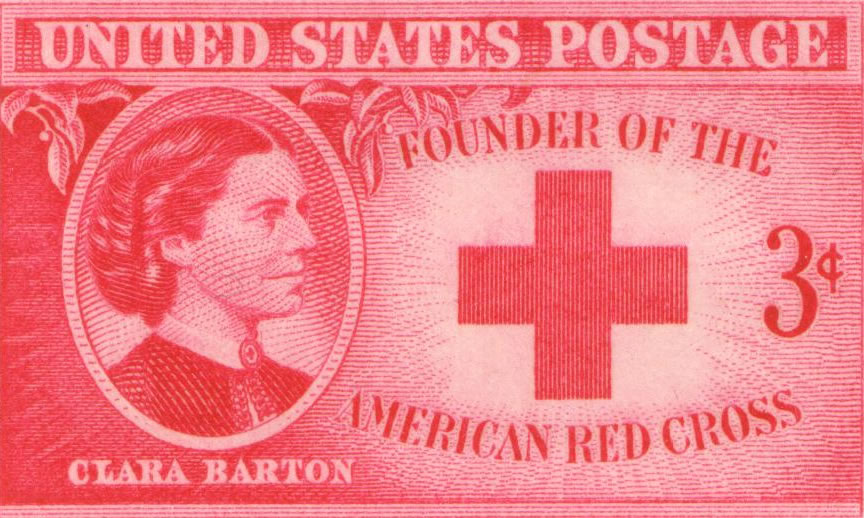
Childhood
Clarissa Harlowe Barton, called Clara, was born on December 25, 1821, in North Oxford, Massachusetts. Before she started school, her brothers taught her spelling, arithmetic, and geography. When she was four, she could already spell three-syllable words. She was very shy.
Teacher
Clara became a teacher when she was seventeen. In 1850, Clara went to teach at a school in Bordentown, New Jersey. Many children could not go to the school because their families could not pay the tuition. Clara offered to teach without a salary if children could attend for free. In this way, she started the first free school in New Jersey. Even though she raised enrollment from six to six hundred, the school board hired a man to be the head of the school instead of offering the job to Clara. Clara resigned.
Angel of the Battlefield
Her congressman helped her get a job as a copyist at the Patent Office in Washington, DC. She was working there when the Civil War (1861–1865) began. After the Baltimore Riots, a trainload of soldiers arrived in Washington with no baggage or supplies. Clara helped take care for them and gather some of the necessary supplies. After the First Battle of Bull Run, Clara advertised in the Worcester, Massachusetts Spy magazine for medical supplies to treat wounded soldiers. Her ads were successful, and she began an organization to distribute bandages, socks, and other supplies. The US Surgeon General, William A. Hammond, gave her permission to travel to places where fighting was taking place. Clara did not work primarily as a nurse during the war; she was important because she obtained and passed out supplies where they were needed. She became known as the “Angel of the Battlefield.”
Providing Closure
In 1865, at Camp Parole, Maryland, she decided to organize a group to find soldiers listed as missing in action. Clara also went to Georgia to identify Union soldiers in unmarked graves at Andersonville, the Confederate prison camp. She helped set up a national cemetery there. She became the first woman bureau head in the United States government when she was appointed head of the Missing Person Office. In coordination with the Bureau of Records, the organizations identified nearly twenty thousand soldiers so that families could know what happened to their loved ones. This was about one-tenth of the total number of missing or unidentified in the Civil War.
Red Cross
In 1869, she went to Geneva, Switzerland, where she met officials of the recently organized International Red Cross. She worked to get the US Congress to agree to the Geneva Convention. This agreement resulted in the formation of the Red Cross, and it asked nations to agree to protect medical personnel on the battlefield. After she returned to the United States, she lived in Danville, New York. In 1877, she offered to lead the American branch of the International Red Cross. Besides helping during wartime, the American Red Cross provides relief for victims of epidemics and natural disasters like floods and earthquakes. Her work helping people in times of war and times of peace made her an eternal symbol of humanitarianism. She died on Good Friday, April 12, 1912, in Glen Echo, Maryland.
Discussion Questions
- Why do you think Clara Barton was willing to teach without getting paid?
- What made Clara Barton important during the Civil War?
- How did Clara help families after the war ended?
- What lasting impact did Clara Barton have through her work with the Red Cross?
Childhood
Clara Barton was born on December 25, 1821, in North Oxford, Massachusetts. Her brothers taught her school subjects before she even started school. She could spell long words by age four, but she was a very shy child.
Teaching Career
At seventeen, Clara became a teacher. In 1850, she taught at a school in Bordentown, New Jersey. Many students couldn’t afford school, so Clara offered to teach for free so all children could attend. She started the first free school in New Jersey, growing it from 6 to 600 students. Despite her success, the school board hired a man to run the school, so Clara resigned.
The Angel of the Battlefield
Clara later worked at the Patent Office in Washington, DC. When the Civil War began, she started helping wounded soldiers by collecting and delivering supplies. She received permission to go to battlefields and bring bandages, socks, and other supplies. Clara became known as the “Angel of the Battlefield.”
Helping Find Missing Soldiers
In 1865, Clara helped find soldiers who were missing in action. She also helped identify Union soldiers buried in unmarked graves at Andersonville prison camp and helped create a national cemetery. Clara became the first woman to lead a government office, helping thousands of families learn what happened to their loved ones.
Red Cross and Later Life
In 1869, Clara visited Geneva, Switzerland, and learned about the International Red Cross. She worked hard to bring the Red Cross to the United States. The American Red Cross helped people during wars and natural disasters. Clara became a symbol of kindness and care. She died in 1912 in Glen Echo, Maryland.