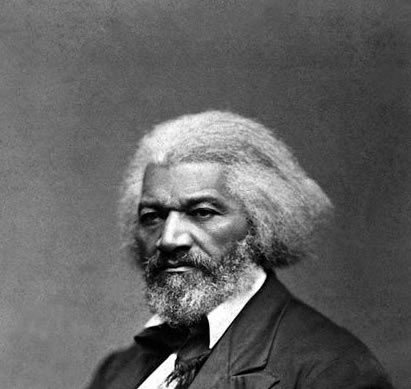
Frederick Douglass |
|
Early YearsFrederick Douglass was one of the most famous abolitionists in American history. He was born near Hillsboro, Maryland, in February of 1818. He was born into slavery and was separated from his mother when he was a baby. Douglass never knew his father and was moved to different residences throughout Maryland during his childhood.Eyes OpenAt the age of 12, Frederick began receiving reading lessons from the wife of his “master,” even though it was illegal to teach slaves to read. Frederick proved to be a quick study and was soon reading newspapers, magazines, and books. Through his reading of political journals, Frederick realized the horrors of slavery. Indeed, many slaveholders endeavored to keep slaves illiterate so that they would not question their position and desire a better life.FreedomDouglass was soon sent away to another slave owner named Mr. Freeman. Mr. Freeman allowed Frederick to teach other slaves to read. Frederick taught over 40 slaves how to read passages from the New Testament. Other slave owners, however, became angry and destroyed the “congregation” in which Frederick taught. Four years later, in 1837, Frederick married a free black woman named Anne Murray. They would have five children. He gained his own freedom by escaping from captivity by dressing as a sailor and boarding a train at Havre de Grace, Maryland, near Baltimore. By the time he reached New York City he was a free man (though not officially a free man). The trip took less than a day. Douglass Becomes a Prominent Abolitionist VoiceDouglass continued to Massachusetts and soon joined the abolitionist cause. Inspired by the famous abolitionist William Lloyd Garrison, Douglass became an anti-slavery speaker and writer. At only 23 years of age, Douglass became a leading speaker for the cause and joined several movements including the American Anti-Slavery Society. He also supported the feminist cause and participated in the Seneca Falls Convention, a women’s rights convention in 1848.Courtesy of the People of Great BritainIn 1845, Douglass authored Narrative of the Life of Frederick Douglass, an American Slave, an autobiography. The book was a critical success and became an instant best seller. The book was translated into three languages, and Douglass was invited to tour Ireland and Great Britain. Douglass spent two years in Europe lecturing on the horrors of slavery. Douglass became a popular figure in Great Britain, where his lectures were “standing room only.” The people of Great Britain, roused by Douglass’s speeches, raised money on his behalf to pay his “owner,” Hugh Auld, for his official freedom. Auld was paid 700 pounds by the people of Great Britain and Douglass was officially a free man in America. The North StarWhen he returned to America, Douglass published The North Star and four other abolitionist newspapers under the motto “Right is of no Sex — Truth is of no Color — God is the Father of us all, and we are all brethren.” He advocated equal education for black children, who received virtually no funding for education. As his reputation grew, Douglass became an advisor to Abraham Lincoln and Andrew Johnson. Douglass led a growing movement that caused a split in the Abolitionist movement. Douglass and others believed the US Constitution was an anti-slavery document, while William Lloyd Garrison believed it was a pro-slavery document. In addition, Garrison believed that The North Star was competing for readers with his own newspaper, the National Anti-Slavery Standard.
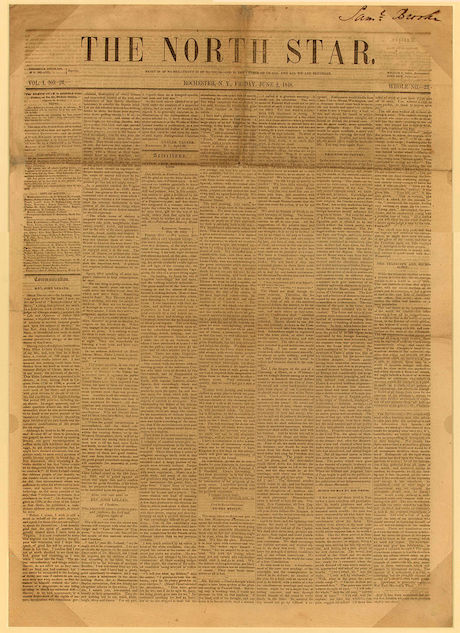
An 1848 Edition of the North Star Douglass Honors LincolnBy the time of the start of the Civil War, Douglass was one of the nation’s most prominent black men. Later, The North Star was merged with other newspapers and was called the Frederick Douglass Paper. Douglass believed the primary cause of the Civil War was to liberate the slaves. After Lincoln issued the Emancipation Proclamation, Douglass continued in the fight for the rights of the freed slaves. After the assassination of President Lincoln, Douglass gave an impromptu speech at his memorial service. While Douglass’s speech mentioned Lincoln’s shortcomings in the fight against slavery, he gave Lincoln much credit for the liberation of the slaves, “Can any colored man, or any white man friendly to the freedom of all men, ever forget the night which followed the first day of January 1863, when the world was to see if Abraham Lincoln would prove to be as good as his word?” The speech was followed by a rousing standing ovation. It is said that Mary Lincoln was so moved by the speech that she gave Douglass Lincoln’s favorite walking stick. After the Civil WarAfter the war, Douglass was made president of the Freedmen’s Bureau Savings Bank and several other diplomatic positions. During reconstruction, Douglass frequently gave speaking tours, particularly at colleges and universities in New England. In 1877, he purchased his final home, which he named Cedar Hill, in the Anacostia section of Washington, DC. Today, the estate is known as the Frederick Douglass National Historic Site. Frederick’s wife, Anne Murray, died in 1881, but he remarried Helen Pitts, a white abolitionist, in 1884. Despite the controversy that their marriage created (she was white and twenty years younger than he), the pair toured Europe in 1886 and 1887. In 1895, Douglass died of a heart attack at his home in Washington. Discussion Questions
Early YearsFrederick Douglass was born into slavery in Maryland in 1818. He was separated from his mother as a baby and never knew his father.Eyes OpenAt age 12, Frederick learned to read from his master’s wife, even though it was illegal. Reading helped him understand the cruelty of slavery, and he began to question his place in the world.FreedomFrederick taught other slaves to read, even though angry slave owners stopped his group. He escaped slavery in 1838 by disguising himself and traveling by train to New York. He later married a free black woman, Anne Murray, and had five children.Douglass Becomes a Prominent Abolitionist VoiceDouglass became a famous anti-slavery speaker and joined the American Anti-Slavery Society. He also supported women’s rights and attended the Seneca Falls Convention in 1848.Courtesy of the People of Great BritainDouglass’s book about his life, published in 1845, made him very popular. He toured Ireland and Britain, where people raised money to officially buy his freedom from his former owner.The North StarDouglass started a newspaper called The North Star with the motto, “Right is of no Sex — Truth is of no Color.” He pushed for equal education and advised Presidents Lincoln and Johnson.Douglass Honors LincolnDouglass gave speeches supporting freedom and praised Abraham Lincoln after his death. Mary Todd Lincoln gave Douglass Lincoln’s favorite walking stick after hearing his moving tribute.After the Civil WarDouglass held many important positions after the war and spoke often about civil rights. He remarried in 1884 to Helen Pitts, a white abolitionist, and toured Europe. He died in 1895 in Washington, D.C. |
| Frederick Douglass Activities |
|