Robert E. Lee |
||||||
|
||||||
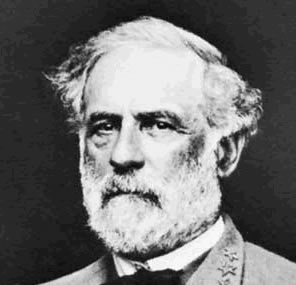
Pre-Civil WarRobert E. Lee was born January 19, 1807, in Stratford, Virginia. He graduated from the U.S. Military Academy in 1829 finishing second in his class. While working as an engineer, Lee married Martha Anna Randolph Custis, the great-granddaughter of Martha Washington by her first husband (not by George Washington). After serving in the Mexican War, Lee served in Baltimore Harbor before becoming superintendent of the military academy. He next served in western Texas before returning to Virginia to settle the estate of his father-in-law. In 1859, Lee was called upon to command a group of marines in the successful capture of radical abolitionist John Brown, who had stormed the federal armory at Harper's Ferry. After the John Brown raid, Lee returned to west Texas. Virginian FirstWith growing hostilities between the north and south regarding slavery and states rights, Winfield Scott summoned Lee to Washington in an attempt to secure his services for the Union. But like most southerners in the 1860's, Lee considered himself more a Virginian than an American, and promptly resigned from the army to give his services to the Confederate States of America. Though Lee was given many assignments in the Confederate army including Major General, Brigadier General and General, Lee is best remembered for commanding his famous Army of Northern Virginia. Commander of the Army of Northern VirginiaRobert E. Lee quickly became a revered figure in the south after defeating Union forces at the Second Battle of Bull Run in 1862. After his victory, Lee moved his army into Maryland, in the hopes of gaining support in the border state, which he believed was being held in the Union against its will. Unfortunately for Lee, the citizens of Maryland gave him a cold reception, as his army met Union forces under George B. McClellan at Antietam Creek in the town of Sharpsburg. In the bloodiest one day battle of the war, Lee's and McClellan's armies fought to a standstill, despite the fact that McClellan had received intelligence concerning the positions and locations of Lee's army. Nevertheless, Lee's army was driven back across the Potomac River to Virginia, rendering the first foray onto northern soil a failure. Chancellorsville and GettysburgLater in 1862, however, Lee's Army of Northern Virginia won a decisive battle at Fredericksburg, then routed Union forces under Joseph Hooker at Chancellorsville in 1863 in what many consider Lee's finest victory. Later that year, Lee made his second invasion of the north, and met Union commander George Meade at Gettysburg, Pennsylvania. With over 160,000 total troops engaged at the fields and bluffs of Gettysburg, it still remains the largest battle ever waged on American soil. Through three days of fighting, Confederates and Union forces decimated each other. Although General James Longstreet urged Lee to be less aggressive, and to wait for a Union attack, Lee refused and took the aggressive. In a bloody series of bombardments and charges, including Confederate General George Pickett's deadly charge across Cemetery Ridge, the Confederates were driven back across the Potomac once again. Not only do historians consider Gettysburg the turning point in the war, but many believe if Lee would have listened to Longstreet, he would have led his army to victory. Battered, Trapped, and DefeatedDespite the loss at Gettysburg, the war was not over. Lee's army had retreated back to Virginia, where general Union General Ulysses S. Grant made a series of bold, bloody attacks against the Confederates known as "The Overland Campaign". Despite losing tens of thousands of soldiers at Wilderness, Cold Harbor, Petersburg, and at other locales, Grant's forces systematically weakened Lee's Army of Northern Virginia. With the morale and health of his army suffering, Lee and his forces held on to the Confederate strongholds of Petersburg and Richmond for ten months, before finally being overwhelmed by Union forces in 1865. Lee, in a last-ditch attempt to link with Joseph Johnston's army, retreated to the town of Appomattox, where he was forced to surrender his army on April 9, 1865.
President of a New CollegeAfter the war, a dejected Lee became president of Washington and Lee University. As a beloved general in the south, he died of heart disease on October 12, 1870, at the age of 63 in Lexington, Virginia. Discussion Questions
Early Life and Military CareerRobert E. Lee was born on January 19, 1807, in Stratford, Virginia. He graduated second in his class at West Point in 1829. He married Martha Custis, a descendant of Martha Washington. After serving in the Mexican War and holding several military positions, he led troops to stop John Brown’s raid at Harper’s Ferry in 1859.Choosing the ConfederacyAs tensions grew between the North and South, Lee was asked to lead the Union Army. But Lee chose to support his home state of Virginia and joined the Confederacy. He held many ranks, but is most famous for leading the Army of Northern Virginia.Important Battles and DefeatsLee won early battles like the Second Battle of Bull Run and Chancellorsville. He tried to bring the war into the North but failed at Antietam and Gettysburg. Gettysburg became a turning point in the war after Lee ignored advice and lost the battle.End of the War and SurrenderDespite some victories, Lee’s army was slowly worn down by Union General Ulysses S. Grant in a series of bloody battles. After a long siege, Lee surrendered at Appomattox Court House on April 9, 1865.Life After the WarAfter the war, Lee became president of what is now Washington and Lee University. He died of heart disease on October 12, 1870, in Lexington, Virginia. |
||||||
| Robert E. Lee Featured Activities | ||||||
|
||||||
| Robert E. Lee Activities | ||||||
|
||||||