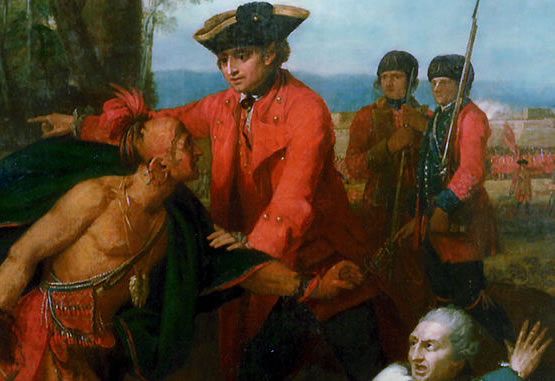
Battle of Lake George |
|
The Battle of Lake George was fought on September 8, 1755. British forces of 1,500 soldiers and 200 Mohawk Indians under the command of William Johnson defeated a much larger allied French and Indian force of 3,500 under German General Baron Dieskau. The BattleThe battle started when French and Indian forces ambushed a group of Massachusetts and Connecticut regiments on a road between Lake George and Ft. Edward. Although the regiments were pushed back, they were able to hold off French and Indian assaults on their base camp. Meanwhile, New Hampshire and New York regiments were sent from Fort Edward to reinforce the other regiments. On the way, these regiments seized a French baggage train along with critical supplies. An astonished General Dieskau was also captured, and the French and Indian troops were scattered away from the main battle. First Major British VictoryThe British victory at Lake George was their first important victory over the French. Two years later, however, the French reclaimed the area during the Battle of Fort William Henry, a fort built by William Johnson just before the Battle of Fort Niagara. In the battle, 6,000 French troops and 1,600 Indians bombarded the fort. British forces under George Monro were forced to surrender. Over 2,300 British were captured, several hundred of which were massacred by the Indians. The loss of Fort William Henry was a severe blow to British military plans, as it prevented them from mounting any offensive towards Montreal, a French stronghold. The events of the battle of Fort William Henry were depicted in the famous novel by James Fenimore Cooper, The Last of the Mohicans. Discussion Questions
Glossary
The BattleOn September 8, 1755, British troops and 200 Mohawk allies led by William Johnson defeated a larger French and Indian force of 3,500 under General Baron Dieskau. The battle began when French and Indian forces ambushed British regiments on the road between Lake George and Fort Edward. Although pushed back, the British held off attacks at their camp. Reinforcements from Fort Edward captured French supplies and even took General Dieskau prisoner. The French forces scattered. First Major British VictoryThis was the first big British victory in the French and Indian War. But two years later, the French returned and won the Battle of Fort William Henry, a fort built by Johnson. Battle of Fort William Henry (1757)The AttackIn 1757, 6,000 French soldiers and 1,600 Indian allies surrounded Fort William Henry. British troops under George Monro had to surrender. Over 2,300 British were captured, and many were killed by the Indian allies. Why It MatteredLosing Fort William Henry was a serious loss for the British. It stopped their plans to attack Montreal. This event was later told in the novel The Last of the Mohicans by James Fenimore Cooper. |