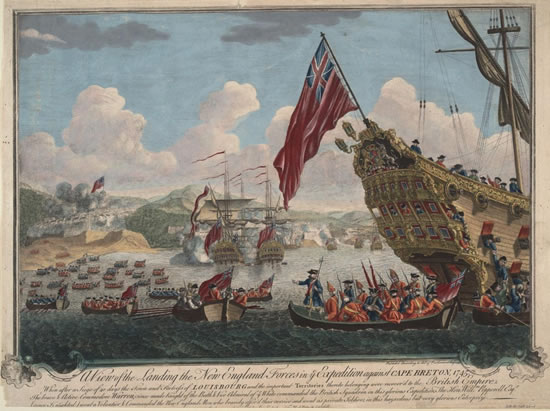
Battle of Louisbourg |
|
The Battle of Louisbourg, in present day Nova Scotia, was one of the most important British victories in the French and Indian War. It marked a change of strategy in how the British fought the war. After several setbacks in the Ohio River Valley, British Prime Minister William Pitt decided that the best strategy for winning the war would be to attack New France in Canada. A Crucial SpotIn 1758, Parliament planned an attack on the Fortress of Louisbourg, which stood in the way of a large-scale British attack on the rest of Quebec using the St. Lawrence River. An Epic Siege FormingOn May 29, 1758, nearly 14,000 men on 150 transport ships and 40 war ships anchored in Gabarus Bay, just three miles from Louisbourg. They were under the command of Jeffrey Amherst. The French defense consisted of about 7,000 soldiers manning the cove and in war ships on the harbor. The SiegeThe British siege lasted over a month and a half. For several weeks, they made hardly any progress in taking the fortress. Eventually, however, their soldiers managed to secure the shore, and the constant pounding from British cannons and guns penetrated the walls of the great fortress, setting large sections of it ablaze. One-by-one, the French warships in the harbor were also destroyed. Finally, on July 26, 1758, French forces surrendered the fortress, which was promptly destroyed by the British. The British now had control of the vital St. Lawrence River. Discussion Questions
Glossary
Why It MatteredThe Battle of Louisbourg was one of the most important British victories in the French and Indian War. After earlier failures, British leaders decided to attack New France in Canada. Taking Louisbourg helped the British move closer to capturing Quebec. A Crucial SpotThe Fortress of Louisbourg blocked access to the St. Lawrence River, which led to the heart of French Canada. The British needed to capture it to move their troops further inland. Preparing for BattleOn May 29, 1758, about 14,000 British troops with 150 transport ships and 40 warships arrived near Louisbourg. They were led by General Jeffrey Amherst. The French had around 7,000 troops and warships guarding the fortress and harbor. The SiegeThe battle lasted more than six weeks. At first, the British made little progress. But they kept attacking, and eventually broke through the fortress walls. Their cannons destroyed the French warships in the harbor. On July 26, 1758, the French surrendered. The British destroyed the fortress and took control of the St. Lawrence River. |