Battle of the Plains of Abraham |
|
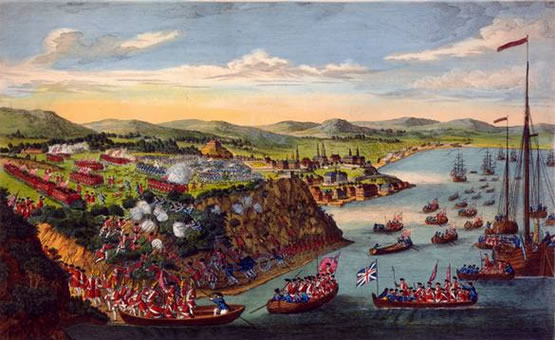
The Battle of Quebec City, often referred to as the Battle of the Plains of Abraham, was one of the most important British victories in the French and Indian War. It was fought on September 13, 1759. British Military PowerThe battle was actually the end of a long siege that began on June 26, when British forces sailed south from Louisbourg on the St. Lawrence River, and landed near Quebec City. The British fleet, under the command of Charles Saunders, featured 49 boats, 1,944 guns, and 13,500 soldiers. They landed their boats in a small cove and were forced to climb a steep cliff and subdue French snipers at the top of the cliff to gain access to an area called the Plains of Abraham, two miles west of Quebec City. French Forces Inside QuebecMeanwhile, French forces, under the command of Louis-Joseph de Montcalm, numbered over 13,000 strong and were positioned inside Quebec City. British Victory and Surrender of QuebecOn September 13, James Wolfe and 4,400 soldiers began forming battle lines on the Plains of Abraham. At the same time, Montcalm and 4,000 soldiers left Quebec City and engaged the British on the plains. Many historians have viewed Montcalm's decision to leave Quebec City as a severe tactical error. Firing began when the two armies met. The British soon gained an advantage and the French quickly accumulated many casualties. Subsequent charges by French forces were easily repulsed by the British. In the battle, General James Wolfe and General Montcalm were both fatally wounded. The French army was forced to retreat back to Quebec City. Upon news of Montcalm's defeat, French naval forces on the St. Lawrence River also retreated. Quebec City was surrendered on September 18, following a lengthy British assault. The loss of Quebec essentially sealed victory for the British in the French and Indian War. Discussion Questions
Glossary
IntroductionThe Battle of Quebec City, also called the Battle of the Plains of Abraham, was a major British victory in the French and Indian War. It took place on September 13, 1759. British Military PowerThe battle followed a long siege that started on June 26. British troops sailed down the St. Lawrence River from Louisbourg with 49 ships, nearly 2,000 cannons, and 13,500 soldiers. They landed near Quebec City and climbed a steep cliff under fire to reach an open area called the Plains of Abraham. French Forces Inside QuebecThe French army, led by General Louis-Joseph de Montcalm, had over 13,000 soldiers positioned inside Quebec City. The Battle and British VictoryOn September 13, British General James Wolfe and 4,400 men set up battle lines. Montcalm responded by marching out with 4,000 soldiers to meet them. This move is now seen as a mistake. The British fired first and caused many French casualties. The French tried to fight back, but the British easily pushed them back. Both generals, Wolfe and Montcalm, were fatally wounded. The French retreated into the city. British forces continued their attack, and Quebec surrendered on September 18. This battle was a turning point that helped the British win the war. |