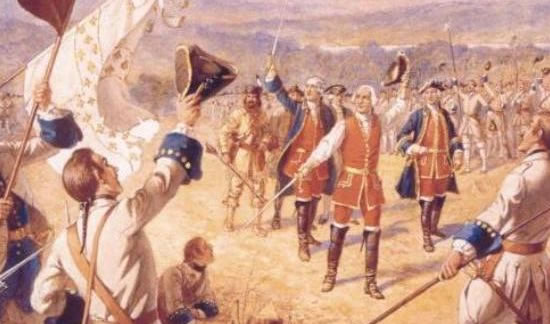
Battle of Ticonderoga |
|
The Battle of Ticonderoga, often referred to as the Battle of Fort Carillon, was fought between July 7 and July 8 of 1758. Fort Carillon was the southernmost fort in New France and was a vital location on Lake Champlain that protected a portage to Lake George. 16,000 British soldiers (the largest British force ever assembled in North America), under the command of Generals Howe and Abercrombie, descended upon the strongly fortified French position. French forces of about 3,200, under the command of Louis-Joseph de Montcalm, had built the fort with high entrenchments, supported by three batteries. In addition, the only clear path to the fort was blocked by the felling of trees as ordered by General Montcalm. Just before the main assault, General Howe was killed in a skirmish. General Abercrombie, then in complete charge, ordered a direct frontal assault on the fort, without waiting for his cannons to be assembled and positioned. The French were easily able to withstand the assault with lethal rounds of gunfire at the advancing British. The British were forced to retreat, after losing over 2,000 soldiers to death or injury. The French victory would be short-lived, however. In 1759, the British successfully invaded the fort and renamed it Fort Ticonderoga. Discussion Questions
Glossary
IntroductionThe Battle of Ticonderoga, also known as the Battle of Fort Carillon, took place on July 7–8, 1758. It was one of the bloodiest battles of the French and Indian War. Fort CarillonFort Carillon was located on Lake Champlain and protected a route to Lake George. It was the southernmost fort in New France and very important to the French defense. The British AttackA huge British army of 16,000 men, led by Generals Howe and Abercrombie, attacked the French fort. The French only had about 3,200 soldiers under General Montcalm. Montcalm had built strong defenses and blocked the road with fallen trees. The BattleBefore the main attack, General Howe was killed in a smaller fight. General Abercrombie then ordered a full attack without using cannons. The French easily defended the fort and fired deadly shots at the British. Over 2,000 British soldiers were killed or hurt, and the rest retreated. AftermathThe French won the battle, but it didn’t last long. In 1759, the British came back and took the fort. They renamed it Fort Ticonderoga. |