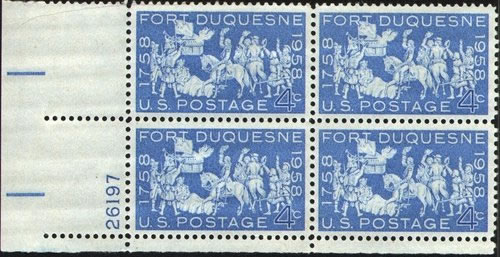
Fort Duquesne |
|
First Major Event of the French and Indian WarThe events at Fort Duquesne marked the first major event in the French and Indian War. In 1754, the area which included the source of the Ohio River was occupied by French settlers. English settlers, moving northwest from Virginia, hoped to colonize the area to take advantage of the region's abundant game. They built a small fort at the forks of the Ohio River known as Fort Prince George. A larger garrison of French settlers, however, arrived soon after and destroyed the fort. Fort Duquesne was built on its ruins. Battles of Jumonville Glen and Great MeadowsIn the spring of 1754, Major George Washington was sent to Fort Duquesne to discuss boundaries, and to persuade the French to leave the area peacefully. The French, however, refused to vacate the area. Washington returned to the region with a group of Virginia troops in an attempt to take the fort by force. On the way to the fort, Washington encountered a French scouting party. He attacked them near a place now known as Jumonville Glen, though at least one French soldier escaped. He then ordered construction of Fort Necessity, which was soon taken by the French after the Battle of Great Meadows. Fort Necessity was subsequently burned to the ground. The British again attempted to take Fort Duquesne in 1755, but were defeated by the French at the Battle of Monogahela. Fort Duquesne Becomes Fort PittThe French occupied Fort Duquesne until 1758. In September 1758, Pennsylvania and Virginia militia, under the command of James Grant, were annihilated by French forces after storming the fort. The heads of dead British militia were impaled on stakes that encircled the fort as a warning against future British invasion. Nevertheless, the small British force was only a detachment of a much larger British force of 6,000 that had moved into the area. On November 26, 1758, the French burned Fort Duquesne to the ground before retreating. The British soon took over the remains, rebuilt the fort and named it Fort Pitt, after Prime Minister William Pitt. Discussion Questions
Glossary
First Major Event of the WarIn 1754, the French built Fort Duquesne at the source of the Ohio River, where the British had tried to build Fort Prince George. This was the first major conflict that started the French and Indian War. Battles of Jumonville Glen and Great MeadowsMajor George Washington was sent to Fort Duquesne to ask the French to leave. They refused. Washington returned with troops, attacked a French scouting group at Jumonville Glen, and then built Fort Necessity. The French attacked and won at the Battle of Great Meadows, burning Fort Necessity afterward. The British tried again in 1755 but were defeated at the Battle of Monongahela. Fort Duquesne Becomes Fort PittThe French held Fort Duquesne until 1758. That September, British militia were defeated in an attack, and French defenders put the heads of British soldiers on stakes around the fort. But the French couldn’t hold off a larger British army. On November 26, they burned the fort and retreated. The British rebuilt it and renamed it Fort Pitt. |