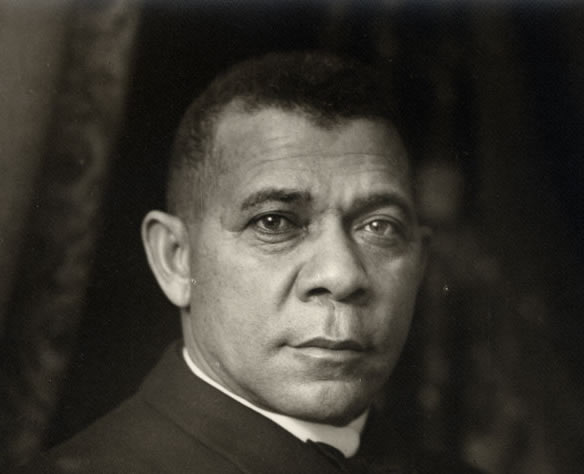
Booker T. Washington

Booker T.Washington

Early Life

Booker T. Washington was born on April 5, 1856 in Franklin County, Virginia. Because his parents were slaves owned by the Burroughs family, Booker was immediately born into slavery. At the age of nine, Booker, his mother, and siblings were freed and moved to Kanawha County, West Virginia. At an early age, he worked with other recently freed slaves as a salt-packer in a coal mine. Because he was hard-working and intelligent, he was hired as a houseboy by the wife of the mine's owner. Booker soon learned to read and write and was even allowed to attend school.

Education and Early Career

At the age of sixteen, Booker enrolled at the Hampton Normal and Agricultural Institute in Hampton, Virginia. The purpose of the Normal School was to train freed black men to become teachers. Washington excelled in his studies and soon came back to teach at Hampton. He was then recommended to become principal at Tuskegee Institute in Alabama, a new school organized by former slave Lewis Adams. Although he was only 25 years old, Washington became the first principal of the Tuskegee Normal and Industrial Institute in 1881. The school would soon become known simply as Tuskegee Institute.

Tuskegee Institute

Much like the Normal School in Hampton, Tuskegee aimed to train black men to become teachers. It also provided instruction in the practical fields of masonry and carpentry. Washington believed that by teaching Black men such practical skills, they would be accepted by the White majority and eventually be granted full civil rights. Tuskegee thrived under Washington's leadership, and he soon made rich and important friends who generously donated to the school including Andrew Carnegie, Henry Rogers, and William Howard Taft. He even hired the famed scientist and professor George Washington Carver, who taught poor, Black southern farmers techniques to keep their soil fertile to maximize production (crop rotation).

The Atlanta Compromise

Washington soon gained a reputation as an excellent orator (speaker). In 1895, he delivered a speech known as The Atlanta Compromise in which he urged the White majority to begin hiring Black workers rather than immigrants and that the very future of the American South was tied to the fate of the Black population and their treatment by the Whites. It is generally considered one of the most important civil rights speeches in American history. Many prominent members of the Black community, however, such as W.E.B Dubois, believed Washington's advocacy of the "industrial" education of Black Americans, and his seeming acceptance of segregation were more harmful than helpful. It was Dubois, in fact, who labeled him the "Great Accomodater," a reference to his acceptance of segregation and Jim Crow Laws.

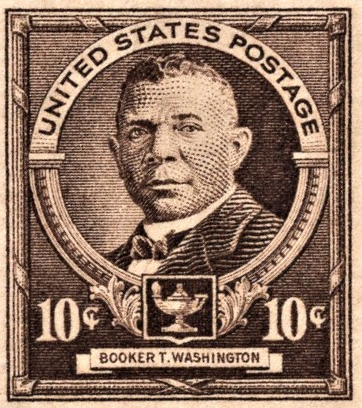
Booker T. Washington Postage Stamp

Author and Legacy

In 1901, Washington authored Up From Slavery, a famous autobiography that detailed the obstacles he encountered to obtain his education and outlined his philosophies of education. In his book he penned the famous quote:

"I have learned that success is to be measured not so much by the position that one has reached in life as by the obstacles which he has overcome while trying to succeed."

Washington remained principal of Tuskegee Institute until his death in 1915. Today, he is remembered as one of the initial pioneers in the quest for Civil Rights.

Discussion Questions

  • Why do you think education was so important to Booker T. Washington?
  • What was Booker trying to teach students at Tuskegee Institute?
  • Do you agree or disagree with Washington’s idea of learning trades to gain respect? Why?
  • Why did W.E.B. Du Bois criticize Booker T. Washington?

Glossary

  • Slavery – A system where people were treated as property and forced to work without pay.
  • Principal – The person in charge of a school.
  • Trade – A job or skill, like farming or carpentry.
  • Segregation – Keeping people apart based on race or other differences.
  • Orator – A public speaker.
  • Autobiography – A book someone writes about their own life.

Early Life

Booker T. Washington was born on April 5, 1856, in Franklin County, Virginia. His parents were slaves, so he was born into slavery. When he was nine years old, he and his family were freed. They moved to West Virginia, where Booker worked in a salt mine. Later, he worked as a houseboy and learned to read and write. He eventually got the chance to go to school.

Education and Career

At age sixteen, Booker went to Hampton Institute, a school for African Americans. He became a great student and later taught there. He was chosen to lead a new school in Alabama called Tuskegee Institute. He became the school’s first principal at just 25 years old.

Tuskegee Institute

At Tuskegee, Booker taught students to be teachers and to learn useful trades like farming, carpentry, and masonry. He believed learning these skills would help African Americans gain respect and rights. The school grew, and Booker got support from wealthy and important people. He also hired George Washington Carver to teach farming methods.

The Atlanta Compromise

In 1895, Booker gave a speech called the Atlanta Compromise. He asked white business owners to hire African Americans instead of immigrants. Some people, like W.E.B. Du Bois, didn’t agree with Booker’s ideas. They thought he accepted unfair treatment too easily.

Books and Legacy

In 1901, Booker wrote a book called Up From Slavery about his life and beliefs. He believed that success should be measured by how many challenges a person has overcome. He stayed at Tuskegee until he died in 1915. Today, he is remembered as a civil rights pioneer.