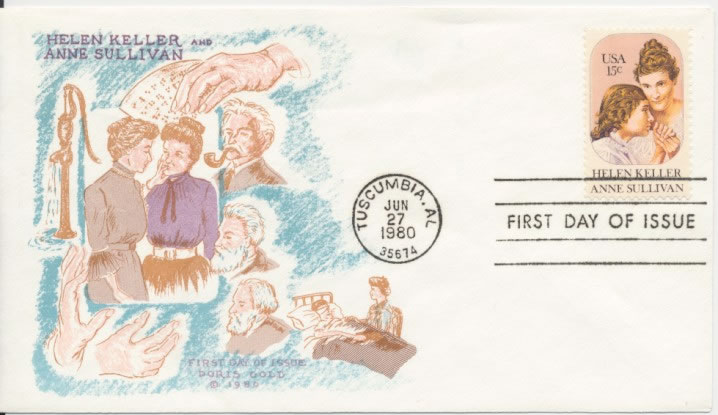
Helen Keller |
Unable to See or HearHelen Adams Keller was born in Tuscumbia, Alabama, in 1880. Her father owned a cotton plantation, and he was an officer in the Confederate Army during the Civil War. She started speaking when she was six months old, and she was able to communicate with her parents. When she was 19 months old, a very high fever left Helen blind and deaf. When she was an adult, both her eyes were replaced with glass eyes for medical and cosmetic reasons. Behavioral ProblemsMartha Washington, the daughter of their family cook, was her friend while she was young. They developed a sort of sign language so they could talk to each other. Helen was bright, but unfortunately, she was also an unruly, spoiled child who disrupted family life with her temper tantrums. Helen Meets Anne SullivanIn 1886, Helen’s mother read a story by Charles Dickens that described how another deaf-blind child named Laura Bridgman had been educated. Alexander Graham Bell taught speech to deaf students using a manual alphabet called “Visible Speech” that was invented by his father. He referred Helen and her parents to the Perkins Institution for the Blind for help. It was there where Helen met Anne Sullivan. They were together for 49 years. Anne Earns Helen's TrustAnne contracted an infection of the eyes called trachoma when she was seven. She was legally blind until she had an operation at age 15 that restored some of her sight. Anne learned the manual alphabet at the Perkins School. Words were signed into the palm of the hand where a deaf-blind person could feel the movement of the fingers. This skill was critical for her success in working with Helen. Anne was loving, patient, and determined. First she taught Helen to behave, then how to spell things with her hands, and then to speak. Helen learned speech by feeling the throats and mouths of others as they spoke. Anne was able to teach Helen to understand finger spelling after she had Helen feel water coming from a pump. Helen described it like this: "I stood still, my whole attention fixed upon the motions of her fingers. Suddenly I felt a misty consciousness as of something forgotten - a thrill of returning thought; and somehow the mystery of language was revealed to me. I knew then that "w-a-t-e-r" meant the wonderful cool something that was flowing over my hand. That living word awakened my soul, gave it light, hope, joy, set it free!" Helen Learns BrailleHelen demanded to know the names of other things. That first day she learned 30 words. After six months, she knew 625. By age 10, she knew the manual alphabet, Braille (an alphabet of raised dots that people can feel), and how to use the typewriter. Helen Graduates from RadcliffeIn 1904, Helen graduated with honors from Radcliffe College. Anne interpreted lessons and spelled out textbooks for her. Helen learned to read French, German, Greek, and Latin in Braille. Because of her accomplishments, Helen became famous. Alexander Graham Bell gave a picture of Helen and one of her letters to a newspaper. People became eager to meet Helen and Anne. Mark Twain called Anne a “miracle worker.” Twain and Keller became friends. Twain introduced her to Henry H. Rogers, an oil executive, who agreed to pay Helen’s expenses at Radcliffe College. Helen was the first deaf-blind person to earn a bachelor of arts degree. Teachings and LegacyHelen was an advocate for women and people with disabilities. She was in favor of women’s right to vote and trade unions; she was against war, child labor, and capital punishment. Helen wrote 12 books including her autobiography, The Story of My Life. She traveled to over 40 countries to lecture on the problems of the blind and the need to prevent the causes of blindness. When she visited Akita Prefecture in Japan, she mentioned that she would like to have an akita dog. Subsequently, the Japanese government gave her an akita as a gift. This is how the akita breed became known to people in the United States. In 1920, she helped found the American Civil Liberties Union. She was presented with the Presidential Medal of Freedom in 1964 and elected to the Women’s Hall of Fame in 1965. Helen devoted her life to helping others. She was a symbol of courage in the face of overwhelming odds. Helen died on June 1, 1968.Discussion Questions
Glossary
Unable to See or HearHelen Adams Keller was born in Tuscumbia, Alabama, in 1880. Her father was a cotton plantation owner and a Civil War officer. At 19 months, Helen became blind and deaf after a high fever. Later, she had glass eyes for medical reasons. Behavioral ProblemsHelen’s friend was Martha Washington, the cook’s daughter. They made their own sign language. Helen was smart but had tantrums and bad behavior. Helen Meets Anne SullivanHelen’s parents asked for help after reading about a deaf-blind girl. Alexander Graham Bell told them to go to the Perkins School for the Blind. There, Helen met Anne Sullivan. They stayed together for 49 years. Anne Earns Helen's TrustAnne lost her vision from a disease called trachoma. She learned a hand alphabet at Perkins and used it to teach Helen. Anne helped Helen behave, spell words, and speak by feeling people’s mouths and throats. Helen Learns BrailleHelen learned her first word—"water"—while feeling it and having it spelled into her hand. She quickly learned more words. By age 10, she knew Braille, sign language, and how to type. Helen Graduates from RadcliffeHelen graduated from Radcliffe College in 1904. She learned many languages in Braille and became famous. Mark Twain introduced her to a sponsor who paid for her college. She was the first deaf-blind person to get a college degree. Teachings and LegacyHelen spoke out for women, workers, and people with disabilities. She wrote 12 books and traveled the world to help the blind. She helped bring the Akita dog to the U.S. and co-founded the ACLU. She received the Presidential Medal of Freedom and died in 1968. |
| Helen Keller Actvities |
|