Rosa Parks

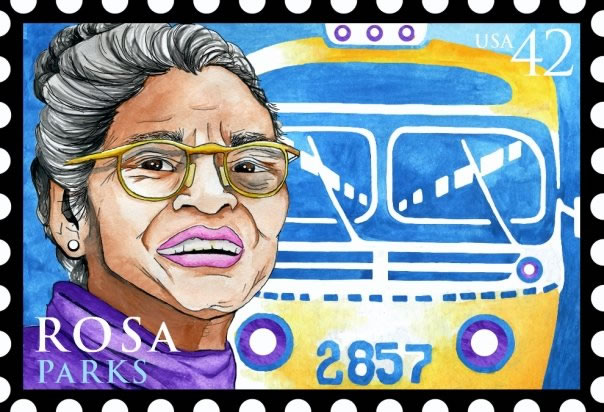
Rosa Parks Postage Stamp

Rosa's Early Years

Rosa Louise McCauley was born February 4, 1913, in Tuskegee, Alabama. Her father was a carpenter, and her mother was a teacher. When she was two, her parents separated. Her family moved to her grandparents’ farm in Pine Level, Alabama. Both her grandparents were former slaves. Pine Level supported the idea of separate but equal. White children rode a bus to their newly built school while African-American children had to walk to a one-room schoolhouse that didn’t have enough desks or supplies. Rosa quit high school when she was a junior to help take care of her grandmother. Afterwards, she worked as a seamstress in a shirt factory in Montgomery. In 1932, Rosa married Raymond Parks. He was a barber who was actively involved in the National Association for the Advancement of Colored People (NAACP).

Arrested for Refusing to Give up her Seat

On December 1, 1955, a bus driver asked Rosa to give her seat on a bus to a white male passenger. She refused. She was arrested and fined $10 plus court costs ($4) for violating a city ordinance that said the bus driver could assign seats. The Montgomery Women’s Political Council printed and circulated a flyer throughout Montgomery’s black community which read as follows:

“Another woman has been arrested and thrown in jail because she refused to get up out of her seat on the bus for a white person … This has to be stopped. Negroes have rights too, for if Negroes did not ride the buses, they could not operate. Three-fourths of the riders are Negro … We are … asking every Negro to stay off the buses Monday in protest of the arrest and trial.”

Montgomery Bus Boycott

This non-violent protest was successful. Dr. Martin Luther King led the Montgomery Improvement Association. They advertised at black churches and asked people to continue the boycott. Ninety percent of Montgomery’s black citizens, estimated to be around 42,000 protesters, walked, carpooled or took cabs. In the beginning, the boycotters were willing to accept a compromise that was consistent with separate but equal rather than asking for complete integration. They asked for courteous treatment by bus operators, first-come, first-served seating on buses, and employment of African American bus drivers.

Unconstitutional!

The boycott lasted 381 days. The bus company lost a lot of money. The United States Supreme Court ruled that the Montgomery segregation law was unconstitutional, and on December 20, 1956, Montgomery officials were ordered to desegregate buses. The bus boycott demonstrated the power of nonviolent mass protest and brought Dr. Martin Luther King to national attention as one of the leaders of the cause. The civil rights movement led to the Civil Rights Act of 1964 – which made it illegal to refuse employment to an individual on the basis of race and made segregation at any public facility against the law.

Later Life

Rosa wrote four books, Rosa Parks: My Story, Quiet Strength, Dear Mrs. Parks: A Dialogue with Today’s Youth and I Am Rosa Parks. At the ceremony where President Bill Clinton presented Mrs. Parks with the Medal of Freedom, she was called “the first lady of civil rights” and “the mother of the freedom movement”. Time Magazine named her one of the 100 most influential people of the 20th century. She died October 24, 2005.

Discussion Questions

  • Why did Rosa Parks refuse to give up her seat?
  • How did the Montgomery Bus Boycott begin?
  • What did the U.S. Supreme Court decide about bus segregation?
  • How did Rosa Parks' actions impact American history?

Glossary

  • Segregation: The separation of people based on race.
  • Boycott: A form of protest where people refuse to use or buy something.
  • NAACP: A civil rights organization fighting for equal rights.
  • Civil Rights Act of 1964: A law that ended segregation and banned job discrimination.

Rosa's Early Years

Rosa Louise McCauley was born on February 4, 1913, in Tuskegee, Alabama. Her father was a carpenter and her mother was a teacher. After her parents separated, Rosa moved with her mother to her grandparents' farm in Pine Level, Alabama. Her grandparents were formerly enslaved. Schools were segregated—white children rode buses to new schools, while Black children walked to old, overcrowded schoolhouses. Rosa left high school early to care for her grandmother and later worked in a shirt factory. In 1932, she married Raymond Parks, a barber active in the NAACP.

Arrested for Refusing to Give Up Her Seat

On December 1, 1955, Rosa Parks refused to give up her bus seat to a white man and was arrested. She was fined $14. In response, a flyer was sent around Montgomery's Black community, asking people to boycott the buses.

Montgomery Bus Boycott

The boycott was peaceful and successful. Dr. Martin Luther King Jr. helped lead the protest. Around 42,000 people stopped using buses. They wanted respectful treatment, fair seating, and jobs for Black bus drivers.

Unconstitutional!

The boycott lasted 381 days. The Supreme Court ruled that bus segregation was illegal. The boycott showed how powerful peaceful protest could be and helped start the civil rights movement. It led to the Civil Rights Act of 1964, which banned segregation and job discrimination.

Later Life

Rosa wrote four books and received the Medal of Freedom from President Bill Clinton. She was called “the first lady of civil rights” and one of the most important people of the 20th century. She passed away in 2005.

Rosa Parks Activities