Early Life
Junípero Serra was born on November 24, 1713, in Petra, on the Spanish island of Mallorca. His birth name was Miquel Josep Serra i Ferrer. As a young boy, he showed a strong interest in religion and education. At the age of 16, he joined the Franciscan order, a group of Catholic friars, and took the name Junípero after one of St. Francis of Assisi’s companions. Serra studied philosophy and theology and later became a teacher at a university in Mallorca.
Journey to the New World
In 1749, Serra left Spain and sailed across the Atlantic Ocean to Mexico. His goal was to spread Christianity to the Native peoples of the Americas. Even though he suffered from poor health and an injured leg that caused him pain for the rest of his life, he traveled hundreds of miles on foot to carry out his work.
Mission Work in California
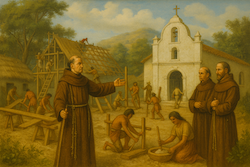
In 1769, Serra helped lead the Spanish effort to settle and Christianize California. He founded the first of many missions at San Diego, which became the starting point of a chain of 21 missions. These missions were religious and farming communities that introduced Spanish culture, language, and Catholic beliefs to Native Americans. Serra personally established nine missions, including San Carlos Borromeo in Carmel, where he made his headquarters.
Legacy and Controversy
Junípero Serra died on August 28, 1784, at Mission San Carlos in Carmel, California. He is remembered as the “Father of the California Missions.” In 2015, he was canonized as a saint by Pope Francis. However, his legacy is debated. While some honor his devotion and accomplishments, others criticize the missions for bringing disease, forced labor, and loss of culture to Native peoples. His story is important for understanding the history of California and the interactions between Europeans and Native Americans.
Discussion Questions
- Why did Junípero Serra travel from Spain to the Americas?
- What was the purpose of the missions he founded in California?
- Why do some people view Serra as a hero while others see him as a controversial figure?
- How did the missions affect Native American communities?
Glossary
- Canonized – Declared a saint by the Catholic Church.
- Franciscan – A member of a Catholic religious order founded by St. Francis of Assisi.
- Mission – A settlement built by religious groups to teach and spread their faith.
- Theology – The study of religion and God.
- Legacy – The lasting impact of a person’s life and actions.
Five Interesting Facts
- Junípero Serra walked thousands of miles despite suffering from a serious leg injury.
- He founded nine missions in California, which later grew into major cities like San Diego and San Francisco.
- Serra was canonized in Washington, D.C., the first saint ceremony held in the United States.
- Mission San Carlos in Carmel is Serra’s burial place.
- Statues of Serra stand in California and in the U.S. Capitol’s Statuary Hall.
Timeline
- 1713 – Born in Petra, Mallorca, Spain.
- 1730 – Joined the Franciscan order.
- 1749 – Sailed to Mexico as a missionary.
- 1769 – Founded the first California mission in San Diego.
- 1784 – Died at Mission San Carlos in Carmel, California.
- 2015 – Canonized as a saint by Pope Francis.