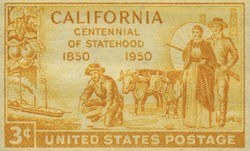
California’s history includes the settlement of Indigenous peoples for thousands of years, followed by Spanish colonization in the 1700s with missions and presidios. In 1848, the discovery of gold sparked the Gold Rush, leading to rapid growth and California’s statehood in 1850.
The Pomo Nation is a Native American people of Northern California, traditionally living around the Russian River, Clear Lake, and the Pacific coast. They are known for their rich cultural traditions, especially their intricate basket weaving, considered among the finest in the world.
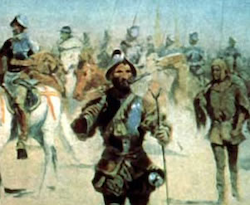
Francisco Coronado was a Spanish explorer who led a major expedition through the American Southwest in search of the legendary Seven Cities of Gold. Although he never found the riches he sought, his journey marked the first European sightings of the Grand Canyon and helped map much of the interior of North America.
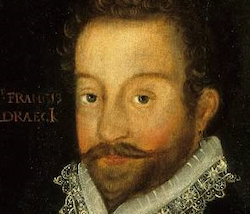
Sir Francis Drake was an English explorer and privateer who became the first Englishman to circumnavigate the globe, plundering Spanish ships and claiming land for England along the way. Celebrated as a hero in England and reviled as a pirate by Spain, he played a key role in defeating the Spanish Armada before dying off the coast of Panama in 1596.
Manifest Destiny was the 19th-century belief that the United States was destined by God to expand its territory across North America. It was used to justify westward expansion, the displacement of Native Americans, and wars such as the Mexican-American War.
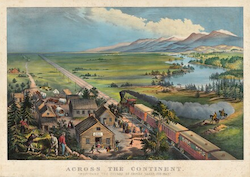
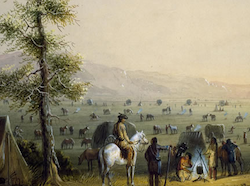
The California Trail was a major overland route used by pioneers in the mid-1800s to reach California during the Gold Rush. Stretching over 2,000 miles, it followed parts of the Oregon Trail before branching off toward the Sierra Nevada.
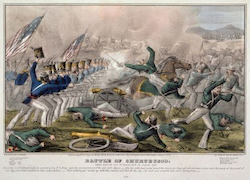
The Mexican-American War (1846–1848) was a conflict between the United States and Mexico following the U.S. annexation of Texas and disputes over the southern border. It ended with the Treaty of Guadalupe Hidalgo, through which the U.S. gained a large portion of the Southwest and established the Rio Grande as the border with Mexico.
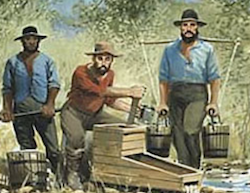
The California Gold Rush began in 1848 when gold was discovered at Sutter’s Mill, drawing hundreds of thousands of people to California in search of fortune. This rapid migration transformed California’s economy and population, eventually leading to its statehood in 1850.
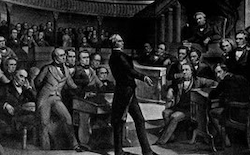
The Compromise of 1850 temporarily eased tensions between free and slave states by balancing interests, but its enforcement of a stricter Fugitive Slave Law angered many in the North. While it delayed secession, the compromise deepened sectional divides and set the stage for future conflicts, making civil war more likely.
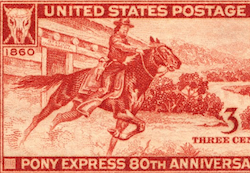
The Pony Express was a fast mail delivery service that operated from April 1860 to October 1861, using a relay of horseback riders to carry mail between Missouri and California in just 10 days. Though short-lived, it played a key role in improving communication across the expanding American frontier.