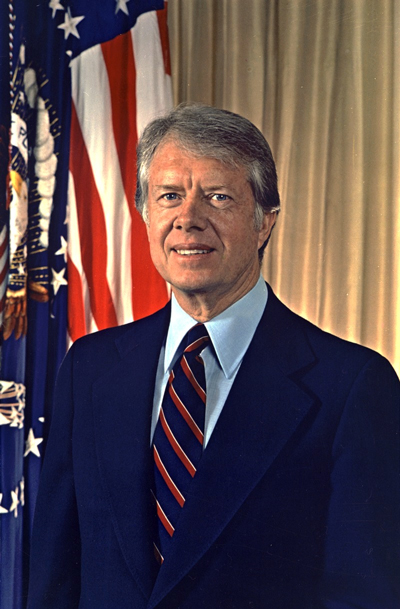
Early Life
James Earl Carter Jr., known as Jimmy Carter, was born on October 1, 1924, in Plains, Georgia. His father was a peanut farmer and small store owner, while his mother was a nurse who worked with African American nurses, an uncommon act for the time. Carter grew up well-mannered and hardworking, helping in his father’s store from age ten. Although he attended an all-white school, two of his best friends were African American, and his parents taught him equality. He became the first in his family to graduate from high school.
United States Naval Academy
After high school, Carter attended a technical school and joined the ROTC at Georgia Tech before entering the U.S. Naval Academy in 1943. He graduated in 1946 in the top 10% of his class and served on submarines. His Navy career took him and his wife to Norfolk, Pearl Harbor, and Washington, D.C., where he worked as an electronics officer.
Governor of Georgia
After leaving the Navy, Carter ran for public office in Georgia, winning a State Senate seat in 1962. Known for his anti-segregation stance, he later ran for governor, losing the first time but winning in a second attempt. His reputation as a progressive leader grew, and after the Watergate scandal, he sought the presidency.
Running for President
Carter entered the 1976 presidential race as an unknown candidate but gained support by promoting honesty and portraying himself as a “common man.” He secured the Democratic nomination and defeated Gerald Ford, becoming the 39th President of the United States.
Policies and Priorities
Carter emphasized energy reform to reduce U.S. dependence on foreign oil and made human rights central to foreign policy. His greatest success was brokering the Camp David Accords between Israel and Egypt in 1978, resulting in a historic peace treaty.

Carter addressing Congress in 1978.
Failure in the Iranian Hostage Crisis
The Iranian Hostage Crisis severely damaged Carter’s presidency. In 1979, Iranian students seized the U.S. embassy in Tehran, holding 66 Americans hostage for 444 days. Carter’s inability to resolve the crisis and a failed rescue mission contributed to his loss to Ronald Reagan in 1980.
Legacy
Despite being seen as a weak president, Carter earned respect for his post-presidential humanitarian work, winning the Nobel Peace Prize in 2002. He is recognized for promoting peace and remains the longest-lived U.S. president. Carter died on December 29, 2024, at the age of 100.
Discussion Questions
- How did Carter’s upbringing influence his views on equality and human rights?
- What role did the Watergate scandal play in Carter’s rise to the presidency?
- Why was the Camp David Accords considered a major achievement for Carter?
- How did the Iranian Hostage Crisis affect Carter’s presidency and reelection chances?
Glossary
- ROTC: Reserve Officers’ Training Corps, a college program for training military officers.
- Camp David Accords: A peace agreement between Israel and Egypt brokered by Carter in 1978.
- Iranian Hostage Crisis: A 444-day standoff where 66 Americans were held hostage in Iran from 1979–1981.
- Humanitarian: A person concerned with promoting human welfare and social reform.
- Watergate Scandal: A political scandal in the 1970s that led to President Nixon’s resignation.
Five Interesting Facts
- Jimmy Carter was the first U.S. president born in a hospital.
- He graduated in the top 10% of his class at the U.S. Naval Academy.
- Carter walked from his inauguration to the White House to show humility.
- He won the Nobel Peace Prize in 2002 for global peace efforts.
- Carter is the longest-lived U.S. president in history.
Timeline of Important Events
- 1924 – Born in Plains, Georgia.
- 1946 – Graduated from the U.S. Naval Academy.
- 1962 – Elected to Georgia State Senate.
- 1970 – Elected Governor of Georgia.
- 1976 – Won the U.S. presidential election.
- 1977 – Inaugurated as 39th President of the United States.
- 1978 – Negotiated Camp David Accords.
- 1979 – Iranian Hostage Crisis began.
- 1980 – Lost reelection to Ronald Reagan.
- 1981 – Hostages released on Carter’s last day in office.
- 2002 – Won the Nobel Peace Prize.
- 2024 - Carter died at the age of 100.
|