Georgia History |
||
|
||
Early Inhabitants and European SettlementIndigenous peoples, including the Creek and Cherokee tribes, lived in the Georgia region for thousands of years before Europeans arrived. The first European settlement, founded by the Spanish in 1566, was later abandoned. In 1732, James Oglethorpe established the colony of Georgia as a refuge for English debtors and as a buffer against Spanish territories in Florida.
Library of Congress video on the founding of Georgia (52 min.) Colonial Era and GrowthIn the 18th century, Georgia developed a slave-based agricultural economy. Though hesitant to support independence, Georgia became the fourth state to ratify the U.S. Constitution after the Revolutionary War. In 1793, Eli Whitney invented the cotton gin in Georgia, which greatly increased the demand for enslaved labor. 19th Century: Secession and Civil WarThe 19th century brought major economic changes, including expanded cotton production and early industrialization. Georgia was one of the first states to secede from the Union. During the Civil War, it suffered severe destruction, especially during Sherman’s March to the Sea in 1864, when Atlanta was burned and Savannah was spared.
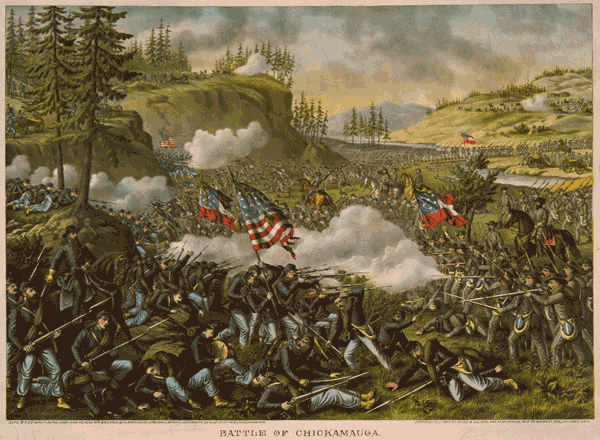
The Battle of Chickamauga in northwest Georgia was one of the deadliest of the Civil War Reconstruction and ModernizationAfter the war, Georgia faced hardship rebuilding its economy and government. Over time, the state industrialized, urbanized, and grew politically and economically. Atlanta became a hub of business and culture. 20th Century and BeyondCivil Rights leader Martin Luther King, Jr. was born in Atlanta in 1929. In 1996, Atlanta hosted the Summer Olympics. Today, Georgia boasts a dynamic economy, major industries, cultural attractions, and the world’s busiest airport. Its history remains a central part of its identity. Discussion Questions
Glossary
Georgia History Timeline
Early Settlement and Colonial GrowthThe Creek and Cherokee tribes lived in Georgia long before Europeans arrived. The Spanish built the first settlement in 1566, but it was abandoned. In 1732, James Oglethorpe founded Georgia as a refuge for debtors and a barrier against Spanish Florida. The colony’s economy grew on slave labor, and Georgia became the fourth state to ratify the U.S. Constitution. Eli Whitney’s invention of the cotton gin in 1793 increased cotton production and expanded slavery. Civil War and ReconstructionGeorgia prospered in the 19th century with agriculture and industry but joined the Confederacy during the Civil War. In 1864, Sherman’s March to the Sea destroyed Atlanta and much of Georgia. After the war, the state rebuilt and industrialized, with Atlanta becoming a major city. Modern GeorgiaMartin Luther King, Jr. was born in Atlanta in 1929, making Georgia central to the Civil Rights Movement. In 1996, Atlanta hosted the Summer Olympics. Today, Georgia is an economic powerhouse, home to cultural landmarks and the world’s busiest airport. |