Early Life in Slavery
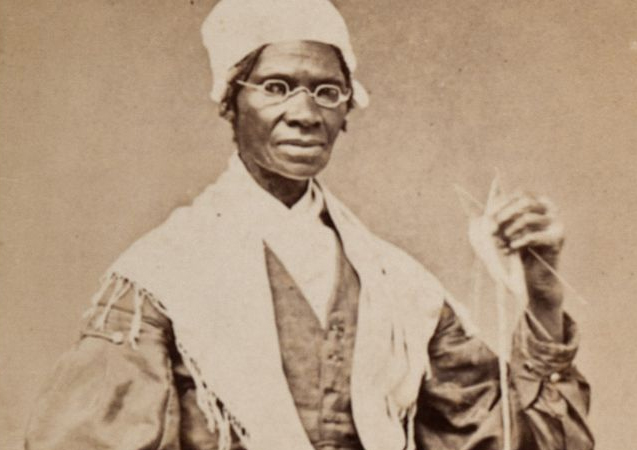
Sojourner Truth was born into slavery in 1797 in Ulster County, New York. Her birth name was Isabella Baumfree. As a child and young woman, she was sold several times from one slaveholder to another. In 1810, she was sold to the Dumont family, where she suffered terrible cruelty and hardship.
Freedom and Faith
In 1826, just one year before slavery was officially abolished in New York, Isabella escaped from the Dumont estate with her infant daughter. She found shelter with Isaac and Maria Van Wagenen, who treated her kindly. It was during this time that she had a powerful religious experience and became a devout Christian. On June 1, 1843, she became a Methodist and changed her name to Sojourner Truth, saying that God had called her to travel and speak the truth.
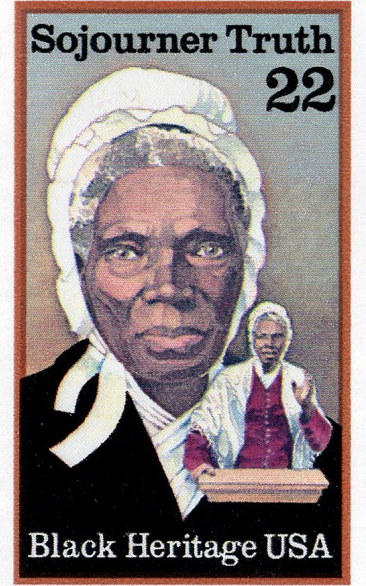
Sojourner Truth Postage Stamp
Becoming a Public Speaker
Truth eventually moved to Massachusetts, where she met important abolitionists and women's rights leaders like William Lloyd Garrison and Frederick Douglass. Garrison was so impressed by her story that he published her autobiography, *The Narrative of Sojourner Truth: A Northern Slave*. That same year, she spoke at the first National Women’s Rights Conference in Worcester, Massachusetts. In 1851, she gave her most famous speech, now called "Ain't I a Woman," at the Ohio Women’s Rights Convention. Her powerful presence and speech made a lasting impression on everyone there, though her exact words remain debated.
Fighting for Equality
Sojourner Truth became known for her strong, passionate speeches about slavery and women's rights. She spoke to audiences all over the country. During the Civil War, she helped recruit black soldiers for the Union Army. Later, she moved to Michigan, where she worked to help formerly enslaved people build new lives.
Legacy and Honors
Sojourner Truth died on November 26, 1883, in Battle Creek, Michigan. In 1999, a 12-foot statue of her was unveiled in Battle Creek's Monument Park. In honor of her legacy, it was announced that Sojourner Truth would appear on the back of the United States $10 bill in 2020, the 100th anniversary of the 19th Amendment, which granted American women the right to vote.
|
Discussion Questions
- Why did Isabella Baumfree change her name to Sojourner Truth?
- How did Sojourner Truth use religion to guide her life and mission?
- What was the impact of her speech "Ain't I a Woman"?
- How did Sojourner Truth continue to fight for freedom after slavery was abolished?
Glossary
- Abolitionist – A person who worked to end slavery in the United States.
- Suffragist – Someone who fought for the right to vote, especially for women.
- Autobiography – A book a person writes about their own life.
- Methodist – A member of a Christian group known for simple worship and helping others.
- Union Army – The army that fought for the northern states during the American Civil War.
Born into Slavery
Sojourner Truth was born in 1797 in New York as Isabella Baumfree. She was enslaved and sold to several different families. In 1826, she escaped slavery with her baby daughter, just before slavery ended in New York.
Finding Her Faith
After gaining freedom, she lived with the Van Wagenen family. There, she became deeply religious. In 1843, she became a Methodist and changed her name to Sojourner Truth. She believed God told her to speak the truth and spread hope.
A Voice for Justice
Truth moved to Massachusetts and worked with famous leaders like Frederick Douglass and William Lloyd Garrison. She gave speeches on slavery and women’s rights. Her most famous speech, "Ain’t I a Woman," was given in 1851 and made a strong case for equality.
Lasting Impact
During the Civil War, she helped recruit black soldiers. Later, she moved to Michigan and continued fighting for the rights of formerly enslaved people. She died in 1883. In her honor, a statue was built in Battle Creek, and she was chosen to appear on the U.S. $10 bill in 2020.
|