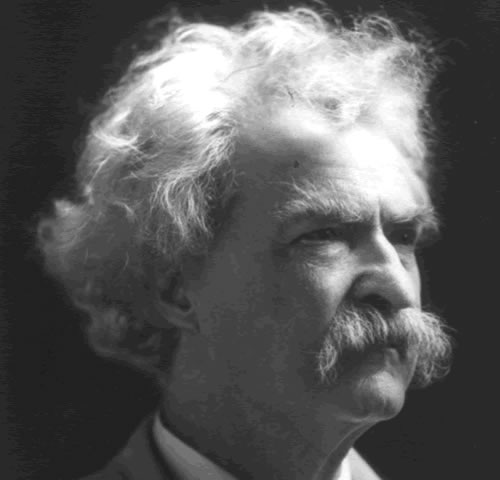
Mark Twain

Mark Twain

Early Life and Origins

Mark Twain was born on November 30, 1835 in Hannibal, Missouri as Samuel Langhorne Clemens. Mark Twain would become his "pen name" later on in his life. When he was four, he moved with his family to Hannibal, Missouri. Hannibal, located on the Mississippi River, would serve as a fictional town in his most famous books, The Adventures of Tom Sawyer, and The Adventures of Huckleberry Finn.

Early Career and the Birth of "Mark Twain"

When Samuel turned 18, he left Hannibal and worked as a printer in New York, Philadelphia, St. Louis and Cincinnati. Four years later, he returned to Hannibal and worked as a riverboat pilot. For some time after the Civil War, Samuel worked as a miner in the town of Virginia City, Nevada. Although he hoped to find gold in Nevada, his efforts ultimately failed. Nevertheless, he did earn his first writing job at the Daily Territorial Enterprise, a newspaper in Virginia City. It was here, in 1863, that Samuel adopted the pen name Mark Twain.

Literary Success and Iconic Works

Mark Twain would soon become one of the greatest authors in American history. In 1876, he published The Adventures of Tom Sawyer, a story about the adventures of a young boy and his friend, Huckleberry Finn in St. Petersburg, Missouri. The most well-known scene in the story depicts how Tom tricked his neighborhood playmates into whitewashing (painting) a fence that he was assigned to by his Aunt Polly. Tom convinces the boys that the whitewashing is so enjoyable that they actually trade him apples and other items just to participate.

In 1889 Twain published The Adventures of Huckleberry Finn, which is considered by many to be a sequel to The Adventures of Tom Sawyer. Many consider The Adventures of Huckleberry Finn as Twain's greatest literary accomplishment, as it magically depicts life along the Mississippi River in the 1800s and illustrates the racist attitudes of the time. The story centers around Huckleberry Finn and his friend, Jim, a runaway slave who escape together on a raft heading north, and then south on the Mississippi River.

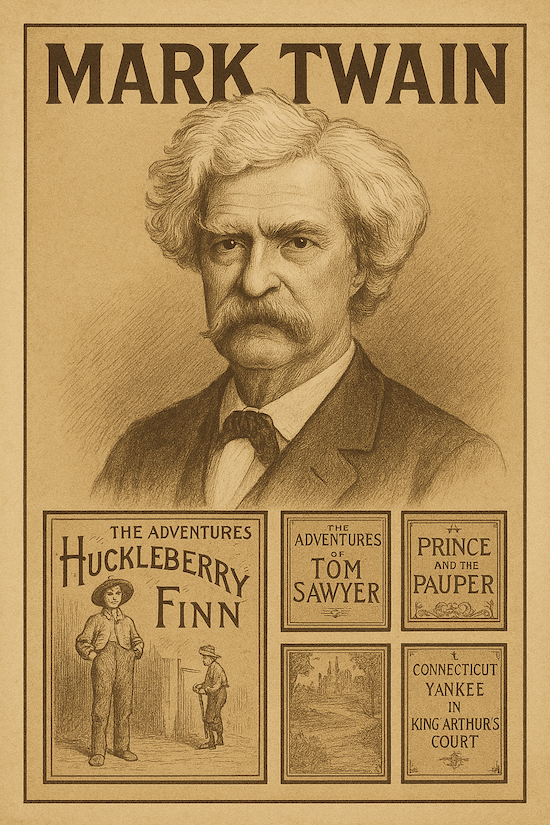
The Adventures of Huckleberry Finn was one of the first published novels that featured colloquial speech, or, words, expressions, and statements used only by residents of a particular geographic location. Twain also authored several other famous works including The Prince and the Pauper (1882), and A Connecticut Yankee in King Arthur's Court (1889).

Mark Twain Infographic

Legacy and Personal Life

Mark Twain remained a colorful character well into his entire life. He was involved in several societies, leagues, and clubs including the American Anti-Imperialist League, an organization that was opposed to America's annexation of The Philippines after the Spanish-American War. He was also a member of the Bohemian Club, a secret club for powerful world leaders.

In addition, he was the author of many famous epigrams (sayings) such as "A man is never more truthful than when he acknowledges himself a liar." and "A habit cannot be thrown out the window, it must be coaxed down the stairs one step at a time." Before his death, Twain was one of the most famous celebrities in the country. Mark Twain died in 1910.

Modern Legacy and Memorials

Today, the Mark Twain Boyhood Home and Museum, located in Hannibal, is one of Missouri's most popular museums. Visitors can explore the Mark Twain Cave and take a riverboat ride down the Mississippi River. The legendary whitewashed fence painted by the fictional character Tom Sawyer borders the property.

Discussion Questions

  1. Why do you think Mark Twain chose to use a pen name instead of his real name?
  2. How did Twain’s childhood in Hannibal influence the stories he wrote?
  3. What makes The Adventures of Huckleberry Finn a significant book in American literature?
  4. How did Twain use humor and satire to comment on the social issues of his time?

Glossary

  • Pen name – A name used by an author instead of their real name.
  • Colloquial speech – Informal language or expressions used in everyday conversation, often specific to a region.
  • Riverboat pilot – A person who navigates boats along rivers, especially important before trains and cars were common.
  • Epigram – A short, clever saying that expresses an idea in a witty way.
  • Anti-Imperialist – Opposed to a country expanding its power and control over other territories or countries.

Early Life

Mark Twain was born as Samuel Langhorne Clemens on November 30, 1835, in Hannibal, Missouri. When he was four years old, his family moved to Hannibal, a town on the Mississippi River. Later in life, Samuel used the name "Mark Twain" when he became a writer. Hannibal inspired the setting for his famous books, The Adventures of Tom Sawyer and The Adventures of Huckleberry Finn.

Jobs and the Name Mark Twain

At age 18, Samuel left home and worked as a printer in big cities like New York and Philadelphia. He later returned to Hannibal and became a riverboat pilot on the Mississippi River. After the Civil War, he went to Nevada to search for gold, but he didn’t find any. Instead, he got a job at a newspaper in Virginia City. In 1863, he started using the pen name "Mark Twain."

Famous Books

Mark Twain became one of America’s most well-known authors. In 1876, he wrote The Adventures of Tom Sawyer, a story about a boy named Tom and his friend Huck. One famous scene shows Tom tricking his friends into painting a fence for him.

In 1889, Twain published The Adventures of Huckleberry Finn. Many people see this book as a follow-up to Tom Sawyer. It tells the story of Huck and Jim, a runaway slave, who travel on a raft down the Mississippi River. The book uses everyday speech from the time and place it was set, making it feel real and honest.

Twain also wrote other books like The Prince and the Pauper and A Connecticut Yankee in King Arthur’s Court.

Later Life and Legacy

Mark Twain was not just a writer. He joined groups like the American Anti-Imperialist League, which did not support the U.S. taking control of the Philippines. He was also in the Bohemian Club, a secret group of leaders.

Twain was known for his clever sayings, like “A man is never more truthful than when he acknowledges himself a liar.” He became one of the most famous people in the country and died in 1910.

Mark Twain Today

Today, people visit the Mark Twain Boyhood Home and Museum in Hannibal, Missouri. They can see the famous whitewashed fence from his books, explore Mark Twain Cave, and take a boat ride on the Mississippi River.