 |
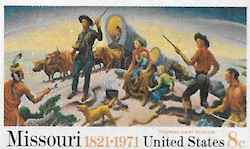
The History of Missouri
Missouri became the 24th state in 1821 as part of the Missouri Compromise, which aimed to balance the number of free and slave states in the Union. Its strategic location along the Mississippi River made it a key battleground during the Civil War, with divided loyalties among its residents. |
|
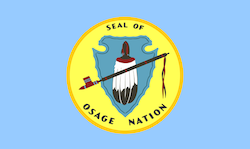 |
Osage Nation
The Osage people, originally from the Ohio Valley, migrated west and became known as powerful hunters and farmers in the central United States. They developed a rich cultural and spiritual life centered on harmony, clan structure, and ceremonies honoring nature and their creator, Wakonda. |
|
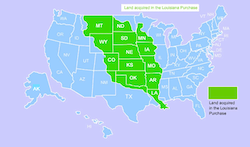 |
Louisiana Purchase
The Louisiana Purchase was a land deal in 1803 where the United States bought a large area of land from France. This purchase doubled the size of the U.S. and included land that would become all or part of 15 states, including Nebraska. |
|
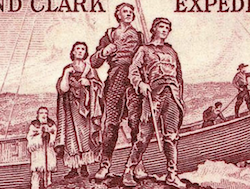 |
Lewis and Clark Expedition
The Lewis and Clark Expedition, led by Meriwether Lewis and William Clark from 1804 to 1806, was a journey to explore the newly acquired Louisiana Territory and find a water route to the Pacific Ocean. Their expedition provided valuable maps, scientific data, and strengthened American claims to the western lands. |
|
 |
The Missouri Compromise
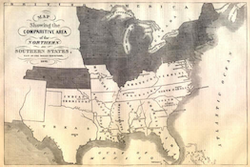
The Missouri Compromise of 1820 temporarily resolved the issue of slavery's expansion by admitting Missouri as a slave state and Maine as a free state, while banning slavery in new territories north of 36° 30' latitude. However, it highlighted the deepening sectional divide between the North and South, setting the stage for further conflict over slavery. |
|
 |
Manifest Destiny
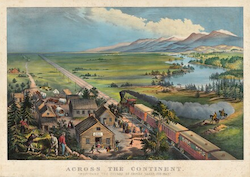
Manifest Destiny was the 19th-century belief that the United States was destined by God to expand its territory across North America. It was used to justify westward expansion, the displacement of Native Americans, and wars such as the Mexican-American War. |
|
 |
Westward Trails Interactive Tours
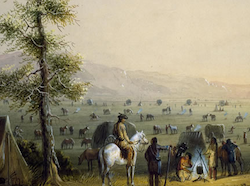
Several of the famed westward trails began in Independence, Missouri.
Oregon | California | Mormon | Santa Fe |
|
 |
Pony Express
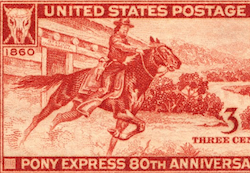
The Pony Express was a fast mail delivery service that operated from April 1860 to October 1861, using a relay of horseback riders to carry mail between Missouri and California in just 10 days. Though short-lived, it played a key role in improving communication across the expanding American frontier. |
|
 |
Bleeding Kansas and the Pottawatomie Massacre
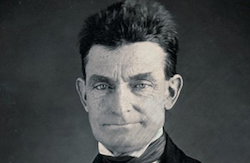
The Pottawatomie Massacre, led by abolitionist John Brown in 1856, involved the brutal killing of five pro-slavery settlers in Kansas. This violent act deepened the hostility between North and South, contributing to the growing unrest that eventually led to the Civil War. |
|
 |
The Border States
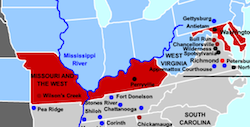
The Border States—Delaware, Maryland, Kentucky, and Missouri—were crucial to the Civil War because they provided vital resources, strategic locations, and large populations with divided loyalties. Their decision to remain in the Union helped prevent the Confederacy from gaining a significant military and political advantage.
|
|