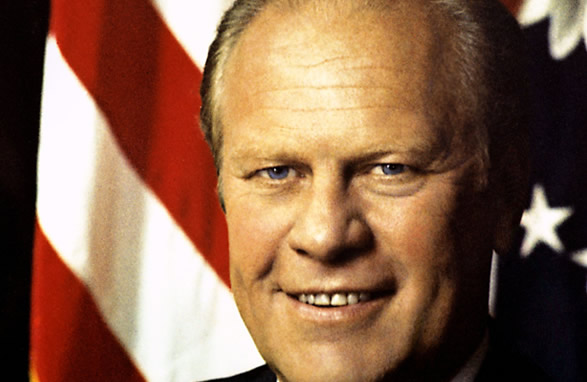
Gerald R. Ford |
|
He Could Have Been an NFL Star!Gerald Ford, originally Leslie Lynch King, Jr., was born on July 14, 1913, in Omaha, Nebraska. Ford’s parents separated about two weeks after his birth and his mother took him to Grand Rapids, Michigan, where she soon married a man named Gerald Ford. Leslie's mother decided to change his name from Leslie Lynch King, Jr., to Gerald Ford, Jr., after her new husband. As a child, Gerald was very athletic and became a star football player in high school, eventually landing a spot on the University of Michigan varsity football team. While at Michigan, Ford not only won a national championship in football, but he majored in economics as well as political science, graduating in 1935. After he graduated from Michigan, Ford turned down NFL contracts from the Detroit Lions and the Green Bay Packers to attend Yale Law School where he coached football and boxing to help pay for tuition. Ford received his LL.B. degree from Yale in 1941 and returned home to Grand Rapids to open his own firm with Philip A. Buchen, who would later serve as his White House Counsel. Ford also served in the military, joining the Naval Reserves after the United States entered World War II. While in the military, Ford saw significant action in the South Pacific and nearly tumbled overboard on one occasion while on the ship he was stationed on. Ford was honorably discharged in 1946, earning several war medals, including the World War II Victory Medal.
Simulated Gerald R. Ford Football Card Nixon's Resignation Leads to Ford's PresidencyFord made his political debut in 1948, quietly running for Congress and pulling off an upset over the five-term incumbent, Barney Jonkman. Ford was able to serve twelve successive terms while participating in important committees such as the Appropriations Committee. The Appropriations Committee determines how the United States government spends money. While in Congress, Ford became extremely popular among his fellow Republicans, including Dwight Eisenhower and Richard Nixon, but was also commended for his ability to reach across party lines and work with Democrats. The Republican Party suffered major losses in 1962 and 1964, which provided young, fresh Republicans, like Ford, the opportunity to shine. Ford was named Chairman of the Republican Conference in 1963, and in 1965, he was named the House Minority Leader, making him the highest-ranking Republican in the House of Representatives. During the Lyndon Johnson presidency, Ford spoke out frequently against Johnson's Great Society programs and how Johnson was handling the Vietnam War. After Johnson decided against running for the presidency in 1968, Ford became a major supporter of Richard Nixon and his successful bid for the White House. This support helped these two men become extremely close. Nixon also won the 1972 election but was quickly engulfed in the Watergate scandal that would lead to a major FBI investigation. In a plea bargain, Nixon's then vice president, Spiro Agnew, resigned from office in 1973 to avoid prosecution for accepting bribes as vice president and governor of Maryland. Nixon subsequently chose Gerald Ford to serve as his new vice president. Ford served as vice president for eight months before the pressure of the Watergate scandal forced Richard Nixon to resign from the presidency in 1974. Gerald R. Ford would become America's 38th president. Unpopular DecisionsShortly after assuming the role of president, Ford pardoned Nixon for any crimes he may have committed, which meant he would never have to face criminal charges for the Watergate scandal. This move was a very controversial one as many Americans wanted to see Nixon brought to justice for his crimes. During his presidency, Ford faced high unemployment and high inflation, which made him extremely unpopular amongst Republicans and Democrats alike. Ford was seen as a large, clumsy man due to his stature, but he is credited with being the man who restored some confidence in the White House after the Watergate scandal. In 1976, Ford decided to run for reelection. Although Ford was able to secure the Republican nomination, he was eventually defeated by Jimmy Carter. Discussion Questions
Glossary
Who Was Gerald Ford?Gerald Ford was born on July 14, 1913, in Omaha, Nebraska. His parents separated soon after he was born, and he moved with his mother to Grand Rapids, Michigan. She got married again, and her new husband adopted Gerald. His name was changed from Leslie Lynch King, Jr. to Gerald R. Ford, Jr. Ford was a great athlete. He played football in high school and at the University of Michigan. He was so good that he got offers to play in the NFL. But instead of playing football, he went to Yale Law School. While there, he coached football and boxing to help pay for school. He became a lawyer in 1941. When World War II started, Ford joined the Navy. He served in the South Pacific and earned medals for his service. He came home in 1946. In 1948, Ford ran for Congress and won. He worked hard and became well liked by both Republicans and Democrats. In 1965, he became the leader of the Republicans in the House of Representatives. He supported President Richard Nixon. When Nixon’s vice president quit in 1973, Ford was picked to replace him. In 1974, Nixon resigned because of the Watergate scandal. That made Gerald Ford the new president. One of the first things he did was pardon Nixon, which made many people upset. Ford also had to deal with big problems like high prices and people losing jobs. He lost the next election to Jimmy Carter in 1976. Gerald Ford is remembered as a kind and honest man who became president at a very hard time for the country. |