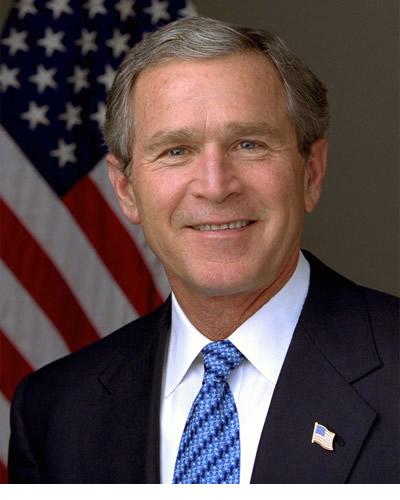
George W. Bush |
Early LifeGeorge W. Bush was born on July 6, 1946, in New Haven, Connecticut. His parents, George H.W. and Barbara Bush, accumulated a great deal of wealth when they moved to Midland, Texas, and began working in the oil industry. George H.W. Bush spent much of his life in business and politics, serving as Vice President and President of the United States. In school, the younger George played multiple sports and was known for being a good all-around athlete. Academically, however, George was average or even below average, causing his parents to worry that he would not be offered admission into an elite university. Because of his family ties, however, Bush was able to matriculate into Yale University. At Yale, Bush spent most of his time socializing rather than studying but was still able to become a part of the Skull and Bones Society, a club whose membership contains some of America’s most powerful people. Two weeks before graduation, he enlisted in the Texas Air National Guard, earning his fighter pilot certification during the height of the Vietnam War. Bush served for a few years and was honorably discharged in 1974. After he left the military, he enrolled in Harvard Business School and began working for a Texas oil firm, where he became wealthy. The Governor of TexasIn 1988, Bush moved his family to Washington DC to help his father on the campaign trail while he was running for president. After his father won the White House, he returned to Texas and led a group of investors who bought the Texas Rangers baseball team. After his father lost his bid for reelection in 1992 to Bill Clinton, George W. Bush decided to run for governor of Texas. Bush was able to win this election in 1994 largely in part to his family name and his popularity from owning the Texas Rangers. As governor, Bush earned a high approval rating, largely because he was able to appeal to both Republicans and Democrats. As his political prospects improved, Bush decided to make a run for the White House in 1999. One of the Most Controversial ElectionsThe 2000 presidential election between George W. Bush and Al Gore would be one of the most highly contested elections in American history. As Election Day unfolded, there was no clear winner. By early the next morning, Bush had 246 electoral votes and Gore had 255, with 270 needed to win. Florida's twenty-five electoral votes were held in the balance as several counties in the state reported problems with balloting. Whichever candidate won Florida would win the election and become president. After more than a month of recounts and legal proceedings, the US Supreme Court decided the election result, giving George Bush the victory. Though Gore lost the election in the electoral college (271 to 266), he received a higher number of popular votes, which only added to the controversy. The September 11 Terrorist AttacksDuring Bush's first term, he faced a terrorist attack on American soil, known as 9/11. On September 11, 2001, Al Qaeda terrorists hijacked four US airplanes that struck the World Trade Center in New York City, the Pentagon outside of Washington, DC, and a field in western Pennsylvania, which may have been headed to the White House or US Capitol Building. Bush promised the American people that he would respond appropriately and his first post-9/11 action was creating the Patriot Act, which allowed the US government to monitor the activity of any suspected terrorists. Bush also created the Department of Homeland Security that was meant to gather intelligence about terrorists and any possible terrorist attacks. In September 2002, the Bush administration announced that the United States would use military force if necessary to prevent threats to its national security by terrorists or "rogue states," especially those that possessed weapons of mass destruction. Based on what would prove to be questionable intelligence reports, the Bush administration successfully obtained a UN Security Council resolution to return weapons inspectors to Iraq. Soon, Bush announced Iraq's noncompliance with the sanctioned inspections, and on March 20, 2003, the United States launched a successful invasion of Iraq, quickly defeating the Iraqi military. Baghdad, the Iraqi capital, fell on April 9, 2003, and Bush declared an end to major combat operations on May 1, 2003. This conflict came to be known as Operation Iraqi Freedom. Questionable LegacyBush was able to win reelection in 2004, defeating Democrat John Kerry. Bush saw great pushback by conservatives when he tried to implement social security reform. In August of 2004, the city of New Orleans was largely destroyed by Hurricane Katrina. The images of thousands of people on rooftops awaiting rescue, and the government's perceived inadequate response, contributed to Bush's declining approval rating. In addition, Bush increased military spending and implemented tax cuts that drained the budget surplus left by Bill Clinton. By 2008, the United States was faced with high unemployment and a credit crisis. By the end of his second term, it was clear George W. Bush would not be remembered as one of America's great presidents. Historians rank him 34th among the 46 ranked presidents. Early LifeGeorge W. Bush was born on July 6, 1946, in New Haven, Connecticut. His family later moved to Midland, Texas, where his father, George H.W. Bush, found success in the oil business and later became President of the United States. George W. Bush was active in sports but had average grades in school. Despite this, he attended Yale University, mostly due to family connections. At Yale, he joined the secret Skull and Bones Society. After graduation, Bush joined the Texas Air National Guard during the Vietnam War and became a fighter pilot. Later, he attended Harvard Business School and became wealthy working in the Texas oil industry. Governor of TexasIn 1988, Bush helped his father’s presidential campaign, then returned to Texas and helped buy the Texas Rangers baseball team. In 1994, he ran for governor of Texas and won. As governor, he gained support from both Republicans and Democrats. With growing popularity, Bush decided to run for president in 1999. The 2000 ElectionThe election between George W. Bush and Al Gore in 2000 was one of the most controversial in U.S. history. The result came down to Florida, where ballot problems caused recounts and legal battles. The U.S. Supreme Court ended the recount and declared Bush the winner, even though Gore had more total votes. Bush became the 43rd President of the United States. 9/11 and the Iraq WarOn September 11, 2001, terrorists attacked the U.S. Bush responded with the Patriot Act and created the Department of Homeland Security. He also announced that America would act against threats from terrorists and countries with weapons of mass destruction. In 2003, the U.S. invaded Iraq, claiming Iraq had such weapons. Though Baghdad fell quickly, the war lasted many years and became very controversial. Second Term and LegacyBush won reelection in 2004. During his second term, he faced many problems. Hurricane Katrina hit New Orleans in 2005, and the government's slow response hurt Bush’s image. His tax cuts and increased military spending led to budget problems. By 2008, the U.S. had high unemployment and a credit crisis. Historians later ranked Bush near the bottom of all presidents, showing how mixed opinions were about his leadership. Discussion Questions
Glossary
Early LifeGeorge W. Bush was born in 1946 in Connecticut but grew up in Texas. His father became president. George was average in school but got into Yale University because of his family. He later joined the Air National Guard and became a pilot. He went to Harvard for business school and made money in the oil business. Governor of TexasIn 1988, Bush helped his father’s campaign, then bought part of the Texas Rangers baseball team. In 1994, he became governor of Texas and was popular with many people. He decided to run for president in 1999. The 2000 ElectionThe election between Bush and Al Gore was very close. The winner depended on Florida, but problems with votes caused a long delay. The U.S. Supreme Court ended the counting and Bush became president, even though Gore got more votes nationwide. 9/11 and the Iraq WarIn 2001, terrorists attacked the U.S. Bush created new security laws and started a war in Iraq, saying Iraq had dangerous weapons. The U.S. quickly won the first battle, but the war continued for many years and caused debate. Second Term and LegacyBush was reelected in 2004. In 2005, Hurricane Katrina caused major damage, and many people felt the government did not respond well. By 2008, the economy was in trouble. Bush left office with low approval, and historians ranked him low among U.S. presidents. |