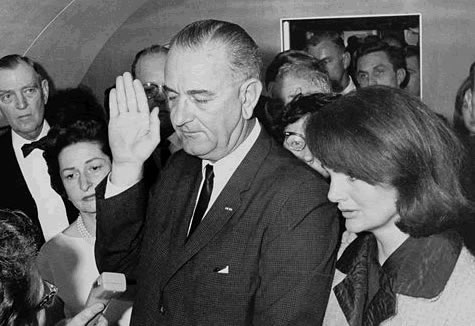
Lyndon B. Johnson |
Youngest Senate Minorty and Majority LeaderLyndon Baines Johnson was born in 1908 in Stonewall, Texas. He grew up relatively poor and worked his way through Southwest Texas State Teacher's College. After spending time teaching students of Mexican descent, he became interested in politics and successfully campaigned for the House of Representatives with the help of his wife, Lady Bird Johnson, in 1937. Johnson served six terms in the House of Representatives and spent time as a lieutenant commander during World War II. In 1948, he was elected to the Senate and soon became the youngest minority leader in Senate history. He then became the youngest majority leader. Ascension to PresidencyKnown as a master manipulator of Congress, he helped President Eisenhower gain passage of several key bills. In 1960, John F. Kennedy chose him to be his running mate in his presidential campaign. On November 22, 1963, President Kennedy was assassinated, and Johnson was sworn in as America’s 36th president. "Great Society" and the Onset of the Vietnam WarDuring his presidency, Johnson successfully advocated a tax cut for the public and a new Civil Rights Bill. He also spoke to the populace of a “Great Society” in which the meaning of life and the “marvels” of man’s labor were one and the same. In 1964, Johnson was reelected by the widest margin in American history. Johnson’s next term included improvements to the education system and social security, measures to reverse widespread poverty, disease, and crime, as well as measures to facilitate foreign relations and conservation. Johnson’s second term, however, was plagued by the escalating situation in Vietnam, which soon became the Vietnam War. Despite his popularity, Johnson decided not to run for a third term as president so he could devote all of his time to establishing peace. Lyndon B. Johnson: Youngest Senate Leader and PresidentLyndon Baines Johnson was born in 1908 in Stonewall, Texas. He grew up in a poor family and had to work hard to pay for college. He attended Southwest Texas State Teacher’s College and later became a teacher for children of Mexican descent. His experiences in the classroom sparked his interest in politics. In 1937, with the support of his wife, Lady Bird Johnson, he successfully ran for the U.S. House of Representatives. Johnson served six terms in the House and briefly joined the Navy during World War II as a lieutenant commander. In 1948, he won a seat in the U.S. Senate. He quickly rose to power and became the youngest minority leader in Senate history. Not long after, he became the youngest majority leader as well. Johnson earned a reputation as a skilled negotiator and was known for working well with both Democrats and Republicans. Becoming President After TragedyIn 1960, John F. Kennedy chose Johnson to be his vice president. When President Kennedy was assassinated in 1963, Johnson became the 36th president of the United States. As president, he worked to pass laws that would benefit the American people. One of his first major successes was pushing for a tax cut and a new Civil Rights Bill. The "Great Society"Johnson shared a vision of America he called the “Great Society.” He wanted to improve life for all citizens by fighting poverty, increasing access to education, and expanding healthcare. He won the 1964 election in a landslide and continued his work by creating new laws to help people with low incomes, protect the environment, and support schools. The Vietnam War and RetirementUnfortunately, the Vietnam War became a major problem during Johnson’s second term. Even though he passed many helpful laws, the war made him less popular. He chose not to run for president again in 1968 so he could focus on trying to bring peace to Vietnam. Johnson left office in 1969 and passed away a few years later. Discussion Questions
Glossary
Early Life and PoliticsLyndon B. Johnson was born in Texas in 1908. He grew up poor and worked his way through college. He became a teacher, then went into politics. In 1937, he was elected to the House of Representatives. He served in the Navy during World War II and was elected to the Senate in 1948. Johnson became the youngest minority and majority leader in Senate history. Becoming PresidentIn 1960, he became vice president under John F. Kennedy. When Kennedy was killed in 1963, Johnson became president. He passed a tax cut and a Civil Rights Bill. The Great SocietyHe spoke about a “Great Society” where life was better for everyone. He worked to improve schools, fight poverty, and help the environment. He won the 1964 election easily. Vietnam War and RetirementBut the Vietnam War became a big problem. Many people disagreed with how it was handled. Johnson did not run again in 1968 so he could focus on peace. He left office in 1969. |