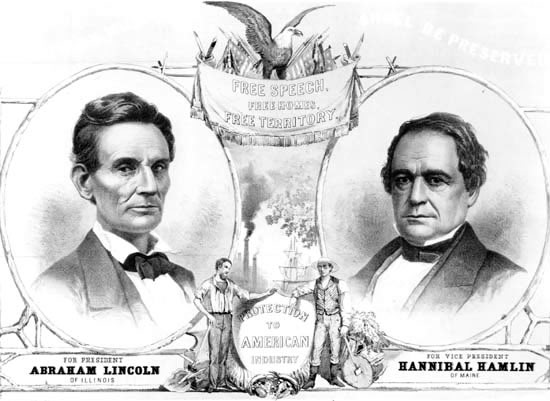
Election of 1860

Election of 1860 

 By 1860, the United States was in the midst of serious political turmoil. The issue of slavery threatened to rip the nation apart. The 1860 presidential election was THE critical issue. The Democratic Party had been split into two factions, the Northern Democrats and the Southern Democrats. The Northern Democrats nominated Stephen A. Douglas from Illinois for president, and the Southern Democrats nominated John C. Breckinridge from Kentucky. Douglas would become the first presidential candidate to "campaign," by embarking on a national speaking tour. The newly formed anti-slavery Republican Party nominated Abraham Lincoln, a Representative from Illinois, legendary for his oratory. Lincoln won the nomination over three more well-known candidates, William Seward, Salmon P. Chase and Edward Bates (all of whom would become members of his cabinet). The Constitutional Union Party nominated John Bell from Tennessee.

Learn more about the Partisan Politics of the Civil War Era

On November 6, 1860, Abraham Lincoln was officially elected as president, despite the fact that he wasn't even listed on the ballot in nine southern states. Because the bulk of the voting population lived in the Northern states, those states had higher electoral values. Lincoln won the three states with the highest electoral values, New York, Pennsylvania, and Ohio. He won 17 states in all. John C. Breckinridge won every southern state except Virginia and Tennessee. Those states were won by John Bell. The election of 1860 turned out to be the second highest on record in terms of voter turnout. The results of the election brought the country to Civil War. South Carolina, whose voters believed that a Republican president would restrict slavery in the new territories, and then attempt to prohibit it completely, supported secession. They believed slavery was an American "institution," and that their agricultural economy would collapse without it. On December 20, 1860, South Carolina issued a Declaration of Secession from the United States. Ten other states would follow its lead within a few months. The new President had a mighty task of preserving a fractured Union. War was the only way.

Discussion Questions

  1. Why did the Democratic Party split into Northern and Southern factions, and how did this affect the outcome of the 1860 election?
  2. How did Abraham Lincoln manage to win the presidency without being on the ballot in many Southern states?
  3. Why did Southern states see Lincoln’s election as a threat to their way of life and economy?
  4. Do you think the Civil War could have been avoided after the 1860 election? Why or why not?

A Divided Nation

By 1860, the United States was deeply divided over the issue of slavery. The country was in serious political trouble, and the 1860 presidential election became a major turning point.

The Candidates

The Democratic Party split in two. Northern Democrats chose Stephen A. Douglas from Illinois, and Southern Democrats picked John C. Breckinridge from Kentucky. Douglas became the first presidential candidate to campaign by traveling and giving speeches across the country.

The new Republican Party, which opposed the spread of slavery, nominated Abraham Lincoln from Illinois. Lincoln was a great speaker and won the nomination over better-known men like William Seward, Salmon P. Chase, and Edward Bates. The Constitutional Union Party nominated John Bell from Tennessee.

The Results

On November 6, 1860, Abraham Lincoln was elected president. He was not even listed on the ballot in nine Southern states, but he won because the Northern states had more people and more electoral votes. Lincoln won 17 states, including New York, Pennsylvania, and Ohio.

Breckinridge won most of the Southern states. John Bell won Virginia and Tennessee. The election had one of the highest voter turnouts in U.S. history.

The South Responds

Many people in the South believed that Lincoln would stop the spread of slavery and eventually try to end it completely. They felt slavery was necessary for their economy and way of life.

On December 20, 1860, South Carolina decided to leave the United States. Ten more Southern states followed in the next few months. The new president, Abraham Lincoln, now had the huge challenge of saving the Union. The Civil War was about to begin.

Election of 1860 Activities