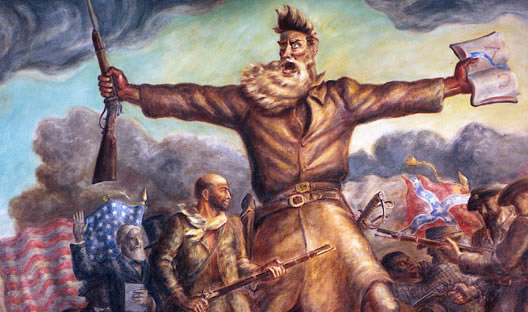
John Brown Rebellion |
|
A Hatred of SlaveryJohn Brown was born on May 9th, 1800, in Torrington, Connecticut. At age 5 he moved to Ohio and acquired a hatred for the institution of slavery from his father. When he was 12, he stayed with a Michigan family who continuously beat their slaves. The image would haunt Brown for the rest of his life. Brown soon became a staunch abolitionist (an advocate for the banning of slavery) and even started a school to help educate young black people in 1834. A Murderous Act of VengeanceIn 1855, John Brown followed five of his sons to "Bleeding Kansas", where a number of abolitionists had recently been murdered. Brown and his sons subsequently murdered five slavery advocates at Pottawatomie, Kansas on May 24, 1856. Brown and his sons immediately became fugitives and withstood a mob of attacking Missourians at Osawatomie. Brown's actions, together with his stand at Osawatomie, made him a legendary figure and a nationally recognized opponent of slavery. Learn more about the Pottawatomie Massacre Planning for an InsurrectionWhen Brown returned east, he formulated a plan to free slaves by force. He had financial support from many wealthy abolitionists in the northeast. Brown's plan included a refuge for runaway slaves in the mountains of Virginia. On October 16, 1859, John Brown, his sons, and a small number of loyal supporters, launched an attack against the federal arsenal at Harper's Ferry, Virginia. He believed word of the arsenal's capture would inspire slaves throughout Virginia to rebel against their owners. The group easily took the town and the arsenal. Brown, however, failed to launch any further offensives and took a defensive position within the arsenal. Brown's group was quickly surrounded by the local militia, and then, a day later, by U.S. marines led by Robert E. Lee. The ensuing battles resulted in the death of two of his sons, his own injuries, and an unconditional surrender. A MartyrAs a result of his actions, Brown was charged with murder and treason. He was hanged at Charleston, Virginia on December 2, 1859. Nevertheless, his rebellion was one of the primary causes of the Civil War. Many southern sympathizers believed Brown's rebellion was a conspiracy against slavery advocates of the south staged by the U.S. Government. Others feared Brown's rebellion would indeed cause a slave insurrection. For many years after his death, Brown was considered a martyr and hero to the abolitionist cause. Discussion Questions
Early Life and BeliefsJohn Brown was born in 1800 in Connecticut. When he was 5, his family moved to Ohio. His father taught him to hate slavery. At age 12, he stayed with a family in Michigan who treated their slaves very badly. This stayed in his memory forever. As he grew up, John Brown became strongly against slavery. In 1834, he even started a school to teach Black children. Violence in KansasIn 1855, Brown went to Kansas, where people were fighting over slavery. After five abolitionists were killed, Brown and his sons killed five pro-slavery men in revenge. This happened on May 24, 1856. After this, Brown became a wanted man. He and his sons also fought off an attack in Osawatomie, Kansas. These events made him famous and feared. The Harper's Ferry PlanLater, Brown planned to end slavery by force. He had support from rich people in the North. His plan was to help escaped slaves hide in the mountains of Virginia. On October 16, 1859, he and his small group attacked a government weapon storage (arsenal) in Harper’s Ferry, Virginia. He hoped this would start a slave rebellion. At first, they captured the arsenal. But Brown waited too long to act. Local soldiers and then U.S. Marines, led by Robert E. Lee, surrounded the group. Two of Brown’s sons died, and Brown was badly hurt before he surrendered. Trial and DeathBrown was arrested and charged with murder and treason. He was hanged on December 2, 1859. Many people in the South thought Brown’s raid was part of a big government plan against them. Others feared it might lead to a slave uprising.To many in the North, John Brown became a hero and a symbol of the fight to end slavery. His actions helped lead to the Civil War. |
| Bleeding Kansas Activities |
|