The Battle of Chancellorsville |
||||
|
||||
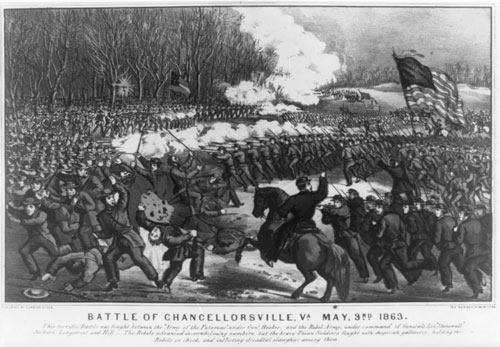
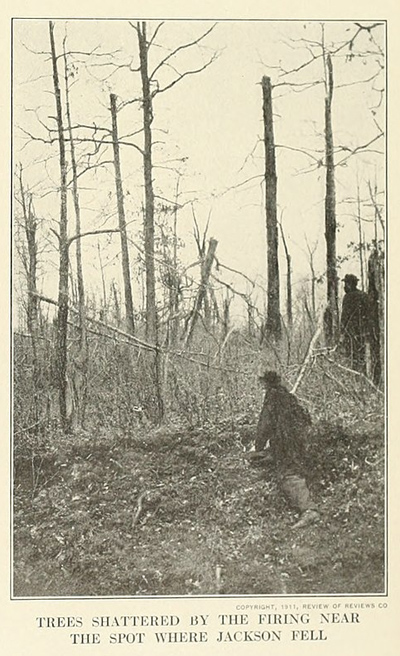
Yet, Another Union CommanderThe Battle of Chancellorsville was fought between April 30th and May 6th, 1863, near the city of Fredericksburg, Virginia, where the Confederates had scored a major victory in December. Union General Joseph Hooker, recently named Commander of the Army of Potomac, planned to launch a massive assault against Lee's Army of Northern Virginia by attacking them at the front and the rear. Hooker's Army was roughly twice the size of Lee's and was well rested and provisioned. Lee Outsmarts HookerOn May 1, 1863, Hooker launched his attack on Lee's Army at Chancellorsville. Lee, in an unconventional military move, decided to split his smaller army into two parts, leaving a small force at nearby Fredericksburg, Virginia, and confronting Hooker's assault with roughly 80% of his army. Union General Hooker, inexperienced and perhaps unconfident in handling such a massive force, ordered his forces to withdraw to defensive positions in the nearby forests around Chancellorsville in the wake Lee's assaults. Jackson Crushes the Union Right; but is Shot by Friendly FireOn May 2, 1863, Confederate General Stonewall Jackson attacked the right flank of the Union Army entrenched around Chancellorsville. Jackson marched his forces of 28,000 men 12 miles undetected to reach the Union right flank. At dinnertime, Confederate forces screaming their "rebel yell" stormed out of the forest and attacked the Union right flank. Union forces were totally unprepared and many were eating dinner. Within an hour, the right flank was totally disintegrated and was in full retreat. They suffered at least 2,500 casualties. Later that evening, however, General Stonewall Jackson was mistaken for Union cavalry and was shot in the arm as he rode out to investigate the feasibility of launching a nighttime attack on the Federals. Jackson contracted pneumonia and died on May 10th. Jackson's death was devastating to the Confederate cause and to Lee's battle strategies through the remainder of the war.
Hooker's IncompetenceDespite the initial setback, Union forces were still in control. Nearly 76,000 Union soldiers were still in positions defending Chancellorsville compared to 43,000 soldiers available to the Confederacy. The two largest parts of Lee's Army of Northern Virginia were positioned on either side of Union forces that occupied an area of high ground known as Hazel's Grove. Luckily for the Confederacy, General Hooker ordered those soldiers, under the command of General Sickles, to a different position on a local road called the Plank Road. Confederate forces proceed to occupy the high ground, where they placed thirty heavy guns. At 5:30 in the morning on May 3, Confederate forces now under the leadership of J.E.B. Stuart (after Jackson was wounded and after the next in command, A.P. Hill, was also wounded) launched a massive attack on the Federal positions around Chancellorsville, aided by the newly installed guns. Fires were sparked in the woods around Chancellorsville, confusing soldiers and killing wounded soldiers rendered immobile. Confederate forces overwhelmed their Union counterparts and Hooker ordered a retreat. Hooker was wounded in the fighting, but refused to turn over command, despite being rendered unconscious for over an hour. Meanwhile, Union forces under John Sedgwick were defeated in their attempts to salvage the battle and the Union Army ultimately withdrew across the Rappahannock River on May 6.
Lee's Greatest Victory; Time to Invade the NorthIn what is considered one of the most decisive Confederate victories of the Civil War, Confederate forces suffered over 13,000 casualties, while Union forces suffered over 17,000. Confederate forces, however, suffered a much greater percentage of casualties. Hooker's reputation was forever tarnished in his handling of the battle. After the battle, he blamed the "incompetence" of his subordinate generals despite the fact that over half of his available soldiers were never deployed into combat. On the Confederate side, the battle is often called “Lee's greatest victory,” and gave him the feeling his army was destined to win the war. The victory at Chancellorsville gave Lee the confidence that his army could win in the North and resulted in his invasion of Pennsylvania and ultimately the Battle of Gettysburg.
NPS Video on the Battle of Chancellorsville
Discussion Questions
Yet, Another Union CommanderThe Battle of Chancellorsville was fought from April 30 to May 6, 1863, near Fredericksburg, Virginia. Union General Joseph Hooker, newly appointed to lead the Army of the Potomac, planned a large attack on General Robert E. Lee’s smaller Confederate army. With twice as many men, Hooker hoped to attack Lee from both the front and the rear. Lee Outsmarts HookerOn May 1, Hooker began his attack. In a bold move, Lee split his army, leaving a small force in Fredericksburg and using the rest to push back Hooker. Hooker, unsure of what to do, moved his forces into defensive positions in the woods near Chancellorsville. Jackson Crushes the Union Right; but is Shot by Friendly FireOn May 2, Confederate General Stonewall Jackson led 28,000 soldiers on a 12-mile march to surprise the Union right flank. At dinnertime, his troops stormed out of the forest with the “rebel yell” and shocked the Union soldiers, many of whom were unprepared. The Union right flank collapsed, suffering 2,500 casualties. That night, Jackson was mistakenly shot by his own men while scouting. He later died of pneumonia on May 10. His loss was a huge blow to the Confederate army and to Lee’s future strategies. Hooker’s IncompetenceDespite the setbacks, the Union still had more troops—about 76,000 compared to Lee’s 43,000. However, Hooker made a major mistake by moving troops away from high ground called Hazel’s Grove. The Confederates quickly took the position and set up thirty heavy guns. On May 3, under the temporary leadership of J.E.B. Stuart, Confederate forces launched a major attack. Fires broke out in the woods, adding to the chaos. Hooker was wounded but refused to give up command. Union forces under General John Sedgwick also failed to win, and the army retreated across the Rappahannock River on May 6. Lee’s Greatest Victory; Time to Invade the NorthThe Battle of Chancellorsville is remembered as one of the most important Confederate victories. The Union lost about 17,000 men, and the Confederates lost over 13,000—though they suffered a higher percentage of total losses. General Hooker’s poor leadership damaged his reputation, especially since he didn’t use half of his available army. For General Lee, the victory gave him great confidence and led him to believe he could win the war by invading the North. This led directly to the Battle of Gettysburg. |
||||
| Chancellorsville Activities | ||||
|