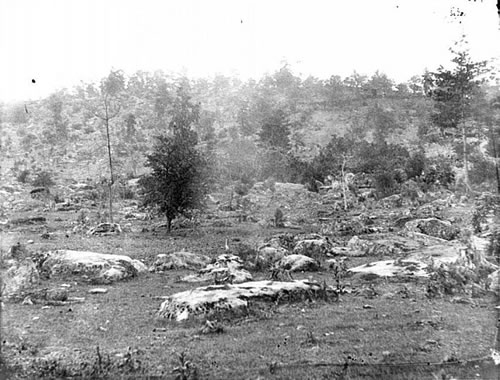
Chamberlain's Stand at Little Round Top |
Little Round Top |
|
Little Round Top was the site of a major Confederate assault on Union positions on the second day of the Battle of Gettysburg. In what may have been the most intense fighting of the entire war, Union forces repulsed numerous Confederate assaults up the hill. The scene at Little Round Top was the setting for the popular Civil War novel, Killer Angels. The 20th MaineOn 4:00 P.M., on July 2, Confederate Commander Robert E. Lee ordered a massive assault on the Union left flank. Union forces under Daniel Sickles had abandoned the grounds near Little Round Top for the higher ground of Devil's Den, leaving Little Round Top vulnerable. Various regiments were quickly dispatched to defend the hill including Joshua Chamberlain's 20th Maine, which was ordered to hold the position at the extreme left flank of the Union line. Chamberlain's Men HoldConfederate forces consisting of Alabama and Texas brigades under the command of Evander Law stormed the hill after marching 20 miles the same day. Violent clashes ensued which included hand-to-hand combat between Union and Confederate soldiers. Numerous Confederate charges and assaults up the hill were repulsed. Colonel Chamberlain, whose 20th Maine Division had run out of ammunition, withstood several Confederate assaults while incurring significant casualties. With no ammunition and massive casualties, Chamberlain knew his men could not withstand another assault. In a last ditch effort to avoid being overrun, he ordered his men to meet the next assault with a bayonet charge, an unconventional military strategy, which shocked the advancing Confederates and halted their offensive. Other Union regiments on Little Round Top held their positions as well, despite sniper fire coming from Confederates on Devil's Den. Over 1,700 casualties from both sides combined were recorded at Little Round Top. Discussion Questions
Proceed to Gettysburg: Day 3Fighting at Little Round TopLittle Round Top was the site of a major Confederate attack on the second day of the Battle of Gettysburg. The Union army faced many strong assaults but managed to hold the hill. This part of the battle was so intense that it was featured in the famous Civil War novel Killer Angels. The 20th Maine Takes PositionAt 4:00 P.M. on July 2, Confederate General Robert E. Lee ordered a big attack on the Union left side. Union troops under General Daniel Sickles had left Little Round Top unguarded to take higher ground at Devil’s Den. In a hurry, Union leaders sent several regiments to protect the hill, including the 20th Maine, led by Colonel Joshua Chamberlain. His regiment was placed at the far left end of the Union line. Chamberlain’s DefenseConfederate soldiers from Alabama and Texas, led by General Evander Law, attacked after marching 20 miles that day. Fierce fighting broke out, including hand-to-hand combat. The 20th Maine fought off many attacks but ran out of ammunition. With no bullets left and many soldiers wounded, Chamberlain ordered a surprise bayonet charge. The move shocked the Confederate soldiers and stopped their attack. Other Union units on the hill also held their ground, even under fire from Confederate sharpshooters at Devil’s Den. In total, more than 1,700 soldiers were killed or wounded in the battle for Little Round Top. |
| Gettysburg Activities |
|