Battle of Gettysburg Day 3 - July 3, 1863 |
||
|
||
|
On the third and final day of fighting, Confederate General Robert E. Lee wished to maintain the offensive and crush the Union Army. His plan was nearly identical to the day before - Longstreet would attack the Union left flank and Ewell would assault and occupy Culp's Hill on the Union right flank. Failure at Culp's HillAt around 4:00 A.M. on the 3rd, however, Lee's plans were foiled when Union forces launched an artillery bombardment on the lower portion of Culp's Hill that the Confederates had occupied the day before, forcing the Confederates there into battle. By 11:00 A.M., Confederate forces had gained little, if any, ground and suffered significant casualties. The failure at Culp's Hill required Lee to change his plans. He decided on an artillery bombardment on the Union line at Cemetery Ridge, before sending a massive infantry charge, which came to be known as Pickett's Charge. Learn more about: Robert E. Lee | James Longstreet Preparing for a Massive AssaultThe artillery bombardment, however, proved relatively ineffective, even though the 150 guns used represented the largest such bombardment in the entire war. The massive amounts of smoke produced from the thundering cannons obscured targets, causing gunners to overshoot. Union forces eventually countered with 80 cannon of their own, adding to the chaos and confusion. To save ammunition, Union Brigadier General Henry Hunt ordered cannon fire to be gradually phased out, confusing Confederate gunners into believing they had been destroyed. The Confederate artillery bombardment was totally unsuccessful, and failed in its objective to soften Union defenses before the ill-fated infantry assault. Pickett's Charge
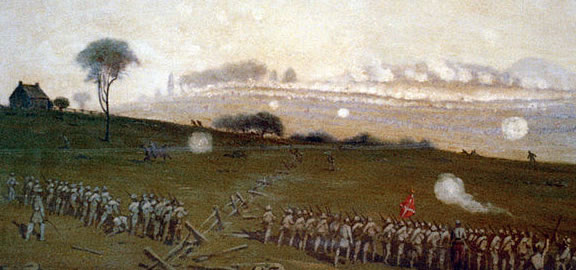
At 3:00 in the afternoon, some 12,500 Confederate soldiers under the command of James Longstreet started their nearly mile-long uphill march to Union positions on Cemetery Ridge behind a stone wall. Interestingly, Longstreet had desperately tried to convince Lee to abandon the assault, believing it to be the equivalent of suicide, but Lee refused, intent on piercing the center of the Union line. Major General George Pickett's brigade was chosen to lead the charge, giving rise to the event's popular name: Pickett's Charge. Learn more about Pickett's Charge Unimaginable CarnageThe Confederates marching through the open fields were easy targets for Union guns and cannons, which fired from all directions on the nine brigades of Rebel soldiers. Huge gaps quickly formed in the Confederate lines from devastating artillery fire that killed or wounded groups of soldiers in a single blast. The carnage quickly demoralized the Confederate soldiers, many of whom turned around and ran. Others were gunned down by musket fire as they neared the stone wall. "Pickett's Charge" was a massacre. Of the 12,500 soldiers who advanced upon Cemetery Ridge, over half were killed or wounded. Union forces suffered about 1,500 casualties. Between 3,000 and 4,000 Confederate soldiers were reportedly captured. Lee, fully aware of the massacre, and worried about a Union counterattack, attempted to rally his soldiers crying out "it's all my fault," but there would be no rally, nor would there be a serious counterattack against the retreating Rebels. A Decisive Union Victory in the Largest Battle in American HistoryOn July 4, a truce was called so each side could collect their dead and wounded. In the July heat, the stench of the decomposing bodies which littered the fields caused many in Gettysburg to become violently ill. As many as 51,000 casualties were documented at the end of the Battle of Gettysburg, with the Confederacy suffering as many as 28,000, and the Union about 23,000. Lee's Army of Northern Virginia retreated back to Virginia and would never fight again on Union soil. President Abraham Lincoln urged General Meade to pursue and attack the reeling Confederates, but the half-hearted pursuit proved ineffective and the Confederates escaped to Virginia. Meade would be soundly criticized for failing to deliver a decisive blow to the Confederates in their retreat. Discussion Questions
Lee’s Final PlanOn the third and final day of the Battle of Gettysburg, Confederate General Robert E. Lee wanted to stay on the attack and defeat the Union Army. His plan was similar to the day before—he ordered Longstreet to attack the Union left and Ewell to attack Culp’s Hill on the Union right. Failure at Culp’s HillAt 4:00 A.M., Union forces bombed Culp’s Hill, forcing the Confederates to fight earlier than planned. By 11:00 A.M., the Confederates had made no progress and suffered heavy losses. Because of this failure, Lee changed plans and ordered a large artillery attack on the Union center at Cemetery Ridge, followed by an infantry charge known as Pickett’s Charge. A Failed Artillery BombardmentAlthough the Confederate bombardment used 150 cannons—the largest in the war—it did little damage. Smoke from the cannons made it hard to aim, and many shots missed. Union General Henry Hunt stopped firing to save ammunition, which fooled the Confederates into thinking Union cannons had been destroyed. The Confederate bombardment failed to weaken the Union line. Pickett’s ChargeAt 3:00 P.M., about 12,500 Confederate soldiers began marching across a mile of open ground toward Cemetery Ridge. General Longstreet had warned Lee that this attack would fail, but Lee insisted. The charge was led by General George Pickett’s men, which is why it became known as “Pickett’s Charge.” Heavy LossesAs Confederate soldiers crossed the open fields, Union cannons and guns fired from all sides. Many Confederate soldiers were killed or wounded in large numbers. Some turned and ran; others were shot down near the stone wall. The charge failed badly. Over half of the Confederate soldiers were killed or wounded, and thousands were captured. Union losses were about 1,500. Lee took the blame and tried to rally his men, but there was no recovery. Union Victory at GettysburgOn July 4, both sides stopped fighting to collect the dead and wounded. The smell of bodies in the summer heat made many in Gettysburg sick. The battle caused around 51,000 total casualties—28,000 Confederate and 23,000 Union. Lee’s army retreated to Virginia and would never fight again in the North. President Lincoln wanted Union General Meade to chase and defeat Lee’s army, but Meade did not follow aggressively. Many criticized him for letting the Confederates escape. |
||
| Gettysburg Activities | ||
|