Pickett's Charge |
||
Pickett's Charge |
||
|
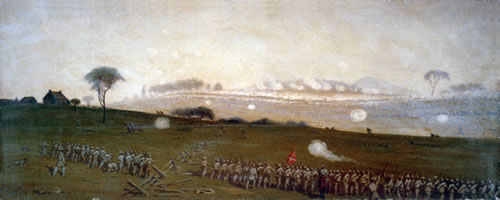
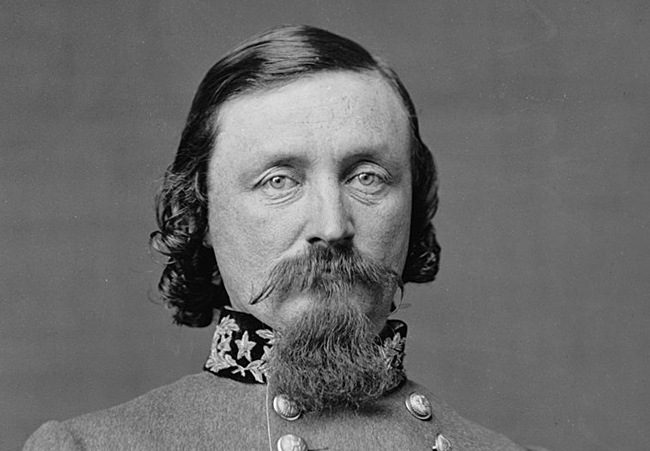
Cemetery Ridge was an important site at the Battle of Gettysburg. For the Union Army, it formed the center of its "fish-hook" defense. For the Confederates, Pickett's Charge up Cemetery Ridge represented a desperate attempt against impossible odds to continue their foray deeper into Northern soil. Longstreet's Pleas Fall on Deaf EarsAfter Confederate attacks on both flanks of the Union army failed to dislodge them on the second day of battle, Confederate Commander Robert E. Lee was determined to strike them at their center on Cemetery Ridge on July 3rd. Lee's second in command, General James Longstreet urged Lee to reconsider the strategy, but Lee refused. Softening the Union Defenses on Cemetery RidgeOn July 3rd, Lee ordered a massive artillery bombardment on the grounds in front of Cemetery Ridge for the purposes of softening the Union defenses. The bombardment was largely ineffective due to defective equipment and poor firing. Furthermore, Union forces returned fire creating an apocalyptic scene of war, fire, and smoke on the battlefield. Union gunners who overshot their targets actually ended up killing scores of Confederate soldiers waiting to advance on Seminary Ridge. The Ill-fated ChargeAt about 2:00 P.M., despite Longstreet's misgivings, Confederate infantry numbering about 12,500 stepped foot onto the grassy fields toward Union defenses nearly a mile away. The Confederate line was nearly a mile wide. As they drove forward on the undulating surface, they took withering fire from Union gunners and cannons from seemingly every direction. Huge gaps started appearing in the Confederate lines from the cannons, causing many to turn and run. It was a disaster for the Confederate Army. One in two soldiers on Cemetery Ridge that day was killed, wounded, or captured. Dozens of officers were killed or injured. Few Confederates made it to the stone wall, though Confederate soldiers under the command of Lewis Armistead were able to push Union forces back at a turn in the stone fence referred to as "The Angle." In what came to be known as the "High Water Mark of the Confederacy, this was the closest Confederate soldiers came to breaching Union defenses. Those soldiers were quickly repulsed.
The rout on Cemetery Ridge would represent the end for Lee's Army in Pennsylvania. He would never again fight on Northern soil. Video on Pickett's Charge from NPS.gov Discussion Questions
Proceed to Gettysburg: Day 3Cemetery Ridge: A Key LocationCemetery Ridge was a central part of the Union army's fishhook-shaped defense at Gettysburg. For the Confederates, it became the target of Pickett’s Charge—a final, desperate effort to break through Union lines and continue invading the North. Longstreet Disagrees with LeeAfter Confederate attacks on both Union flanks failed on July 2, General Robert E. Lee wanted to strike the Union center on Cemetery Ridge the next day. His second-in-command, General James Longstreet, strongly disagreed and tried to change Lee’s mind, but Lee stuck to his plan. Artillery Bombardment BeginsOn July 3, the Confederates launched a huge cannon attack to weaken the Union center. However, the bombardment failed due to poor equipment and bad aim. Union cannons returned fire, creating a smoky, fiery battlefield. Some Union shells even hit Confederate soldiers waiting to charge. The Tragic ChargeAt 2:00 P.M., about 12,500 Confederate soldiers began marching across nearly a mile of open fields toward Union lines. As they advanced, Union guns fired from all sides. Many Confederates were killed or wounded, and large gaps formed in their line. Some turned and ran. Only a few reached the stone wall, especially at a spot called "The Angle," where General Lewis Armistead’s men briefly broke through. This moment, known as the "High Water Mark of the Confederacy," was the closest the South came to winning at Gettysburg—but they were quickly pushed back. The End of Lee’s InvasionThe failed charge on Cemetery Ridge marked the end of Lee’s campaign in the North. His army would never again fight on Union soil. |
||
| Gettysburg Activities | ||
|