Abraham Lincoln - Childhood |
||||||||||||||
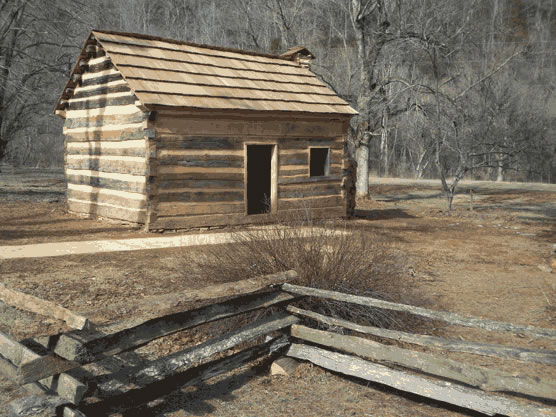
Early ChildhoodAbraham Lincoln was born on February 12, 1809, in Hardin County, Kentucky, to Thomas and Nancy Lincoln in their one room log cabin on their farm known as Sinking Spring (near modern-day Hodgenville, Kentucky). Although Thomas lacked formal education, he was an excellent farmer and carpenter, and often times served as a member of the jury. Thomas and Nancy joined a small Baptist church in the area that had broken away from the larger church over the issue of slavery. Tragedy in Pigeon CreekWhen Abe was two, the family moved to nearby Knob Creek Farm, where Abe's first memories of his childhood were formed. Because of difficulties his father had with the title to the farm, Thomas Lincoln moved his family to Pigeon Creek, Indiana in 1816 where the seven year-old Abraham helped him build a log cabin in the woods. Two years later, Nancy died of "milk sickness." Milk sickness is a rare disease caused by drinking the milk or consuming the meat of a cow that had fed on poisonous roots. In 1819, however, Thomas married Sarah Bush Johnston, whom Abraham would call "mother." Sarah was a kind and warm woman who brought her three children, Matilda, Elizabeth, and John to the Lincoln homestead to live with Abraham and his sister. Motivated to LearnFrom an early age, Sarah recognized Abraham's quick wit and intellect and encouraged him to read. Abraham became an avid reader, gobbling up any book he could get his hands on from neighbors, clergymen, and traveling teachers. Abraham attended school on an inconsistent basis. At times, traveling teachers may have taught at a nearby rudimentary schoolhouse, and at other times Abraham walked several miles to the nearest school. Lincoln himself admitted that the total amount of schooling he received in his childhood was no more than twelve months; nevertheless, he became an excellent reader, learned to write, measure, and make division and multiplication calculations. Abraham took his studies very seriously. Without paper in the house to practice his writing and math, he often did arithmetic on the back of a wooden spoon using charcoal as a makeshift pencil. Lincoln described where he grew up and the opportunities for education in the following quote: "It was," he once wrote, "a wild region, with many bears and other wild animals still in the woods. There I grew up. There were some schools, so-called, but no qualification was ever required of a teacher beyond "readin', writin', and cipherin'" to the Rule of Three. If a straggler supposed to understand Latin happened to sojourn in the neighborhood, he was looked upon as a wizard." Abe's Physical GiftsAbe's growing desire to attend school conflicted with his father's demands on him, which often made him appear lazy to his neighbors. His father often rented him out to perform manual labor tasks such as shucking corn, hoeing, gathering, and plowing. During the early 1800's, Abe's father was entitled to all of the money earned as a result of his son's labor. Abe's considerable strength was evident with his unusual skill and power with an axe. Abe was said to be able to chop more wood and split more rails than anyone around. Far larger and stronger than the other boys in the region, Abe could outrun and outwrestle all of them. Unlike most boys of his time, however, Abe avoided hunting because he took no pleasure in killing animals. A Lifelong LessonAlthough Abe gained a reputation as a prankster, and for his storytelling abilities, he also gained a reputation for honesty. When he was nineteen years old, he was hired to co-steer a flatboat down the Mississippi River to unload produce to be sold at the plantations in the South and to return with the money earned. For these services, Abe was paid eight dollars a month. More importantly, these forays into the South opened Abe's eyes to the world beyond the Indiana frontier and likely begun to shape his views toward the horrors of slavery as he witnessed the auctions and treatment of slaves firsthand. Discussion Questions
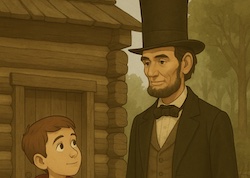
Early ChildhoodAbraham Lincoln was born on February 12, 1809, in a one-room log cabin in Hardin County, Kentucky. His parents, Thomas and Nancy Lincoln, were hardworking people who joined a small Baptist church that opposed slavery. Hard Times in IndianaWhen Abe was two, the family moved to Knob Creek Farm, and later to Indiana. They built a new home there, but tragedy struck when Nancy died from a disease called milk sickness. In 1819, Thomas remarried a kind woman named Sarah, who brought her children to live with the Lincolns. Abe grew close to her and called her “mother.” Abe Loves to LearnSarah noticed that Abe was smart and loved to read. Even though he only went to school for about one year total, he read many books and taught himself writing and math. With no paper in the house, he practiced using charcoal on wooden spoons and other surfaces. Hard Work and StrengthThough Abe wanted to study more, his father needed him to work. Abe did heavy jobs like chopping wood, plowing, and carrying supplies, and his father kept the money he earned. Abe was known for being strong, fast, and a great wrestler, though he didn't enjoy hunting. Seeing the World BeyondAt age nineteen, Abe traveled down the Mississippi River to sell goods and return with money. These trips helped him see life beyond his hometown—and exposed him to the terrible reality of slavery in the South, something that likely shaped his future beliefs. Go on to next page: Middle Years Part 1
|
||||||||||||||
| Lincoln Activities | ||||||||||||||
|
||||||||||||||
| Lincoln Pages | ||||||||||||||