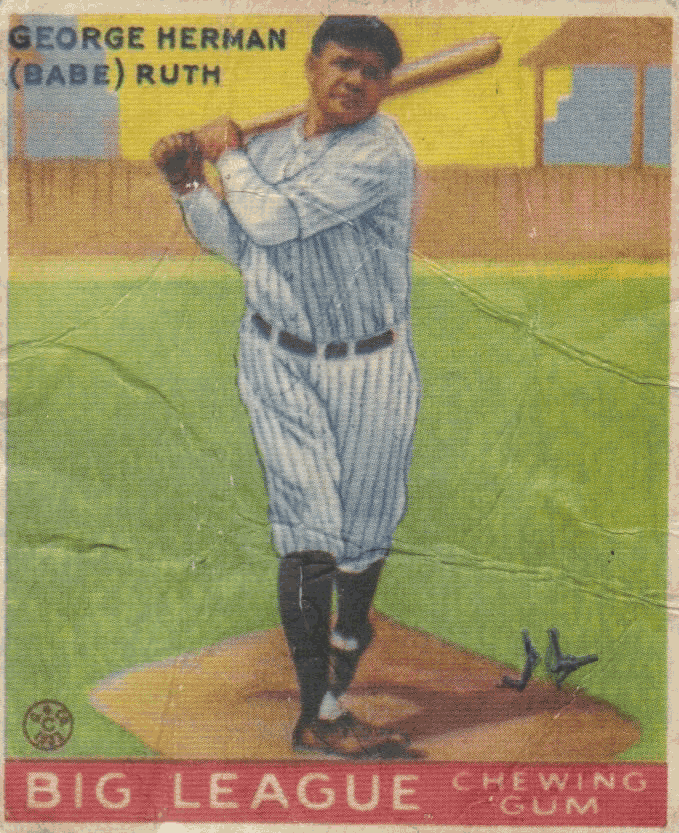
Babe Ruth and the Curse of the Bambino |
|
Baseball is a Superstitious GameBaseball is famous for its superstitions and superstitious players. Some players name their bats for good luck, others follow strict rituals when they're hitting, still others refuse to shave or change their socks when they're doing well. Perhaps the most celebrated superstition in baseball history is the infamous "Curse of the Bambino" which supposedly plagued the Boston Red Sox following their sale of the legendary slugger Babe Ruth, who was nicknamed "the Bambino." The Sale of Babe RuthBabe Ruth was originally a pitcher on the Boston Red Sox. With Ruth on the team, the Red Sox had enjoyed great success, winning five of the first fifteen World Series titles. In 1920, Red Sox owner Harry Frazee sold Babe Ruth to the New York Yankees, supposedly, at least in part, to finance the production of a Broadway play. Following the sale of Ruth, the fortunes of the two teams involved in the sale indeed changed drastically. Ruth would be considered one of the greatest baseball players of all time and would become one of the biggest celebrities on the planet. The Yankees would go on to play in 39 World Series, winning 26 of them. During the same time, the Red Sox played in only four World Series and lost all of them. The Fall of the Red SoxOver the years, bad luck seemed to plague the Red Sox. For example, In 1986, the Red Sox were one out away from winning the World Series against the New York Mets, when a simple ground ball inexplicably rolled through the legs of Red Sox first baseman Bill Buckner, which allowed the Mets to rally and win the game. The Mets would win Game 7 and thus the World Series. By this time, many Red Sox fans believed they were cursed and the terms "Curse of the Bambino" were popularized in books and in the media. Entire generations of Red Sox fans lived their lives without experiencing the joy of their team winning a World Series. Yankees fans would taunt Red Sox fans by wearing shirt emblazoned with "1918" - the last year in which the Red Sox won a World Series. The Shocking End of the CurseEven curses don't last forever. Finally, in 2004, the Red Sox defeated the New York Yankees in the American League Championship Series and then the St. Louis Cardinals in the World Series. In the series, the Cardinals biult a three games to zero lead. The Red Sox became the first team in baseball history to win a World Series after losing the first three games. Coincidentally, Cardinals batter Edgar Renteria made the last out for the Cardinals. He wore uniform number "3," the same number as Babe Ruth. Discussion Questions
Baseball SuperstitionsBaseball is known for its many superstitions. Some players name their bats, follow special routines before hitting, or avoid changing socks when they are winning. One of the most famous baseball superstitions is the "Curse of the Bambino." This curse was believed to affect the Boston Red Sox after they sold Babe Ruth, also called "the Bambino." Selling Babe RuthBabe Ruth started as a pitcher for the Red Sox and helped them win five World Series titles. In 1920, Red Sox owner Harry Frazee sold Ruth to the New York Yankees, possibly to pay for a Broadway play. After this, the Yankees became very successful, winning 26 World Series titles, while the Red Sox lost every one of their next four appearances. Red Sox MisfortunesThe Red Sox seemed unlucky for many years. In 1986, they were one out away from winning the World Series, but a ground ball went through the legs of player Bill Buckner, helping the Mets win. Fans began to believe in the "Curse of the Bambino." Yankees fans even wore shirts with "1918," the last year the Red Sox had won a World Series. The Curse is BrokenIn 2004, the Red Sox finally beat the Yankees in the playoffs and then defeated the St. Louis Cardinals in the World Series. They became the first team to win a series after losing the first three games. Ironically, the last out was made by Edgar Renteria, who wore number 3—Babe Ruth’s number. |
| Babe Ruth Activities |
Babe Ruth Math Activities |