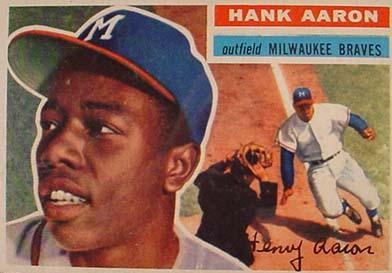
Hank Aaron |
|
Early Life
Called up to the MajorsAaron became the last Negro League player to make the jump to the Major Leagues when he was signed by the Boston Braves in 1952. By the time that Aaron reached the majors, the Boston Braves had become the Milwaukee Braves. Aaron played brilliantly in the minor leagues and even became MVP of the South Atlantic League despite being the constant target of prejudice. In 1954, the Boston Braves called him up to the Major Leagues when left fielder Bobby Thompson broke his ankle. Despite going 0–5 in his Major League debut (no hits in five at bats), Aaron was in the majors to stay. During his first year, he batted .280 (this means he would average 28 hits per 100 at bats) with 13 home runs. These totals were among the lowest of his amazing career. In 1955, Aaron made his first of 24 All-Star games and batted .314 with 27 home runs. Hank would hit 20 or more home runs for 20 consecutive years. The next year, in Aaron’s third year in the majors, he won the batting title with a .328 average. He was also named the Sporting News National League Player of the Year. 1957 would become one of the best years of his career. After being switched to cleanup (fourth in the batting order), Aaron responded with 44 home runs and 132 RBIs (runs batted in—this means that as a result of something he did with the bat, like get a hit, sacrifice fly, ground out, or walk, a player(s) on his team scored). That year, he led the Milwaukee Braves to their only World Series title. In the years following the World Series, the Milwaukee Braves never again reached the playoffs. Nevertheless, Aaron continued to establish himself as one of the game’s great hitters and began amassing impressive batting statistics. In 1962, the Milwaukee Braves moved to Atlanta and became the Atlanta Braves.
Hank Aaron Baseball Card Home Run Record
Discussion Questions
Early LifeHank Aaron was born on February 5, 1934, in Mobile, Alabama. He was the third of eight children. After hearing a speech by Jackie Robinson, he became determined to play baseball. Aaron played baseball and football in high school and started playing semi-pro baseball at age 15 for the Mobile Black Bears, earning $10 per day. Joining the Negro LeaguesIn 1951, Hank joined the Indianapolis Clowns in the Negro Leagues and helped them win the Negro League World Series in 1952. He was soon signed by the Boston Braves, who later became the Milwaukee Braves. He faced discrimination in the minor leagues but still won MVP of the South-Atlantic League. Major League Debut and SuccessIn 1954, Hank joined the Major Leagues when a teammate was injured. Though he didn’t get any hits in his first game, he soon became one of baseball’s best hitters. In 1955, he made the first of 24 All-Star appearances. He won the batting title in 1956 and helped the Braves win the World Series in 1957. Breaking RecordsAfter the Braves moved to Atlanta, Hank continued to hit home runs and collect records. In 1970, he became the first player with 3,000 hits and 500 home runs. In 1974, he hit his 715th home run, breaking Babe Ruth’s career home run record. He ended his career with 755 home runs and remains the all-time leader in RBIs. LegacyHank Aaron was inducted into the Baseball Hall of Fame in 1982. His jersey number "44" was retired by both the Braves and the Brewers. Atlanta’s Turner Field is located on Hank Aaron Drive, named in his honor. |
| Hank Aaron Activities |
|