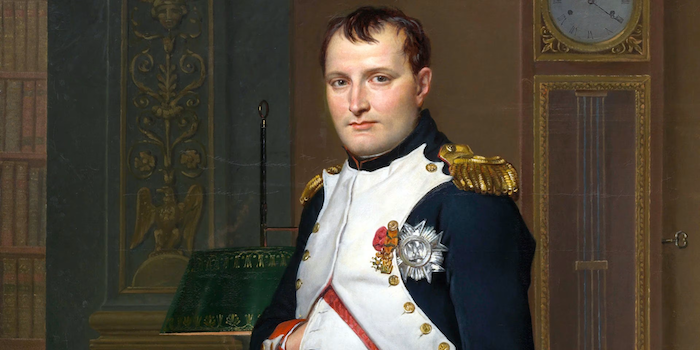
Early Life and Education
Napoleon Bonaparte was born on August 15, 1769, on the island of Corsica, which had only recently become a French territory. He was the fourth of eleven children in his family. His father, Carlo Bonaparte, was a lawyer and a prominent Corsican noble, while his mother, Letizia Ramolino, was known for her strong character. Napoleon's early education took place in Corsica, but at the age of nine, he moved to mainland France to attend military school. This marked the beginning of his long and tumultuous relationship with France. He excelled in his studies, particularly in mathematics, and showed a keen interest in military strategy.
Military Rise and Early Campaigns
Napoleon’s military career began when he was commissioned as a second lieutenant in the French artillery at the age of 16. His early years in the military were marked by the turbulence of the French Revolution. In 1793, during the Siege of Toulon, Napoleon distinguished himself with his strategic genius, which helped secure a French victory. His rise continued with a series of successful campaigns in Italy (1796-1797), where he earned a reputation as one of the most capable military commanders in Europe. Napoleon’s ability to inspire loyalty and execute bold military maneuvers became his hallmark during this time.
The Egyptian Campaign and Political Ambitions
In 1798, Napoleon embarked on an ambitious expedition to Egypt with the goal of undermining British influence in the region. Although his military objectives were mixed, the campaign provided him with invaluable political leverage. While in Egypt, Napoleon discovered the Rosetta Stone, which would later lead to significant advances in the understanding of ancient Egyptian civilization. However, as the political situation in France deteriorated, Napoleon returned home in 1799 and seized power through a coup, effectively ending the French Revolution and establishing himself as First Consul.
The Napoleonic Empire
In 1804, Napoleon crowned himself Emperor of the French, solidifying his control over France. He introduced sweeping reforms that modernized French society, including the Napoleonic Code, which laid the foundation for legal systems in many countries. He sought to expand French influence across Europe, engaging in a series of wars known as the Napoleonic Wars (1803-1815). His military genius led to significant victories at Austerlitz (1805) and Jena (1806), but his ambition also led to overreach. The ill-fated invasion of Russia in 1812 marked the beginning of his downfall.
Exile and Legacy
After a series of defeats and the eventual loss of his empire, Napoleon was exiled to the island of Elba in 1814. He briefly escaped in 1815 and returned to France for the Hundred Days, but after his defeat at the Battle of Waterloo, he was exiled again, this time to the remote island of Saint Helena. Napoleon died there on May 5, 1821. Despite his controversial and often tyrannical rule, Napoleon remains a highly influential figure in world history, known for his military brilliance, legal reforms, and the lasting impact of his empire on Europe. |