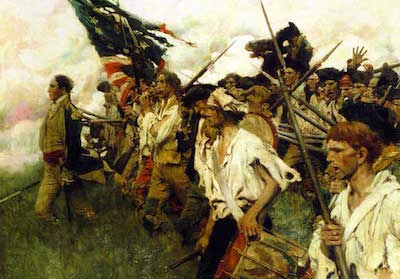
The Battle of Brandywine Creek |
|
Philadelphia, Pennsylvania was the center of American government in 1777. On September 11, well into the Revolutionary War, George Washington got wind that the British were mounting an attack on Philadelphia in an attempt to occupy the Patriot capital. The loss of the city would have terrible consequences for the Patriot cause, so Washington began mobilizing his forces along Brandywine Creek to stop the British advance. He stationed troops along fords - shallow areas along the river that could be crossed by wading. Expecting a head-on attack from the British, he placed the bulk of his forces on the high ground of Chadds Ford. If he could force the fight to Chadds Ford, Washington thought, then his troops would have an advantage and could easily defeat the British. The coming battle would feature the highest number of soldiers in the entire war and would become the longest single-day battle as well. Howe's Army Crushes Washington'sWashington assumed that British General Sir William Howe would plan a frontal assault; but instead, Howe sent General Wilhelm von Kynphausen and some of his troops to fight the Americans at Chadds Ford, but he also sent a portion of his army upstream of Brandywine Creek - to a ford that Washington had not guarded. This weak link allowed the British forces to easily cross the creek and surprise the Americans from the right side. Washington, not expecting the attack, sent a portion of his troops to the area, but it was too late. The right flank of the army crumbled under Howe's surprise attack, and the front fell to General von Kynphausen's army. Philadelphia Falls; Congress FleesWashington sent part of the army to guard from the back, allowing the other part to escape to the northeast. When night fell, the rest of the Continental Army retreated, led by Marquis de Lafayette, who was wounded in the battle. Patriot Generals Nathanael Greene and Casimir Pulaski held off Howe's column long enough to allow the retreat. The Continental Congress was forced to flee Lancaster, and then York, before the British arrived in Philadelphia a few days later, occupying it easily. The American army also moved its military supplies to Reading, Pennsylvania, ahead of the British arrival.The Battle of Brandywine Creek was a staggering defeat for the Continental Army. Washington's army plummeted in size from 15,000 to 6,000 after the battle. In 1777, Philadelphia was the center of the American government. On September 11, during the Revolutionary War, George Washington learned that the British planned to attack the city. Losing Philadelphia would be a big problem for the Patriots. To stop the British, Washington set up defenses along Brandywine Creek. He placed most of his troops at Chadds Ford, expecting a direct attack. He believed this spot gave his army the best chance to win. This battle would have the most soldiers and be the longest one-day battle of the war. Howe Surprises WashingtonWashington thought British General Sir William Howe would attack head-on. Instead, Howe split his army. He sent General von Kynphausen to fight at Chadds Ford, while sending other troops to cross the creek farther upstream where Washington had no guards. These troops attacked from the side and surprised the Americans. Washington tried to respond, but it was too late. The American right side collapsed, and Kynphausen broke through at the front. Philadelphia Is TakenWashington moved part of his army to protect the retreat, and the rest escaped to the northeast. Marquis de Lafayette, who was injured in the battle, helped lead the retreat. Generals Greene and Pulaski slowed down the British long enough to let others get away. The Continental Congress had to leave Philadelphia and move to Lancaster, then York. The British took Philadelphia easily. The American army also moved their supplies to Reading. The Battle of Brandywine was a huge loss. Washington's army dropped from 15,000 to just 6,000 soldiers. |
| Brandywine Creek Activities |