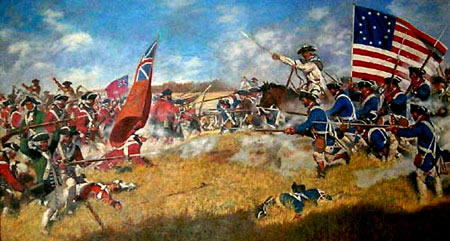
Battle of Cowpens |
British Success in the Southern TheaterDespite the success of the combined American and French forces in the Middle Colonies, the southern colonies remained under British control. The British had recently captured the port cities of Savannah, Georgia and Charleston, South Carolina in 1778 and 1779. The siege at Charleston was particularly costly for Patriot forces. 5,000 Patriot soldiers were surrendered, making it the single largest loss of soldiers for the Patriot cause during the Revolutionary War. Daniel Morgan's AssignmentOn October 14, 1780, General George Washington chose Nathanael Greene to lead Patriot forces in the South against the British. Because Greene's small army of 2,300 soldiers would be no match for the British armies in the area, he decided to split it into two parts, giving command of the detachment he sent to the west of the Catawba River to Brigadier General Daniel Morgan. Morgan was to join another militia in the area and was assigned to protect the locals living in between the Broad and Pacolet Rivers. Morgan Decides the Location of the Coming BattleBritish General Charles Cornwallis, in charge of British forces in the South, ordered Banastre (Benny) Tarleton to engage Morgan's forces, and to protect a fort he mistakenly believed Morgan would attack. By disposing of Morgan's army, Cornwallis would have a clear path to invade North Carolina. When Tarelton realized Morgan's army had no intention of taking the fort, he called for reinforcements and began following Morgan, who decided to engage Tarelton at an area in between the Broad and Pacolet Rivers where cows often grazed. Morgan was said to have positioned his army in between the two rivers, so that his soldiers could not desert the army when attacked. Morgan Defeats Tarleton's RedcoatsAt 6:45 in the morning on January 17, 1781, Tarelton's exhausted and possibly malnourished army engaged Morgan's at what came to be known as Cowpens. Before Tarleton's arrival, however, Morgan had positioned his troops in formations that ultimately confused the charging British soldiers and officers. After the initial British charge, the first two lines of Patriot fighters withdrew. Tarelton believed the Patriots to be in full retreat and ordered his soldiers to charge. What Tarelton failed to account for, however, was a third line of Patriot fighters waiting for the British charge. In an attempt to chase the lines of Patriots who seemed to be in retreat, British forces charged directly into the third line of Patriots who immediately halted the British advance with a bayonet charge of their own. Many exhausted British soldiers surrendered on the spot and others turn and ran. Soon, the British army was outflanked and Patriot forces began attacking the British from behind. British forces began a disorderly retreat, despite the desperate urgings of Tarelton to continue fighting. The Beginning of the End for the BritishAs the battle ended, Morgan captured 712 British soldiers. 110 British soldiers were killed in the battle. 128 Patriot soldiers were killed or wounded. The surprising Patriot victory at Cowpens served as a turning point in the Southern campaign of the Revolutionary War. Cowpens would ultimately prove to be the first step in the eventual end of the war as it caused Cornwallis to abandon South Carolina, engage General Nathanael Greene at Guilford's Courthouse in North Carolina, and eventually withdraw his battered army to Yorktown, Virginia - where his army would eventually come under siege and surrender. Discussion Questions
Glossary
Five Interesting Facts
Timeline of Key Events
Even though Ameican and French forces did well in the Middle Colonies, the British controlled the South. They had captured Savannah and Charleston, two major port cities. The fall of Charleston was especially bad for the Patriots, with 5,000 soldiers captured — the largest loss for the Americans in the war. Daniel Morgan Gets His OrdersOn October 14, 1780, George Washington chose Nathanael Greene to lead forces in the South. Since Greene's army was too small to fight the British head-on, he split it in two. He sent part of the army west of the Catawba River under Brigadier General Daniel Morgan. Morgan’s job was to protect settlers near the Broad and Pacolet Rivers. Morgan Chooses the BattlefieldBritish General Cornwallis told Banastre Tarleton to go after Morgan. Cornwallis believed Morgan might attack a nearby fort. Tarleton followed Morgan, hoping to stop him. Morgan picked a spot between the Broad and Pacolet Rivers called Cowpens — a field where cattle grazed. He placed his army there so his soldiers couldn’t run away during the fight. Morgan Defeats the British at CowpensEarly in the morning on January 17, 1781, Tarleton’s tired army attacked. Morgan had set up three lines of Patriot soldiers. The first two lines fell back on purpose to trick the British. Thinking the Patriots were retreating, Tarleton ordered a full attack. But the third line of Patriots stopped the charge with a surprise bayonet attack. The British were confused and many gave up or ran away. The Patriots then surrounded the British and won the battle. A Turning Point in the WarAfter the battle, Morgan captured 712 British soldiers. The British lost 110 men, and the Patriots had 128 killed or wounded. The win at Cowpens was a major turning point. It forced Cornwallis to leave South Carolina and move into North Carolina, where he later faced Greene again. Eventually, Cornwallis retreated to Yorktown, Virginia — where he would surrender, ending the war. |