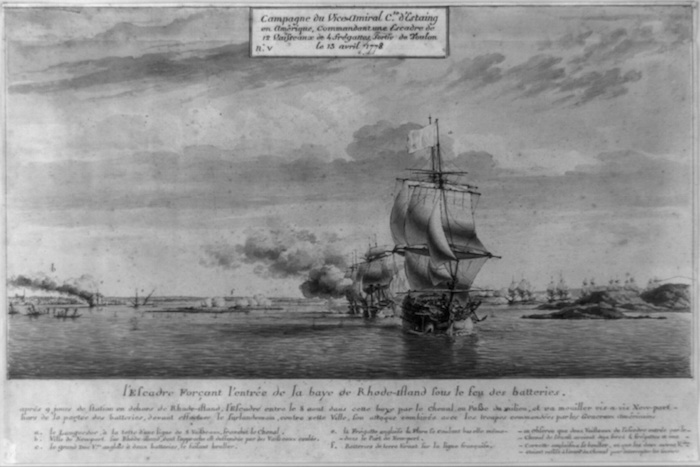
Battle of Newport |
Howe Controls Newport, Rhode IslandDespite being a strategic victory for the British, the Battle of Newport represented several milestones for the Continental Army in its fight against the British. The city of Newport, in Rhode Island, was the fourth-largest city in the thirteen colonies. It was located on an island, making it easy to defend. Newport also had a good harbor, making it possible for fleets of ships to remain there in the winter without the water freezing. In late 1776, British general Sir William Howe concocted a plan to take the city of Newport, hoping to end the war by 1777. In December 1776, Howe took control of Newport and Rhode Island. The First Rhode Island RegimentAfter the British took the city of Newport, legislators from Rhode Island voted to mobilize three regiments of soldiers to take the city back. Rhode Island simply didn’t have enough landowners to establish more armies with the groups that had already been created. Thus, the government passed an act allowing non-white men to fight in the war, including slaves. The slaves would be given their freedom and paid for their service. The First Rhode Island Regiment was composed of 100 soldiers and included Black men and Indians. The regiment was led by white colonel Christopher Greene. Rhode Island Remains in British ControlOn August 29, 1778, the First Rhode Island Regiment fought for the first time. Until that date, forces from the Continental Army led by John Sullivan were attacking the British forces at Newport, trying to take the city back. However, they finally abandoned their cause and were preparing to retreat back to northern Rhode Island. At that time, reinforcements from the British Royal Navy arrived on the scene, and they attacked the Americans as they made their retreat. Eventually, the Americans made it back to the mainland, and British forces maintained their control of Rhode Island. Growing Pains for the French and AmericansThe Battle of Newport was significant for one other reason: it was the first time that French and American forces worked together to fight the British after France entered the Revolutionary War to fight on the side of the Americans. The Battle of Newport, however, proved that the two sides had work to do concerning communication and execution, before their combined forces could be successful. The Battle of Newport in 1776 was a strategic British victory. Newport, Rhode Island, was an important city with a good harbor, making it easy to defend. In late 1776, British General Sir William Howe took control of the city, hoping to end the war by 1777. The First Rhode Island RegimentAfter the British took Newport, Rhode Island decided to form three regiments to take it back. Due to a shortage of landowners, the government allowed non-white men, including slaves, to fight. These soldiers were promised freedom and pay. The First Rhode Island Regiment was made up of 100 soldiers, including Black men and Native Americans, and was led by Colonel Christopher Greene. Rhode Island Stays Under British ControlOn August 29, 1778, the First Rhode Island Regiment fought for the first time. American forces led by John Sullivan had been attacking the British at Newport but had to retreat when British reinforcements arrived. The British continued to control Rhode Island after the battle. French and American Forces Work TogetherThe Battle of Newport was the first time French and American forces worked together after France joined the war on the American side. However, the battle showed that the two sides needed to improve their communication and teamwork before they could defeat the British effectively. |