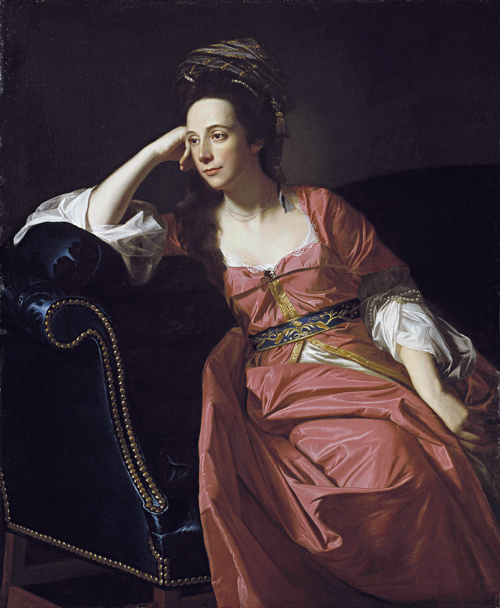
Was Margaret Kemble Gage her Husband's Worst Enemy at Lexington and Concord? |
Margaret Kemble Gage was the wife of Thomas Gage, a British general during the American Revolution. She was born in New Brunswick, in the New Jersey Colony, and moved to England after getting married in 1773. When tensions escalated between American colonists and the British officers in the American colonies, Thomas Gage was sent to Massachusetts to enforce Britain's latest set of rules meant to keep the colonists in check. These rules, known as the Intolerable Acts, punished the colonists for dumping British tea into Boston Harbor during the Boston Tea Party, and included punishments such as the closure of Boston Harbor and the requirement that colonists quarter soldiers in their homes if necessary. Margaret Kemble Gage traveled back to America with her husband. How did the Colonists Know?When Thomas Gage reached Massachusetts and noticed that many of the colonists seemed ready to rebel, he decided to concoct a plan to prevent the uprising. He learned that the colonists were storing ammunition and weapons at a base in Concord, and decided in secret to march to Concord to destroy the weapons base and capture two leaders of the revolution, John Hancock and Samuel Adams. Gage didn't tell anyone about his plans except for a senior officer. However, when he and his soldier arrived at night, their march was stopped by the colonists, who had received advanced warning of the attack. In the battle that ensued, the British failed to capture Hancock and Adams, and weren't able to destroy the colonists' weapons, since most of them had been moved. Gage was sent back to England and replaced. Was Margaret Passing Secrets to the Sons of Liberty?It was clear that the colonists were warned in advanced about Gage's plans, but the question remains of how. It is thought that Rebel leader Joseph Warren was somehow able to access Thomas Gage's inner chambers; likely with the assistance of a spy. Historians theorize that this spy was Margaret Kemble Gage, who was said to have sympathized with the struggles of the colonists. In addition, William Gordon, a pastor in Massachusetts, later wrote that Warren's spy was "a daughter of liberty unequally yoked in the point of politics" - a description that might point directly to Kemble Gage. However, we may never know for sure if she was the spy or not, as Joseph Warren died months after the incident during the Battle of Bunker Hill. Thomas Gage may also have been suspicious of his wife and sent her back to England. She would never return to America. The mysterious spy of Lexington and Concord may remain one of history's greatest mysteries. Margaret Kemble Gage was married to British General Thomas Gage during the American Revolution. She was born in New Brunswick, New Jersey, and moved to England after their marriage in 1773. When tensions grew between the colonists and Britain, Thomas Gage was sent to Massachusetts to enforce the Intolerable Acts—laws that punished colonists for the Boston Tea Party. These laws included closing Boston Harbor and forcing colonists to house British soldiers. Margaret went back to America with her husband. How Did the Colonists Know?General Gage planned a secret mission to stop a colonial rebellion. He learned that weapons were hidden in Concord and wanted to destroy them and arrest John Hancock and Samuel Adams. He told only one senior officer about the plan. However, when British troops arrived, the colonists were already waiting for them. The mission failed—Hancock and Adams escaped, and the weapons had already been moved. Gage was soon recalled to England and replaced. Was Margaret Passing Secrets?It was clear the colonists had been warned ahead of time, but no one knows exactly how. Some believe Joseph Warren, a patriot leader, had help from a spy inside Gage’s circle. Historians suspect it may have been Margaret Kemble Gage, who may have supported the colonists’ cause. A pastor named William Gordon later described the spy as "a daughter of liberty unequally yoked in the point of politics"—possibly referring to Margaret. We'll likely never know the truth. Joseph Warren died at the Battle of Bunker Hill, and Margaret was sent back to England by her husband. She never returned. The identity of the mysterious spy remains a historical mystery. |